Feb. 3, 2020 (GIN) – The African Growth and Opportunity Act (known as “AGOA”) which aimed to assist the economies of sub-Saharan Africa and improve economic relations between the U.S. and the region is out of step with the new trade deals of the Trump administration. Inotherwords, time’s up. A new economic plan is on the drawing board and African leaders suspect it’s a Trumpian take it or leave it deal. Kenyan President Uhuru Kenyatta is expected to be the first to sign on to the bilateral “free-trade agreement” at a Rose Garden meeting with President Donald Trump in Washington this week. It will be America’s first such deal with a sub-Saharan nation and replace the 20 year old AGOA that expires in 2025. AGOA, which provides 39 sub-Saharan African countries duty-free access to the U.S. for about 6,500 products ranging from textiles to manufactured items, has come under increasing criticism in Washington, which wants fast-growing African economies to open up to US goods and services. But the model agreement has few fans among African leaders who have a preference for multilateralism as they move towards an African Continental Free Trade Agreement which comes into force in July. “The Trump administration wants to do bilateral deals, not multilateral deals,” said Aubrey Hruby, in an interview with the Financial Times. Macharia Kamau, Kenya’s principal secretary for foreign affairs, hinted at the risks for Kenya’s fragile, sometimes flailing, economy. “They could easily swamp our markets into oblivion, he said. “Any deal cannot b at the expense of our local capabilities, which are nascent at best.” Meanwhile, in late-breaking news from Kenya, flags are flying at half mast for Daniel arap Moi who served as Kenya’s president from 1978 to 2002. He died peacefully this week at Nairobi Hospital, according to his son Senator Gideon Moi. He was 95 years old. Moi was an autocratic leader who ruled for more than 20 years. “Our nation and our continent were immensely blessed by the dedication and service of the late Mzee Moi; who spent almost his entire adult life serving Kenya and Africa,” President Uhuru Kenyatta said in a statement. He came to power in 1978, upon the death of President Jomo Kenyatta, having been vice-president until then. Diplomats said an attempted coup four years later transformed him from a cautious, insecure leader into a tough autocrat. President Uhuru Kenyatta has declared a period of national mourning to last until the funeral day, with the national flag being flown at half mast.
By Lauren Victoria Burke, NNPA Newswire Contributor
Congresswoman Karen Bass, Chair of the Congressional Black Caucus
In an effort to emphasize measurable policy change with tangible direct action, members of the Congressional Black Caucus will be convening the Congressional Black Caucus National Black Leadership Summit on February 3rd and 4th. The Summit with include over 400 Black leaders from around the country to discuss critical issues of the day, including the 2020 Census and voting rights. The event was created to “test the strength of our democracy and determine the fate of our nation’s most prominent institutions.” The event has been defined as “an emergency convening” during a crucial year that includes a pivotal presidential contest. The CBC is organizing the National Black Leadership Summit in partnership with civil rights, labor and social justice organizations. The event will take place in the U.S. Capitol Visitor Center in Washington, DC. “We want to make sure people across the country have their voices heard over this day and a half convening. There’s going to be a specific ask of our communities. Very shortly after we will be convening on how to implement that specific ask,” said Rep. Bonnie Watson-Coleman (D-NJ) at a January 29 press conference on Capitol Hill in Washington reviewing the details of the summit. “I want to be clear. We stand up, we give back and we get things done. We believe in the people we serve so we are excited that people will come from all over this nation to join us. We know that we have an administration in office that is not standing with us and not fighting with us. We decided that we needed a movement,” said Rep. Joyce Beatty (D-OH). The Congressional Black Caucus is now 55 members, the largest CBC in history and the largest Caucus in Congress. “We have suffered through the last three years of this administration where we have watched gains that we have made over the last several decades either at risk or an attempt to dismantle. That is why the year 2020 is extremely important. I’m proud of the work of the CBC,” said Rep. Karen Bass (D-CA) who is the current Chair of the Congressional Black Caucus. When asked what was special about this particular event compared to other before it, Rep. Watson-Coleman told reporters, “I don’t know where to begin. This is an emergency urgent convening because we look at all of the policy and the attempts regarding this administration, whether it’s access to health care, whether it’s public education, or housing or the climate. Whatever the issue is we have seen negative and disparate impact on the Black community. “There have been so many distractions involved because we have an entertainer in charge in the White House who serves to distract from the evil and mean things being done,” added Rep. Watson-Coleman. There have been many gatherings, convention and convening over the past several decades. But the National Black Leadership Summit has been emphasizing the need for a specific and active push to create substantive policy change in a way events in the past have not. Each year in September, the CBC Foundation convenes an Annual Legislative Conference for what may sound like a similar event to some. But the CBC 2020 National Black Leadership Summit has been defined as a more specific effort to meld policy talk with related action. Lauren Victoria Burke is an independent journalist for NNPA and the host of the podcast BURKEFILE. She is also a political strategist as Principal of Win Digital Media LLC. She may be contacted at LBurke007@gmail.com and on twitter at @LVBurke
No matter who you are, or where you live, there’s a central concern that links consumers all over the country: the ever-rising cost of living. For many consumers, the combined costs of housing, transportation, food, and utilities leave room for little else from take-home pay. From Boston west to Seattle, and from Chicago to Miami and parts in between, the rising cost of living is particularly challenging in one area: housing. Both homeowners and renters alike today cope as best they can just to have a roof over their families’ heads. The nation’s median sales price of a new home last September in 2019 was $299,400, according to the U.S. Census Bureau. Even for an existing home, the St. Louis Federal Reserve noted its median price in December was $274,500. For renters, the cost of housing is also a serious challenge. Last June, the national average rent reached $1,405, an all-time high. But if one lives in a high-cost market like Manhattan, Boston, Los Angeles, or San Francisco, a realistic rental price is easily north of $3,000 each month. Now a new report from Harvard’s Joint Center for Housing Studies (JCHS) finds that the American Dream of homeownership is strained even among households with incomes most would think adequate to own a home. From 2010 to 2018, 3.2 million households with earnings higher than $75,000 represented more than three-quarters of the growth in renters in its report entitled, America’s Rental Housing 2020. “[F]rom the homeownership peak in 2004 to 2018, the number of married couples with children that owned homes fell by 2.7 million, while the number renting rose by 680,000,” states the report. “These changes have meant that families with children now make up a larger share of renter households (29%) than owner households (26%).” To phrase it another way, America’s middle class is at risk. Consumer demographics that traditionally described homeowners, has shifted to that of renters. And in that process, the opportunity to build family wealth through homeownership has become more difficult for many — and financially out of reach for others. “Rising rents are making it increasingly difficult for households to save for a down payment and become homeowners,” says Whitney Airgood-Obrycki, a JCHS Research Associate and lead author of the new report. “Young, college-educated households with high incomes are really driving current rental demand.” Included among the report’s key findings: · Rents in 2019 continued their seven-year climb, marking 21 consecutive quarters of increases above 3.0%; · Despite the growth in high-income white renters, renter households overall have become more racially and ethnically diverse since 2004, with minority households accounting for 76 percent of renter household growth through 2018; and · Income inequality among renter households has been growing. The average real income of the top fifth of renters rose more than 40 percent over the past 20 years, while that of the bottom fifth of renters fell by 6 percent; · “Despite the strong economy, the number and share of renters burdened by housing costs rose last year after a couple of years of modest improvement,” says Chris Herbert, Managing Director of the Joint Center for Housing Studies. “And while the poorest households are most likely to face this challenge, renters earning decent incomes have driven this recent deterioration in affordability.” This trend of fewer homeowners has also impacted another disturbing development: the nation’s growing homeless population. Citing that homelessness is again on the rise, the JCHS report noted that after falling for six straight years, the number of people experiencing homelessness nationwide grew from 2016–2018, to 552,830. In just one year, 2018 to 2019, the percentage of America’s Black homeless grew from 40% to more than half – 52%. That independent finding supports the conclusion of the Department of Housing and Urban Development’s report to Congress known as its Annual Homeless Assessment Report. While some would presume that homelessness is an issue for high-cost states like California, and New York, the 2019 HUD report found significant growth in homeless residents in states like Alabama, Louisiana, Mississippi, Virginia, and Washington as well. According to HUD, states with the highest rates of homelessness per 10,000 people were New York (46), Hawaii (45), California (38), Oregon (38), and Washington (29), each significantly higher than the national average of 17 persons per 10,000. The District of Columbia had a homelessness rate of 94 people per 10,000. And like the JCHS report, HUD also found disturbing data on the disproportionate number of Black people who are now homeless. For example, although the numbers of homeless veterans and homeless families with children declined over the past year, Blacks were 40% of all people experiencing homelessness in 2019, and 52% of people experiencing homelessness as members of families with children. These racial disparities are even more alarming when overall, Blacks comprise 13% of the nation’s population. When four of every 10 homeless people are Black, 225,735 consumers are impacted. Further, and again according to HUD, 56,381 Blacks (27%) are living on the nation’s streets, instead of in homeless shelters. The bottom line on these research reports is that Black America’s finances are fragile. With nagging disparities in income, family wealth, unemployment and more – the millions of people working multiple jobs, and/or living paycheck to paycheck, are often just one paycheck away from financial disaster. Add predatory lending on high-cost loans like payday or overdraft fees, or the weight of medical debt or student loans, when financial calamity arrives, it strikes these consumers harder and longer than others who have financial cushions. And lest we forget, housing discrimination in home sales, rentals, insurance and more continue to disproportionately affect Black America despite the Fair Housing Act, and other federal laws intended to remove discrimination from the marketplace. The real question in 2020 is, ‘What will communities and the nation do about it?’ For Keeanga-Yamahtta Taylor, an assistant professor of African-American studies at Princeton University and author of the new book, “Race for Profit: How Banks and the Real Estate Industry Undermined Black Homeownership”, federal enforcement of its own laws addressing discrimination and acknowledging the inherent tug-of-war wrought from the tension of public service against the real estate industry’s goal of profit, there’s little wonder why so many public-private partnerships fail to serve both interests. In a recent Chicago Tribune interview, Professor Taylor explained her view. “You don’t need a total transformation of society to create equitable housing for people,” said Taylor. “We have come to believe that equitable housing is just some weird thing that can’t happen here, and the reality is that we have the resources to create the kinds of housing outcomes that we say we desire.” “The way to get that has everything to do with connecting the energy on the ground to a different vision for our society — one that has housing justice, equity and housing security at the heart of it,’ Taylor continued. “The resources and the money are there, but there’s a lack of political will from the unfortunate millionaire class that dominates our politics… I think, given the persistence of the housing crisis in this country, we have to begin to think in different ways about producing housing that is equitable and actually affordable in the real-life, lived experiences of the people who need it.” Amen, Professor Taylor. Charlene Crowell is the Center for Responsible Lending’s communications deputy director. She can be reached at charlene.crowell@responsiblelending.org.
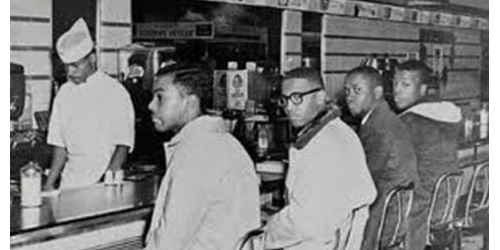
Greensboro students sit-in at Greensboro lunch counter
On Feb 1, 1960, four African American college students from the North Carolina A&T State University quietly sat down at the whites-only Woolworth’s lunch counter in Greensboro, North Carolina and ordered coffee. It was a planned move by the four students, designed to attract media attention to the issue of segregation. Denied service, as was the custom in those dark days, the four continued to peacefully occupy their seats and refused to leave until the store closed that night. The peaceful protest inspired others to join in for daily protests. By Feb 5, 300 students were present at the store. On Saturday, February 6, over 1,400 North Carolina A&T students met in the Harrison Auditorium on campus. They voted to continue the protests and went to the Woolworth store, filling up the store. During the sit-ins, white customers heckled the black students. North Carolina’s official chaplain of the Ku Klux Klan, George Dorsett, as well as other members of the Klan, were present. The brave freshmen from NCA&T, who would later be adorned with the iconic label of the “Greensboro Four”, consisted of David Richmond, Franklin McCain, Joseph McNeil, and Ezell Blair Jr. (Jibreel Khazan). The sit-ins soon spread to nearby towns and other Southern cities. Sales at the boycotted stores dropped by a third, leading Woolworth to abandon segregation policies; the dining area in most stores were desegregated after July 25, 1960. The Greensboro sit-in was not the first such event, but it catalyzed a much larger nonviolent sit-in movement across the country, which played a definitive role in the fight for civil rights. In its wake, segregation of public places became illegal under the Civil Rights Act of 1964. The Woolworth Department Store in Greensboro was subsequently converted into the International Civil Rights Center and Museum (Woolworth went out of business in 1997). The street south of the building is named February One Place. Today, the site of the Woolworth store where the sit-in took place is now the International Civil Rights Center and Museum.