Category: World News

  • Newswire: First 6 days of War on Iran cost US $11.3 Billion, Pentagon says, But we can’t afford SNAP, right?

    Newswire: First 6 days of War on Iran cost US $11.3 Billion, Pentagon says, But we can’t afford SNAP, right?

    “They got money for war, but can’t feed the poor.” – Tupac Shakur

    According to the Pentagon, the first week of the war against Iran that President Donald Trump involved the U.S. in voluntarily, not out of any discernible necessity, has cost the nation upwards of $11 billion.
    The New York Times reported that Pentagon officials revealed the estimated price tag for the first six days of this war of choice to lawmakers in a closed-door briefing on Capitol Hill on Tuesday, saying the cost of the war had already exceeded $11.3 billion.
    What’s worse is that the estimate doesn’t include all costs, and it’s much higher than previously projected.


    From the Times: The estimate did not include many of the costs associated with the operation, such as the buildup of military hardware and personnel ahead of the first strikes. For that reason, lawmakers expect the number to grow considerably as the Pentagon continues to calculate the costs that accumulated just in the first week.

    Still, it appeared to be the most comprehensive assessment Congress had received so far amid mounting questions about the objectives, scope, and time frame for the war. The New York Times and The Washington Post reported earlier that defense officials had said in recent congressional briefings that the military used up $5.6 billion of munitions in the first two days of the war.

    That is a far larger amount and munitions burn rate than had been publicly disclosed. The Center for Strategic and International Studies had estimated that the first 100 hours of the operation cost $3.7 billion, or $891.4 million each day.

    Not long ago, the U.S. government was shut down for roughly a month and a half, largely because one particular party thought we couldn’t afford to extend health care subsidies. MAGA Republicans are still trying to convince the nation that cutting SNAP benefits is an absolute necessity, lest they bankrupt the U.S. Trump has been telling U.S. citizens to cut back on their spending because his promise to bring down the price of goods turned out to be big, beautiful bullsh-t.

    But we can afford a war of choice that has cost a billion dollars nearly a dozen times over in the first week.

    Oh, well — at least our strikes on Iran aren’t killing innocent school children or anything like that.

    Meanwhile, the Trump administration just keeps boasting about how it is “DEVASTATING” Iran with constant missile strikes. The tweet below was posted by the White House on the same day it was revealed that a preliminary investigation showed the U.S. was likely responsible for a missile striking an Iranian elementary school, reportedly killing 175 people, the overwhelming majority of whom were children.

    “We won’t stop until the military objectives are met,” the White House tweeted.

    Apparently, the administration means what it says, no matter the cost, whether we’re talking about the cost of lives or additional billions in spending that we’ve been told the nation can’t afford to spend on education, food security, healthcare, or anything else that would actually put “America first.” (And that’s their slogan, not all ours.)


    Seriously, if there was any nation in need of an actual regime change, it’s currently the good, old U.S. of A.
  • Newswire : On 61st Anniversary of Bloody Sunday, worries about the future of voting rights and calls to action

    Newswire : On 61st Anniversary of Bloody Sunday, worries about the future of voting rights and calls to action

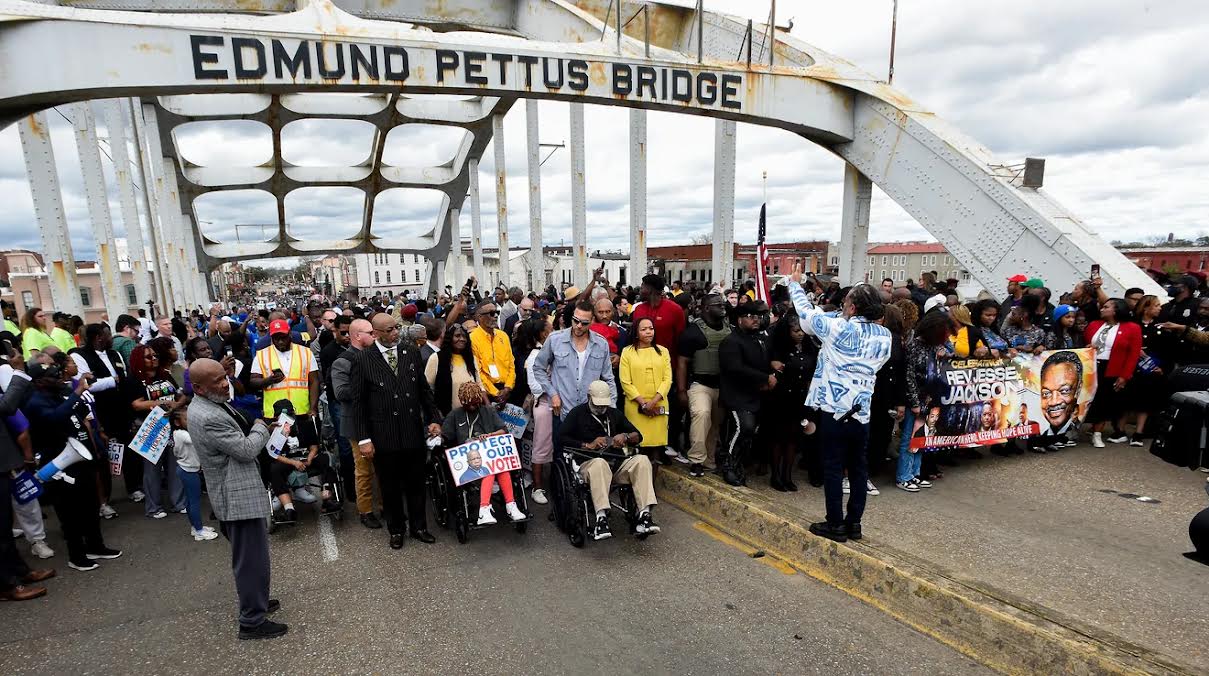
    A diverse group of people, including several public figures, gathered on the Edmund Pettus Bridge, singing and celebrating while holding signs advocating for voting rights.

    People crossing the Edmund Pettus bridge on Sunday and  Spiver Gordon, Greene County civil rights veteran and foot soldier next to Congresswoman Sewell on bridge

    By Kim Chandler, Associated Press and other sources

    SELMA, Ala. (AP) — Sixty-one years after state troopers attacked Civil Rights marchers on the Edmund Pettus Bridge in Selma, thousands gathered in the Alabama city this weekend amid new concerns about the future of the Voting Rights Act.
    The March 7, 1965, violence that became known as Bloody Sunday shocked the nation and helped spur passage of the landmark legislation that dismantled barriers to voting for Black Americans in the Jim Crow South.
    The anniversary was celebrated in this city that served as crucible for the voting rights movement, with events through the weekend ending with a commemorative march across the bridge Sunday. But the commemoration came as the U.S. Supreme Court considers a case that could limit a provision of the Voting Rights Act that has helped ensure some congressional and local districts are drawn so minority voters have a chance to elect their candidate of choice.
    “I’m concerned that all of the advances that we made for the last 61 years are going to be eradicated,” said Charles Mauldin, 78, one of the marchers beaten on Bloody Sunday.
    Former and current Democratic officeholders, civil rights leaders and tourists descended on Selma to pay homage to the pivotal moment of the Civil Rights Movement and to issue calls to action. Speakers warned of the looming court decision and criticized the Trump administration’s actions on immigration and efforts to roll back diversity, equity, and inclusion.
    Standing at the pulpit of the historic Tabernacle Baptist Church, Maryland Gov. Wes Moore, said that like the marchers on Bloody Sunday, they must press forward.
    “Years after Bloody Sunday, the progress that stemmed from that sacrifice is now being rolled back right in our faces,” the governor said. Moore is the nation’s only Black governor currently in office.
    “We are choosing this fight because those who marched across the Edmund Pettus Bridge deserve better than us cowering while the freedoms that we inherited and they fought for, are being ripped away,” Moore said.
    Illinois Gov. JB Pritzker, speaking at a rally at the foot of the bridge, said racism is on the rise in America and “Trump’s Supreme Court is gutting the Voting Rights Act.”
    “Let’s march forward today with the knowledge that we are the inheritors of the faith that brought marchers to the bridge 61 years ago. It is now on us to bend the arc of the moral universe toward justice,” Pritzker said.
    The annual commemoration in Selma is a mix of a civil rights remembrances, church services and a street festival filled with vendors and food trucks. It is also part political rally with an eye on November’s midterm elections and a longer view to the 2028 presidential race.
    The commemoration included a tribute to the late Rev. Jesse Jackson, the civil rights leader and two-time presidential candidate who regularly attended the annual Selma march. He died on Feb. 17 at age 84.
    Yusef Jackson said his father’s legacy will be carried forward. “In November, we will go back to the polls and take our government back, setting our country on the right path,” Jackson said.
    The looming court decision cast a shadow over the festivities. Justices are expected to rule soon on a Louisiana case , Calais vs Louisiana, about the role of race in drawing congressional districts. A ruling prohibiting or limiting that role could have sweeping consequences, potentially opening the door for Republican-controlled states to redistrict and roll back majority Black and Latino districts that tend to favor Democrats.
    U.S. Rep. Shomari Figures won election in 2024 to an Alabama district that was redrawn by a federal court to give Black voters a greater voice. His district will likely be targeted if the state gets the opportunity to redraw lines. He said what happened in Selma and the subsequent passage of the Voting Rights Act “was monumental in shaping what America looks like and how America is represented in Congress.”
    In 1965, the Bloody Sunday marchers led by John Lewis and Hosea Williams walked in pairs across the Selma bridge headed toward the state capital of Montgomery. Mauldin, then 17, was part of the third pair behind Williams and Lewis.
    At the apex of the bridge, they could see the sea of law enforcement officers, including some on horseback, waiting for them. But they kept going.
    “It wasn’t that we didn’t have fear, it’s that we chose courage over fear,” Mauldin recalled.
    Spiver Gordon, Greene County civil rights leader said this anniversary was a little bitter-sweet, since three close friends, Rev. Jesse Jackson, Joanne Bland and Rev. Bernard Lafayette, had all passed in the three weeks leading up to this 61st anniversary of Bloody Sunday.
    A crowd of several thousand filed behind elected officials on this Sunday for the march across the bridge, this time protected by state law enforcement officers.

  • Newswire : After a president-filled celebration, Rev. Jesse Jackson’s family gathers for an intimate homegoing

    Newswire : After a president-filled celebration, Rev. Jesse Jackson’s family gathers for an intimate homegoing

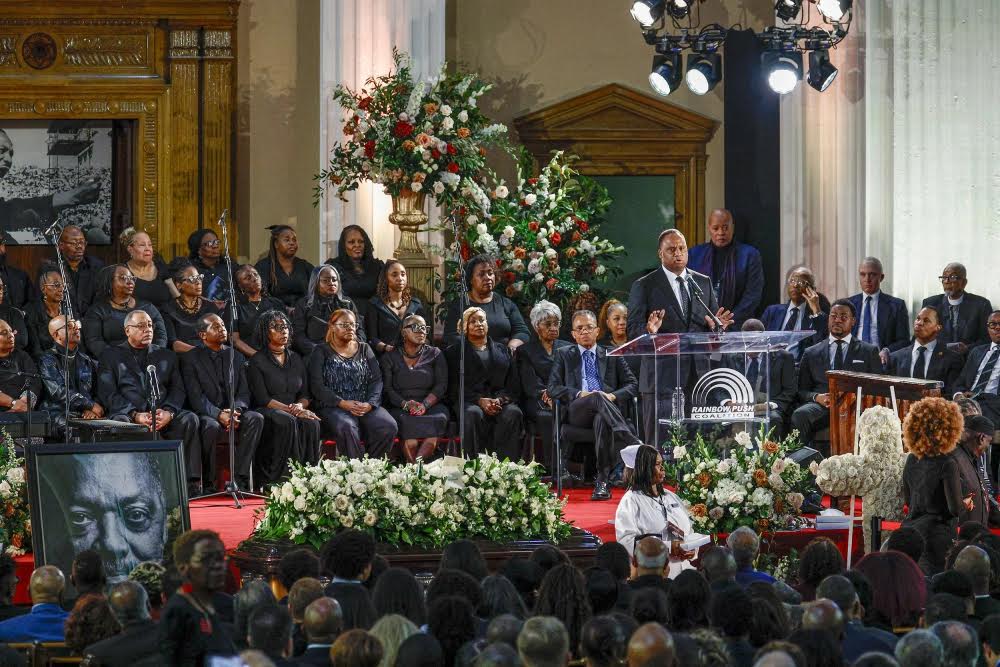
    Private family funeral for Rev. Jesse Jackson

    By The Associated Press

    CHICAGO — A day after former presidents, sitting governors and local Chicago residents alike attended a vibrant, televised celebration for the late Rev. Jesse Jackson Sr., the family and friends who knew him best hosted a more intimate gathering Saturday to grieve the civil rights leader at his organization’s headquarters.

    The private memorial service at the Rainbow PUSH Coalition’s headquarters on the South Side of Chicago includes only a few hundred attendees, most of whom are family members, allies and confidants. The homegoing is meant as a capstone to a week of services held across the country

    “I foresee tomorrow will represent everything that Rev. Jackson stood for,” the Rev. Chauncey D. Brown, a pastor to a Chicago-area church and mentee of Jackson’s, said Friday.. “It will include dignitaries and icons, as well as many from where the true power lies, with the people in the streets.”
    Some members of the public who gathered outside the PUSH headquarters were allowed to enter the chamber.
    “Over the last two weeks, we’ve been focusing on connecting to people that Reverend worked with across the years,” said Rev. Janette Wilson, a longtime senior advisor to Jackson and executive director at Rainbow PUSH Coalition. “When you look at his work, it is so vast in the economic and political arenas.”
    Since his death last month, Jackson’s family and allies have honored the late reverend with commemorations, community service and demonstrations they say continue his work.
    Mourners were first allowed public visitations at the Rainbow PUSH headquarters in February, giving Jackson’s longtime neighbors a chance to say goodbye to the civil rights leader.
    The late reverend then lay in state at the South Carolina Capitol. Jackson grew up in segregated Greenville, South Carolina. As a high schooler, he led fellow students into a protest that desegregated a local library, starting a lifetime of civil rights activism.
    Services honoring Jackson in Washington, D.C., were postponed after a request for him to lie in honor at the U.S. Capitol was denied. House Republican leadership cited the precedent that only former presidents and senior generals regularly receive the privilege.
    Jackson’s mentees also honored his legacy by organizing on issues such as voting rights, economic inequality and political organizing in the weeks after his passing. Rainbow PUSH hosted a forum for community organizers and clergy whom Jackson mentored to discuss his impact on their careers.
    Wilson said that the best way to honor Jackson is to continue advocating for progressive, inclusive solutions to the pressing economic and political challenges of the day. She cited policies that addressed the impending socioeconomic effects of artificial intelligence, improved public schools and a focus on youth mental health as areas he was contemplative on at the end of his life.
    She also said that Jackson never shied away from being political.
    “We’re in a global moment where peace in the world is in jeopardy, where we just have bombs being dropped carelessly, killing children, innocent victims of political actions,” said Wilson of the ongoing war in the Middle East. “When the government cuts SNAP benefits and you have millions of children and families who will be food insecure, I think you have to tell them that we’re fighting for you.”
    Services honoring Jackson in Washington, D.C., were postponed after a request for him to lie in honor at the U.S. Capitol was denied. House Republican leadership cited the precedent that only former presidents and senior generals regularly receive the privilege.
    Jackson’s mentees also honored his legacy by organizing on issues such as voting rights, economic inequality and political organizing in the weeks after his passing. Rainbow PUSH hosted a forum for community organizers and clergy whom Jackson mentored to discuss his impact on their careers.
    Wilson said that the best way to honor Jackson is to continue advocating for progressive, inclusive solutions to the pressing economic and political challenges of the day. She cited policies that addressed the impending socioeconomic effects of artificial intelligence, improved public schools and a focus on youth mental health as areas he was contemplative on at the end of his life.
    She also said that Jackson never shied away from being political.
    “We’re in a global moment where peace in the world is in jeopardy, where we just have bombs being dropped carelessly, killing children, innocent victims of political actions,” said Wilson of the ongoing war in the Middle East. “When the government cuts SNAP benefits and you have millions of children and families who will be food insecure, I think you have to tell them that we’re fighting for you.”
    The headquarters also greeted nearly 100 progressive activists from Minnesota. The assembled groups represented civil, labor and immigrants’ rights groups who were recently thrust into the national spotlight after President Donald Trump’s administration’s enhanced immigration enforcement operation in the state sparked protests.
    “It’s really empowering, at least for me, to see the coalition coming together and to understand the history of civil rights and human rights and immigrants’ rights,” said Yeng Her, the organizing director at the Immigrant Defense Network, one of the organizations that has protested the Trump administration in Minnesota.
    The Jackson family invited the activists to Chicago to learn more about Jackson’s strategies and find resources for their own organizations. Organizers met Rainbow PUSH alumni and some of Jackson’s children.
    The gathering was a prelude to both the private service for Jackson’s family and another commemoration.
    On Sunday, members of the Jackson family and many of Jackson’s mentees will travel to Selma, Alabama, to commemorate the “Bloody Sunday” protest marches when civil rights activists were beaten by police on the Edmund Pettus Bridge in 1965.
    Jackson himself often attended the same anniversary march.
    “Reverend always thought three-dimensionally,” said Jimmy Coleman, a longtime aide to Jackson and native of Selma.
    “Selma has always stood for the basics of what civil rights is, what we are debating in policy. He was always focused on what we needed in terms of policy in any given political moment, and that’s what the march represents,” said Coleman.

  • Newswire : President Trump refuses to sign bills until SAVE America Act passes 

    By NewsOne staff
    On Sunday, President Donald Trump posted on social media that he wouldn’t sign any more legislation unless Congress passes the SAVE America Act.
    According to NPR, Trump took to Truth Social, demanding that the SAVE America Act “be done immediately” and “supersedes everything else.” While Republicans have tried to position the SAVE America Act as a simple voter ID bill, the changes the bill would make to voting would disenfranchise millions. The voter ID aspects would require a voter to provide two forms of ID that prove citizenship, such as a passport or birth certificate. This could create problems for married women who could have a different name on their birth certificate than on their driver’s license.
    The bill would also place a blanket ban on mail-in ballots except for military and people with disabilities. The GOP’s justification for all these changes is that it’s intended to prevent noncitizens from voting, despite all evidence showing that’s an incredibly uncommon occurrence. Trump and the GOP seem to think these changes will exclusively hurt Democrat voters, despite 1 in 3 voters using mail-in ballots.
    “MUST GO TO THE FRONT OF THE LINE. I, as President, will not sign other Bills until this is passed, AND NOT THE WATERED DOWN VERSION – GO FOR THE GOLD,” he wrote. The Guardian reports that Trump also demanded new provisions be added to the bill that would ban transgender people from participating in women’s sports and gender-affirming surgeries for minors.
    Trump is a deeply unpopular president, as more and more voters disapprove of his handling of the economy, the tactics employed by ICE in their mass deportation campaign, and the war in Iran, which is already having a pronounced, negative impact on the American economy. It was already looking like the Democrats would flip the House last year, which is why Trump pushed several red states to engage in mid-decade redistricting efforts. Several blue states, most notably California, began redistricting efforts of their own to neutralize the gains.
    So now Trump is trying to make it that much harder to vote in the hopes that the GOP maintains its narrow majority in Congress. In addition to pushing for the SAVE Act, Trump has also called for the transfer of control over elections from states to the federal government. Several of Trump’s advisers are reportedly drafting an executive order that would declare a national emergency and allow the president to make changes to how elections are conducted.
    While the SAVE America Act passed in the House, it’s facing significant pushback in the Senate, where it needs to clear a 60-vote threshold to pass. The GOP has only a 53-47 majority in the House, meaning several Democrats would need to vote for the bill. Senate Minority Leader Chuck Schumer has publicly stated that no Democrats will vote for the bill.
    Additionally, a study by the Brennan Center found that 21.3 million Americans lack immediate access to proof of citizenship, meaning nearly a quarter of eligible voters could be disenfranchised. “The SAVE Act would disenfranchise Americans of all ages and races, but younger voters and voters of color would suffer disproportionately,” the Brennan Center for Justice wrote in February.
    “If Trump is saying he won’t sign any bills until the SAVE Act is passed, then so be it: there will be total gridlock in the Senate,” Schumer posted on X Sunday. “Senate Democrats will not help pass the SAVE Act under any circumstances.”

  • “5th Little Girl”, Sarah Collins Rudolph, sole survivor of the 16th Street Baptist Church bombing in Birmingham speaks at Second Baptist Church Black History program

    “5th Little Girl”, Sarah Collins Rudolph, sole survivor of the 16th Street Baptist Church bombing in Birmingham speaks at Second Baptist Church Black History program

    by John Zippert, co-owner

    On February 15, Second Baptist Church hosted a Black History program that brought Sarah Collins Rudolph to Greene County to talk about her experience as the sole survivor of the September 15, 1963 bombing, by the Klu Klux Klan, of the 16th Street Baptist Church in Birmingham. Sarah Collins Rudolph was the younger sister (aged 12 at the time) of Addie Mae Collins, one of four girls tragically killed in the bombing of the church, in the midst of the Civil Rights Movement.


    Sarah Collins Rudolph was in the ladies restroom in the basement of the 16th Street Baptist Church, with four other young ladies – her sister Addie Mae Collins, Denise McNair, Carole Robertson and Cynthia Wesley, all 14 years old. They were taking a break between Sunday School and a Youth Day program at the church.


    When the bomb exploded around 10:22 in the morning, Sarah Collins Rudolph said she had just walked across the rest room from the other four to wash her hands in the sink. The Klan placed the bomb in an outside stairway that led to the basement that was adjacent to the women’s rest room. The last thing she remembers before the blast, was Denise McNair asking her sister Addie Mae Collins to adjust a sash on her dress.


    Four of the girls were killed instantly by the blast and Sarah survived with serious injuries from the bomb, including glass and other fragments that cut her eyes, face, arms, legs and other parts of her body. She was rescued and sent to the hospital by the first church members that dug through the rumble from the explosion.


    Sarah was confined to the hospital for weeks after the explosion. She was blind in her right eye and had it replaced with a prosthetic eye. Her many cuts healed leaving visible scars both physical and psychological. She says, even today, when she hears loud noises, she revisits the terror of the bomb explosion. She relates this to PSTD experience by soldiers in war, reliving their combat experiences.Sarah was not able to attend the funerals of her sister and the other three girls because she was in the hospital. When she returned to school, she received no special counseling or other assistance to adjust to the explosion which changed her life.


    She finished high school and then worked in various capacities at industrial fabrication plants and domestic work, taking care of elderly and sick people. She married three times. She said that she eventually found a church in Birmingham that helped her to understand that by accepting Christ and his teachings could help her to live a fuller and more meaningful life.


    She testified at the trials of the three KKK members, who were eventually brought to justice for the horrendous crime of bombing the church in 1963, including ‘Dynamite Bob” Chambliss, Frank Cherry and Thomas Blanton.
    In the mid 1990’s more than thirty years after the bombing, she began giving interviews and speaking out about her life and experiences. She tried unsuccessfully to get compensation for herself and families of other victims of racial and civil rights crimes. So far she has been unsuccessful in getting any compensation from the state of Alabama or the Federal government, for her injuries and suffering from the 1963 bombing of the church.


    In her travels to speak on the bombing and being the only survivor, she met Tracy Snipe, a professor at Wright State University in Ohio, where he teaches history, politics and related subjects. Snipes collaborated with Sarah Collins Rudolph to write a book on her life including the 1963 bombing. The book is entitled “the Fifth Little Girl”. At the end of the Second Baptist Church Black History Program, participants were able to purchase copies of her book ($30.00) and have it inscribed to them by her.
    The program at Second Baptist Church was sponsored by United Purposes, and its community partners. The organization is headed by Miriam Leftwich, who organized the program and introduced Ms. Rudolph. The program also featured information on Black History, singing, poetry reading , and a liturgical dance presentation, mostly by young people to honor the guest speaker.


    This program had a very profound impact and impression on this writer and others who attended the program and were not aware that there was a fifth little girl, who survived the bombing , that has lived another more than six decades to give first-hand testimony about one of the most consequential events of the Civil Rights Movement and Black History in America.

    Sarah in the hospital with both eyes bandaged from the bomb explosion
    Sarah in the hospital with both eyes bandaged from the bomb explosion
  • Newswire: Peace talks be dammed; the U.S. and Israel invade Iran, and casualties mount

    Newswire: Peace talks be dammed; the U.S. and Israel invade Iran, and casualties mount

    by Frederick H. Lowe, BlackmansStreet.Today

    President Donald Trump announced on his social media that a joint invasion between the U.S. and Israel resulted in the death of Iran’s Supreme Leader Ali Khamenei.

    In addition, three U.S. soldiers were also killed, and five others were seriously injured, according to U.S. Central Command during “Operation Epic Fury,” the joint U.S.-Israeli military operation against Iran. Trump said more American deaths are expected. As of March 3rd, the death toll of U.S. Service personnel was 6, with many injured.

    At least 165 people were killed when a strike hit an all-girls school in Minab, which is in Iran’s southern Hormozgan province. A local official said among the dead were students, parents, and school staff.

    Trump also urged the Iranian people to “seize control of your destiny” by rising against the Islamic leadership that has ruled the nation since 1979.

    The attack on Iran by the U.S. and Israel was launched in the middle of diplomatic efforts to avert conflict. Congress was not consulted on the invasion, which has been cast as a war.

    President Trump does not have the power to declare war on another country. The Founding Fathers and the Constitution gave war authority and power to Congress, and Congress alone, said the ACLU.

    President Trump violated the Constitution when he announced that the U.S. was going to war and launched an open-ended bombing campaign against Iran, a country with nearly 100 million people, without ever going to Congress for authorization.

    President Trump ordered U.S. military strikes against Iran without prior congressional authorization, and key members of the U.S. Congress say they were not given intelligence briefings before the operation began.

    Several lawmakers strongly criticized the decision as a violation of constitutional and statutory war powers.

    The attack on Iran reportedly targeted military sites as well as the leadership of the Iranian regime.

    Explosions were heard in Israel and Gulf countries after Iran launched a wave of drones and missiles in a strong response to being attacked.

    Trump announced the invasion in an eight-minute speech after the first bombs had fallen.

    Antonio Guterres, the UN Secretary-General, called for an immediate cessation of hostilities and de-escalation and warned that a failure to do so risks a wider regional conflict with grave consequences for civilians and regional stability.

    Mr. Guterres declared that the military escalation in the region undermines international peace and security, and recalled that all Member States must “respect their obligations under international law, including the Charter of the United Nations,” which prohibits “the threat of the use of force against the territorial integrity or political independence of any state, or in any other manner inconsistent with the Purposes of the United Nations.”

    The attack on Iran reportedly targeted military sites as well as the leadership of the Iranian regime.

  • Newswire: Civil Rights TV launches in Selma as the World’s First 24/7 Civil Rights Television Network

    Newswire: Civil Rights TV launches in Selma as the World’s First 24/7 Civil Rights Television Network

    By Arizona Informant

    SELMA, Ala. — Civil Rights TV, the world’s first 24-hour television network dedicated exclusively to civil rights history, education, and future equity, has officially launched on the Connect To Your City OTT platform powered by Connect2OTT.
    The network debuts from Selma, Alabama — one of the most historically significant cities in the American civil rights movement — marking a new chapter in how civil rights stories are preserved, amplified, and carried forward for future generations.
    Civil Rights TV operates continuously on the Connect To Your City OTT platform powered by Connect2OTT, offering documentaries, news analysis, live discussions, educational programming, global civil rights coverage, and cultural storytelling. The channel functions as both a historical archive and a living platform addressing contemporary civil rights challenges.
    Civil Rights, Technology, and the AI Era
    As technology and artificial intelligence increasingly shape access to information, media, and opportunity, Civil Rights TV launches at a moment when access to digital infrastructure itself is emerging as a civil rights issue.
    Media fragmentation, misinformation, and uneven access to technology continue to reshape public discourse. While on-demand platforms have expanded individual content access, large-scale live broadcasting still faces challenges related to congestion, latency, and energy consumption.
    Civil Rights TV leverages broadcast-efficient OTT architecture designed to reduce bandwidth usage and energy requirements, enabling continuous global distribution without placing added strain on network infrastructure.
    Why Civil Rights TV Matters Now
    Civil Rights TV is not only a media launch—it is a signal.
    The network underscores the importance of preserving civil rights history using the most accurate and comprehensive sources available. For generations, the Black press has maintained some of the deepest and most reliable documentation of the civil rights movement, currents events, news and critical Black history, much of which remains underrepresented in modern digital media archives and inaccessible to artificial intelligence (AI) systems.
    As a result, Civil Rights TV will rely heavily on national Black press for news, historical archives and independent voices. Prominent digital news platforms, podcasts, and broadcasters—will play an instrumental role in shaping continuous coverage, historical interpretation, and public discourse.
    About Connect2OTT
    Connect2OTT currently manages more than 250 live 24/7 television and radio channels streaming to audiences in more than 190 countries. Civil Rights TV joins this ecosystem as a flagship channel, designed to foster global conversation while demonstrating how media distribution, energy efficiency, and AI readiness can coexist responsibly.
    About Larry Witherspoon
    Larry Witherspoon is a technology entrepreneur and founder of Phoenix-based Connect2 Technologies, LLC, including Connect2OTT, Connect2AI, and Connect To Your City OTT Platform.
    In 2006, Witherspoon launched FaithFone Wireless, the world’s first Christian-owned and operated mobile phone company—years ahead of today’s fintech and mobile banking platforms. As a mobile virtual network operator (MVNO), FaithFone introduced mobile banking, digital tithing, live television and radio, content downloads, and branded debit- card-based person-to-person payment functionality before mobile commerce was widely understood by major telecom and financial institutions.
    That early convergence of mobile, media, and financial technology laid the foundation for Witherspoon’s current work across AI, energy efficiency, broadcasting, and infrastructure optimization.

    Community Content Submissions

    Civil Rights TV welcomes article submissions from trusted community voices, journalists, and verified organizations. Content may be submitted through an official upload portal or via email for editorial review.
    Submissions approved for broadcast will be scheduled during the network’s community programming window from 12:00 a.m. to 5:00 a.m., with select pieces considered for prime- time airing based on their significance, accuracy, and value to the broader civil rights dialogue.
    Media Contact Tina Michelle
Connect2OTT / Civil Rights TV Phone: (480) 740-7777
Email: Contact@civilrightstv.com Website: CivilRightsTV.com

  • Leo Branch seeks re-election as District 4, Board of Education seat

    Leo Branch seeks re-election as District 4, Board of Education seat

    Greetings, my name is Leo Branch, Sr. and I am asking for your vote and support on May 19, 2026, in District 4 for re-election for a member of the Greene County School Board of Education, where I presently serve as School Board president.
    I am married. My wife Dorothy, a retired educator, and I live in Forkland. We are members of Mt. Pilgrim Primitive Baptist Church, where I serve as a Deacon and Sunday School teacher. We have four grown children that graduated from the Greene County school system and have gone on to receive graduate degrees from various colleges and universities.
    During my years on the school board, I have educated myself on the state and national educational policies and laws that impact our students, our school staff and our communities. These training in state and federal laws and policy making, school budgeting, hiring and evaluating Superintendents, establishing and creating visions and goals to improve school and students’ achievements is essential in making good School Board decisions.
    Again, I am asking for your vote and support for me, a dedicated candidate who has the best interest of all of our children at heart. Students’ education remains a top priority to me. Thank you for your vote and support.

  • Trey Diveley announces candidacy for Greene County Commissioner

    Greene County, AL — My name is Trey Diveley, and I am announcing my candidacy for Greene County Commissioner, District 3.

    I am a disabled combat veteran who served this country with honor. I know what it means to fight for something bigger than myself, and I believe it is time to bring that same level of commitment, accountability, and results-driven leadership to Greene County. I served my country, and now I am ready to serve Greene County.

    I currently serve as Vice President of Operations for Merchants & Farmers Bank and serve on the Board of Directors for the Eutaw Chamber of Commerce. In my professional career, I specialize in finding money for communities through grants and vendor audits. I know how to identify funding opportunities, recover lost revenue, and ensure taxpayer dollars are spent wisely and responsibly. Greene County should never leave money on the table while our roads, services, and opportunities need improvement.

    For too long, District 3 has dealt with broken promises, lack of transparency, and missed opportunities. Our community deserves leadership that delivers real results — not excuses. We need stronger infrastructure, smarter financial management, and leadership that is focused on the people instead of politics.

    My mission is simple: bring accountability back to local government, fight for every dollar available to our county, improve infrastructure, support economic growth, and make sure every citizen in District 3 has a voice that is heard and respected.

    This campaign is about action, not politics as usual. It is about standing up for our community and moving Greene County forward with strong, honest leadership.

    I humbly ask for your support and your vote.

    Vote Trey Diveley for Greene County Commissioner, District 3

  • Newswire : Supreme Court ruling against Trump tariffs will offer relief, some business owners say

    Newswire : Supreme Court ruling against Trump tariffs will offer relief, some business owners say

    By Megan Cerullo, HBCU News

    Business owners said that a Supreme Court ruling on Friday striking down sweeping U.S. tariffs could spell relief by lowering their costs and potentially leading to refunds.
    The high court ruled that President Trump does not have the authority to impose levies on imports under the International Emergency Economic Powers Act, or IEEPA. Mr. Trump last year invoked the 1977 law to impose tariffs on dozens of U.S. trade partners, claiming that trade deficits and the flow of fentanyl and other illegal drugs into the U.S. constitute national emergencies.Beth Benike, co-founder of  Busy Baby, which makes mealtime accessories for babies, said that uncertainty about the legal status of the IEEPA tariffs had forced her to halt all imports from China, where the Minnesota-based company’s products are made. She also has inventory in China that her manufacturer is holding for her overseas.
    “I should have had it shipped last month, but I was waiting for the Supreme Court decision, because it was the difference between paying an extra $48,000 [in tariffs] or not,” she told CBS News before the Supreme Court issued its long-awaited decision on Friday.
    Not all businesses opposed the emergency tariffs. Before the high court’s ruling, Drew Greenblatt, owner of Maryland manufacturer Marlin Steel told CBS News on Friday that he supported higher levies on U.S. trade partners because they provided a “level playing field” that allowed Marlin Steel to better compete with overseas steelmakers.
    The average U.S. tariff rate on all imports is around 17%, including levies Mr. Trump imposed under IEEPA, according to the nonpartisan Tax Policy Center. Scrapping the IEEPA duties will drop the average tariff rate to the 7% range, according to Michael Gregory, deputy chief economist at BMO Capital Markets Economics.
    A recent analysis from the Federal Reserve Bank of New York found that U.S. businesses and consumers bore the brunt of Mr. Trump’s tariffs in 2025, paying for nearly 90% of the levies. The Trump administration disputes the analysis.
    Billions in potential refunds
    Scott Lincicome, vice president of general economics at the Cato Institute, a nonpartisan think tank, said the Supreme Court ruling against Mr. Trump’s tariffs nullifies “the biggest and baddest of Trump’s 2025 tariffs.”
    “The court’s decision is welcome news for American importers, the United States economy, and the rule of law, but there’s much more work to be done,” he said in an email after Friday’s ruling. “Most immediately, the federal government must refund the tens of billions of dollars in customs duties that it illegally collected from American companies pursuant to an ‘IEEPA tariff authority’ it never actually had.”
    The Treasury Department collected $287 billion in tariffs in 2025, up 192% from the previous year, according to the Federal Reserve Bank of Richmond. As of mid‑December, roughly $130 billion had been collected in IEEPA tariffs, although total refunds for businesses could approach $150 billion, according to economists with PNC Financial Services Group.
    “I am expecting a full refund, but if for some reason we don’t get them, I would have to raise my prices, which will be tough for consumers,” Benike said. “People buying baby products are already buying new stuff they didn’t have to buy before they had the baby, so they are already squeezed.”
    Rachel Rozner, owner of Elden Street Tea Shop in Reston, Virginia, said ahead of the decision that a Supreme Court ruling striking down the IEEPA tariffs could make an “astronomical” difference for her business. Most of the tea and other products she sells come from China, India, Japan and Nepal.
    “If I can just order and get the product, and I know the price is good, that will take away a lot of stress,” she told CBS News.
    Meanwhile, some experts think the issue of tariff refunds could end up in court.
    “[W]e think it’s reasonable to assume a few months would pass before refunds begin, and even longer if the distribution faces significant legal challenges,” Morgan Stanley analysts said in a report.
    Although Rozner’s business could be eligible for a tariff refund following the ruling, she expressed concern that she might never see the money.
    “What if they run out of money before you’re able to get your refund?” Rozner said. “I’m worried that some people might get refunds and others will not, and that people will take advantage of the system.”
    We Pay the Tariffs, an advocacy group of 800 small businesses that opposes the Trump administration’s tariffs, said the IEEPA levies had damaged small businesses by forcing them to take out loans and freeze hiring.
    “Today’s Supreme Court decision is a tremendous victory for America’s small businesses, who have been bearing the crushing weight of these tariffs,” the group’s executive director, Dan Anthony, said in a statement to CBS News.
    The group also urged the White House to issue “full, fast and automatic refunds” to employers that had paid the tariffs.
    Trump announces new tariffs
    The Trump administration has previously said it can deploy other import duties to replace the IEEPA tariffs. To that end, after the high court’s ruling, Mr. Trump promptly announced he would impose a 10% global tariff under Section 122 of the 1974 Trade Act, and then announced the next day he’s raising it to 15%.
    The president also indicated that his administration would expand other existing tariffs, such as levies imposed under Section 301 of the Trade Act and Section 232 of the Trade Expansion Act of 1962.
    Section 301 allows the U.S. president to apply country-based tariffs if the U.S. Trade Representative determines that another nation is engaging in unfair trade practices. Section 232 authorizes the president to impose duties on trade partners to protect national security, based on an investigation from the Department of Commerce.
    Still, those tariffs are more restrictive than the IEEPA levies, however. Section 122 tariffs are capped at 15% and may remain in force only for 150 days, according to Capital Economics. The tariff rate also must be the same for all trade partners, limiting Mr. Trump’s ability to negotiate different deals with different countries.
    Section 301 tariffs also can’t be applied to all foreign imports, according to trade experts. And replacing IEEPA tariffs with substitute levies could also take many months, according to Morgan Stanley.
    If businesses could get a boost from the removal of IEEPA tariffs, consumers may not see a dip in prices, with companies such as Walmart recently saying that they are hiking their prices because of the import duties.
    “Any consumer looking for relief from tariff-driven price hikes did not find it at the Supreme Court today,” Alex Jacquez, chief of policy and advocacy at Groundwork Collective, a progressive think tank focused on economic issues, said in a statement on Friday.
    He added that refunds for businesses could take years to process and that, even if they are eventually administered, “there is little reason to believe companies will pass those savings on to consumers.”