Tag: Black History

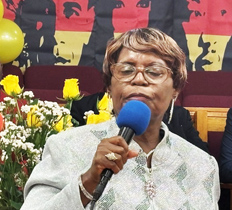
  • “5th Little Girl”, Sarah Collins Rudolph, sole survivor of the 16th Street Baptist Church bombing in Birmingham speaks at Second Baptist Church Black History program

    “5th Little Girl”, Sarah Collins Rudolph, sole survivor of the 16th Street Baptist Church bombing in Birmingham speaks at Second Baptist Church Black History program

    by John Zippert, co-owner

    On February 15, Second Baptist Church hosted a Black History program that brought Sarah Collins Rudolph to Greene County to talk about her experience as the sole survivor of the September 15, 1963 bombing, by the Klu Klux Klan, of the 16th Street Baptist Church in Birmingham. Sarah Collins Rudolph was the younger sister (aged 12 at the time) of Addie Mae Collins, one of four girls tragically killed in the bombing of the church, in the midst of the Civil Rights Movement.


    Sarah Collins Rudolph was in the ladies restroom in the basement of the 16th Street Baptist Church, with four other young ladies – her sister Addie Mae Collins, Denise McNair, Carole Robertson and Cynthia Wesley, all 14 years old. They were taking a break between Sunday School and a Youth Day program at the church.


    When the bomb exploded around 10:22 in the morning, Sarah Collins Rudolph said she had just walked across the rest room from the other four to wash her hands in the sink. The Klan placed the bomb in an outside stairway that led to the basement that was adjacent to the women’s rest room. The last thing she remembers before the blast, was Denise McNair asking her sister Addie Mae Collins to adjust a sash on her dress.


    Four of the girls were killed instantly by the blast and Sarah survived with serious injuries from the bomb, including glass and other fragments that cut her eyes, face, arms, legs and other parts of her body. She was rescued and sent to the hospital by the first church members that dug through the rumble from the explosion.


    Sarah was confined to the hospital for weeks after the explosion. She was blind in her right eye and had it replaced with a prosthetic eye. Her many cuts healed leaving visible scars both physical and psychological. She says, even today, when she hears loud noises, she revisits the terror of the bomb explosion. She relates this to PSTD experience by soldiers in war, reliving their combat experiences.Sarah was not able to attend the funerals of her sister and the other three girls because she was in the hospital. When she returned to school, she received no special counseling or other assistance to adjust to the explosion which changed her life.


    She finished high school and then worked in various capacities at industrial fabrication plants and domestic work, taking care of elderly and sick people. She married three times. She said that she eventually found a church in Birmingham that helped her to understand that by accepting Christ and his teachings could help her to live a fuller and more meaningful life.


    She testified at the trials of the three KKK members, who were eventually brought to justice for the horrendous crime of bombing the church in 1963, including ‘Dynamite Bob” Chambliss, Frank Cherry and Thomas Blanton.
    In the mid 1990’s more than thirty years after the bombing, she began giving interviews and speaking out about her life and experiences. She tried unsuccessfully to get compensation for herself and families of other victims of racial and civil rights crimes. So far she has been unsuccessful in getting any compensation from the state of Alabama or the Federal government, for her injuries and suffering from the 1963 bombing of the church.


    In her travels to speak on the bombing and being the only survivor, she met Tracy Snipe, a professor at Wright State University in Ohio, where he teaches history, politics and related subjects. Snipes collaborated with Sarah Collins Rudolph to write a book on her life including the 1963 bombing. The book is entitled “the Fifth Little Girl”. At the end of the Second Baptist Church Black History Program, participants were able to purchase copies of her book ($30.00) and have it inscribed to them by her.
    The program at Second Baptist Church was sponsored by United Purposes, and its community partners. The organization is headed by Miriam Leftwich, who organized the program and introduced Ms. Rudolph. The program also featured information on Black History, singing, poetry reading , and a liturgical dance presentation, mostly by young people to honor the guest speaker.


    This program had a very profound impact and impression on this writer and others who attended the program and were not aware that there was a fifth little girl, who survived the bombing , that has lived another more than six decades to give first-hand testimony about one of the most consequential events of the Civil Rights Movement and Black History in America.

    Sarah in the hospital with both eyes bandaged from the bomb explosion
    Sarah in the hospital with both eyes bandaged from the bomb explosion
  • Newswire: Biden-Harris Administration celebrates Juneteenth with concert and new initiatives to honor Black History

    By Stacy M. Brown
    NNPA Newswire Senior National Correspondent

    The White House marked Juneteenth with a vibrant celebration on the South Lawn on Monday, June 10. The celebration featured performances by celebrated African American artists, including Gladys Knight, Raheem DeVaughn, Patti LaBelle, Charlie Wilson, and Doug E. Fresh. Over 2,000 guests, including President Joe Biden and First Lady Dr. Jill Biden, attended the event, which officials said emphasized the Biden-Harris Administration’s dedication to preserving and honoring African American history.
    Since taking office, President Biden and Vice President Harris have prioritized advancing racial justice and recognizing Black history as an essential component of American history. The White House said the dedication is reflected in significant actions such as signing the Juneteenth National Independence Day Act into law, establishing the Emmett Till and Mamie Till-Mobley National Monument, and posthumously awarding the Presidential Medal of Freedom to civil rights icon Medgar Evers.
    Amid efforts to combat attempts to rewrite history and undermine racial progress, the administration hosted a live-streamed event featuring officials, artists, civil rights leaders, and scholars to discuss federal initiatives to protect African American history. The gathering highlighted ways the public can commemorate Juneteenth and emphasized the broader historical significance of African American experiences.
    In conjunction with the celebration, the President’s Committee on the Arts and the Humanities organized the second annual Juneteenth National Independence Day event in partnership with the White House. The large-scale concert also honored Black Music Month, showcasing African American musical legends and underscoring the cultural importance of this federal holiday.
    Harris declared June 19, 2024, one of three National Days of Action on Voting, focused on enhancing voter engagement and safeguarding voting rights. The White House noted that National Days of Action will also occur on August 6 and September 17, 2024.
    Aligned with Biden’s Executive Order on Promoting the Arts, the Humanities, and Museum and Library Services, several federal agencies announced new initiatives to protect African American history and culture. The National Archives Museum will display the original Emancipation Proclamation and General Order No. 3 from June 18 to June 20, 2024, while the National Park Service will offer free entrance to park sites on Juneteenth.
    The National Endowment for the Humanities (NEH) has launched a digital repository to deepen public understanding of African American history. Additionally, NEH will establish a nationwide program celebrating Juneteenth, leading to a grand 160th-anniversary celebration in 2025.
    In response to the rising incidence of book bans targeting historically marginalized groups, the U.S. Department of Education announced it had appointed a coordinator to address the impact of such restrictions on civil rights. The White House Initiative on Advancing Educational Equity will host events emphasizing the importance of culturally relevant education.
    The National Endowment for the Arts (NEA) plans to announce new recipients of the NEA Jazz Masters Fellowship, celebrating the contributions of African American musicians to jazz. The Institute of Museum and Library Services (IMLS) will highlight projects that preserve African American history as part of its “250: All Stories. All People. All Places initiative.”
    The administration said it has significantly invested in preserving African American history through infrastructure and preservation projects. The Department of Interior’s National Park Service (NPS) and the Historic Preservation Fund have allocated substantial funds for these efforts, including grants to support underrepresented communities and historic site nominations.
    Federal agencies, including the Department of Transportation, are working to document and uplift the stories of communities affected by past federal policies. The NEH prioritizes projects that preserve historical collections on slavery and its legacies. At the same time, the President’s Committee on Arts and the Humanities will launch initiatives to support underserved creative and cultural communities.
    “Through these actions and policies, the Biden-Harris Administration reaffirms its commitment to advancing racial equity and ensuring that America’s promise is realized for all citizens,” the White House said in a Fact Sheet.

  • Holds Black History Program Eutaw Housing Authority swears in new officials

    black history

    The Eutaw Housing Authority Advisory Board swore in new officials at its regular meeting held February 23, 2016. The ceremony was conducted by City of Eutaw Municipal Judge Grace Stanford.  This event was followed by a Black History Program with a special focus on Greene County.

    LaTarsha Johnson served as mistress of order, followed by a greeting from Jacqueline Davis. Faye L. Tyree recited a reading on Shirley Chisom as a pioneering African-American politician. Chisom was the first African American woman to serve in Congress and the first African American woman to run for President of the United States.
    A panel consisting of Sara Duncan, Ovetta Smith, Leo Branch, Lorenzo French and Derrick Hall reflected by on history. Mrs. Ovetta Smith recalled times pass when she, Dr. Martin Luther King, Jr. and Julian Bond worked together to get people registered to vote. She also recalled an incident where Rev. Gilmore was beaten on the side of the head. She felt the injustice of it all just for standing up for what was right.
    Leo Branch recalled the sit-in under the Oak Tree in Forkland singing We Shall Over Come. He recalled when there was a time when we were not allowed to get an education. Now you can. Every child can get the education they need.
    Derrick Hall stated as a young man, his mother instilled in them to put God first, go to school and get the best education you can and respect your elders.
    Ms. Sarah Duncan remembered that Gilmore and Branch where two main pioneers in the Greene County movement.  They had the community support back then. Everyone loved one other; helped one other. “Only when we come together on one accord can we move forward as we did back then. It is important our children know where we came from and why it is important to vote and know our history to make things better for our livelihood,” she stated.
    Lorenzo French recited a Martin Luther King Jr. speech, his last one addressing the garbage workers in Tennessee. The youth present were asked questions and received prizes. Refreshments were served. The Black History program was enjoyed by all.