by E. Eduardo Castillo and Huizhong Wu, AP News
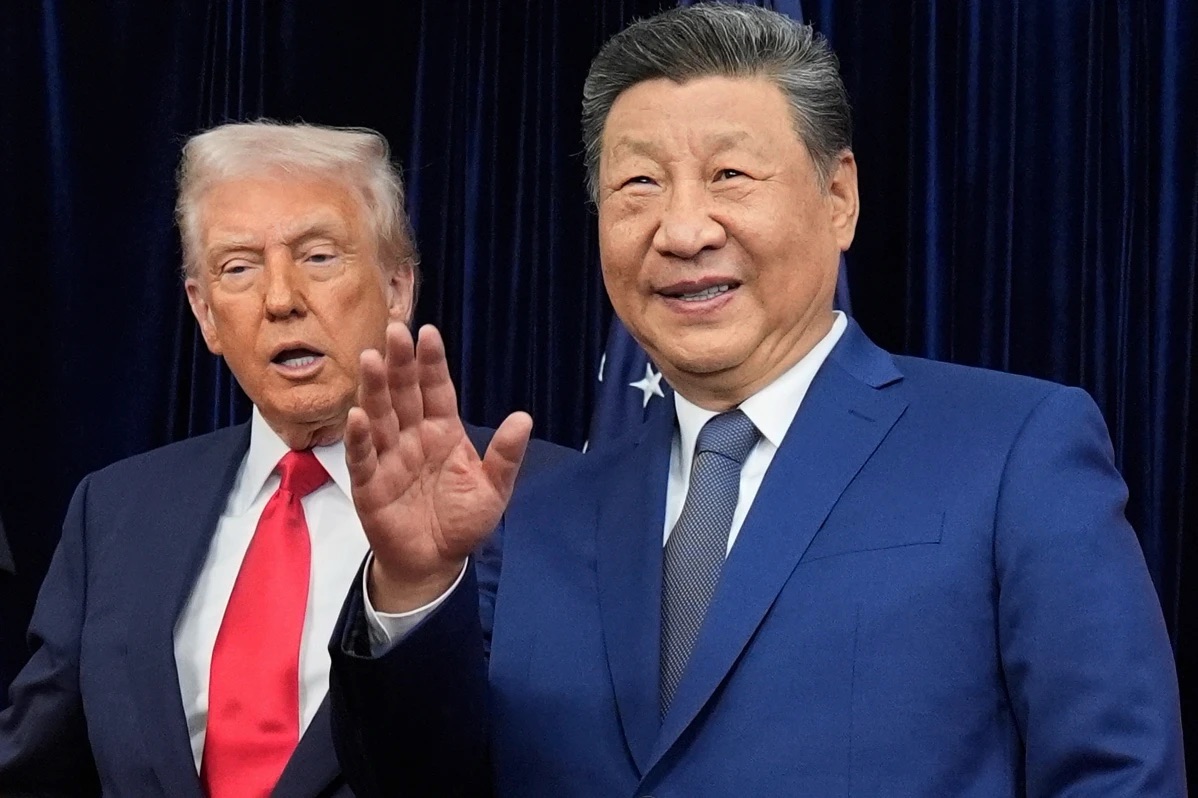
BEIJING (AP) — As Presidents Xi Jinping and Donald Trump prepare for a highly anticipated summit, both China and the United States say their ties have been broadly stable in recent months — and they are planning on keeping it that way.
But many issues are at stake in one of the world’s most consequential relationships, with no easy end in sight.
Few expect major breakthroughs to the long-running frictions between China and the U.S., which range from competition in technology to the thorny question of Taiwan, whose main ally is the U.S. Ending the war with Iran is likely to be added to the agenda, with Beijing being one of the unofficial mediators in the conflict.
“On both sides there is a consensus that U.S.-China stability is important,” said Henrietta Levin, senior fellow for the Freeman Chair in China Studies at the Center for Strategic and International Studies in Washington. “Once you get past the question of stability, the ‘what’s next’ in the relationship gets a little more complicated, and so for that reason, the most likely thing to come out of the meeting is very little.”
Here’s what to know about the summit:
There may be a trade deal, but not a resolution
The China-U.S. trade war started with Trump’s first term, but turned up a notch in April last year, on Trump’s so-called “Liberation Day,” when he announced 34% tariffs on all Chinese goods. China retaliated with counter tariffs and other measures, such as restrictions on rare earth exports. Tariffs reached as high as 145% in the escalating back and forth.
The two sides, realizing the sky-high tariffs weren’t sustainable, then called for a trade truce, halting many of the punitive economic measures. The two leaders met in South Korea in Octoberand extended the truce for another year. China promised to purchase soybeans from American farmers, while the U.S. dropped tariffs by more than half.
“China’s strategy was to promote stability by fighting back,” said Fudan University professor Zhao Minghao, an expert in international relations. “Both sides could very well issue a comprehensive trade agreement this time. But this doesn’t mean the war is over, and the agreement will have conditions.”
Last year’s trade truce did not resolve any of the bigger picture issues, and it did not mean a return to how things were. China now has a new export permit requirement for rare earth exports that it can tighten at any time.
Further, this time around, “there’s been a lack of the intensive type of engagement that has characterized past summits,” said Wendy Cutler, vice president of the Asia Society, and a former trade negotiator for the U.S.
China in April issued new regulations that built out a framework for identifying and countering foreign measures targeted at Chinese companies. Under the new rules, for example, China’s Ministry of Commerce told impacted companies, such as one petroleum refinery that bought Iranian crude oil, to ignore U.S. sanctions.
Although some say the sides could announce a continuation of the trade truce, they note they have continued to take targeted actions. “It’s a fragile truce,” said Cutler.
The White House said Sunday they are also planning to discuss creating a new “Board of Trade” to keep their countries talking on economic issues.
China’s ability to buy high-tech chips is still a thorny issue
The U.S. imposed restrictions on exports to China of advanced computer chips and related tech, such as the machines to make the chips, as early as Trump’s first term in office.
Nvidia, a California company and the leading designer of advanced chips, has pressed Trump to allow it to export them to China. Nvidia founder Jensen Huang has argued that selling the chips will build reliance on American tech for Chinese AI firms.
But the increasing list of restrictions on chip exports may only push China deeper in its drive for self-reliance. “China’s attitude has changed subtly, it seems more focused on advancing its domestic chip industry rather than continuing to rely on advanced chips from the United States,” Zhao said in written comments.
China sees Taiwan as the ‘biggest risk’ in ties with the US
Two weeks before the meeting, Chinese Foreign Minister Wang Yi said in a call with U.S. Secretary of State Marco Rubio that the bilateral relationship has remained generally stable, but Taiwan remains the “biggest risk” to their ties. China signaled again on Thursday that Taiwan would be a top priority for discussion.
Few expect a resolution to the Taiwan issue, lingering since China and Taiwan split in a civil war in 1949. While Beijing claims Taiwan, the island is a self-ruled democracy.
Tensions have only risen since Taiwan first elected Tsai Ing-wen as president in 2016. Her Democratic Progressive Party says Taiwan is functionally independent and its own sovereign state. Beijing has broken off communication with Taiwan’s government, and in recent years, started sending warplanes and warships closer to the island in almost daily drills.
The island’s current president, Lai Ching-te, is also from the DPP. Beijing has criticized Lai repeatedly, even depicting him as a “parasite” in propaganda imagery for its military exercises.
The U.S. is required by law to ensure Taiwan can defend itself but officially maintains a position of what has been called strategic ambiguity, leaving the question of whether the U.S. would get involved militarily if China decided to reclaim Taiwan by force. Trump has also said recently that he discussed arms sales to Taiwan with Xi, which led to further questions of whether the U.S. would support Taiwan.
“One possibility is that China and the U.S. can take the strategy of a sort of ‘reciprocal restraint’, such as reducing the number of American arms sales to Taiwan, in exchange for fewer military exercises from the mainland aimed at Taiwan,” said Zhao.
The US wants China to put pressure on Iran
As the world awaits an end to the war in Iran that has shaken the global economy, the conflict is likely to surface in the talks.
China has openly criticized the United States and Israel over the war. In addition, given its close political and economic ties with Iran, it is seen by some as an unofficial mediator that could influence Tehran. So far, Beijing has remained cautious, preferring to not get deeply involved.
“I don’t think China has any interest in solving the problems the U.S. has created for itself in the Middle East,” Levin, of the Center for Strategic and International Studies, said.
A few days before the trip, U.S. Treasury Secretary Scott Bessent called on China to pressure Iran to open the Strait of Hormuz, and said that by buying Iranian oil, Beijing is funding terrorism.
“Let’s see if China — let’s see them step up with some diplomacy and get the Iranians to open the strait,” Bessent said on Fox News. “Iran is the largest state sponsor of terrorism, and China has been buying 90% of their energy, so they are funding the largest state sponsor of terrorism.”
Wu covers Chinese culture, society, and politics for The Associated Press, as well as the country’s growing overseas influence from Bangkok. She was previously based in Taiwan and China.
