Tag: death sentence

  • Newswire: Alabama governor commutes death sentence of man who didn’t kill anyone

    Newswire: Alabama governor commutes death sentence of man who didn’t kill anyone

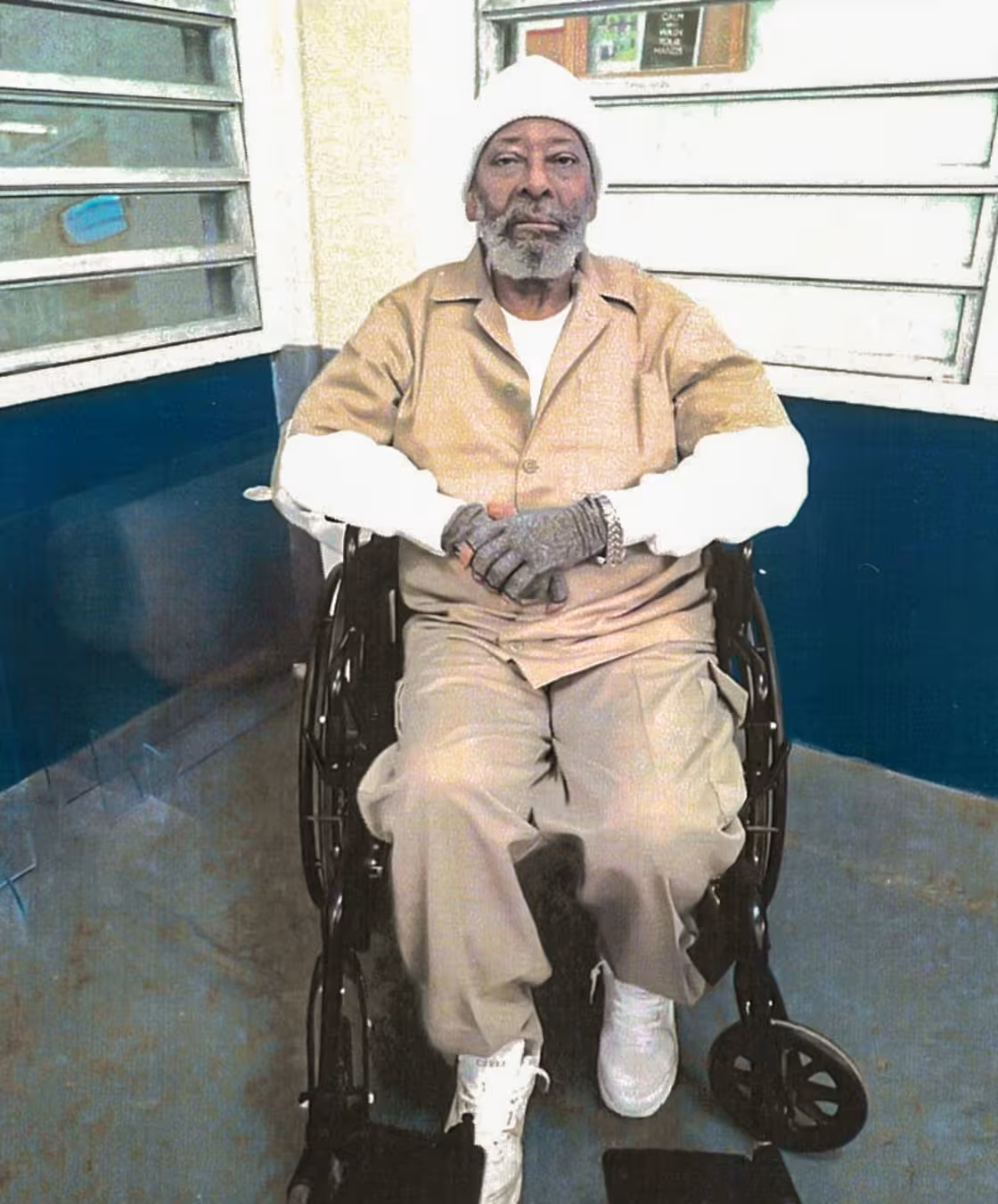
    Alabama Gov. Kay Ivey commuted on Tuesday, March 10, the death sentence of Charles “Sonny” Burton to life without parole, saying his execution, which was set for Thursday, would be “unjust.”

    In 1991, Burton was one of six men involved in the robbery of an AutoZone store in Talladega that ended with the murder of a customer, Doug Battle; Burton did not pull the trigger in the killing.

    “Doug Battle was brutally murdered by Derrick DeBruce while shopping in an auto parts store. But DeBruce was ultimately sentenced to life without parole. Charles Burton did not shoot the victim, did not direct the triggerman to shoot the victim and had already left the store by the time the shooting occurred. Yet Mr. Burton was set to be executed while DeBruce was allowed to live out his life in prison,” Ivey said in a statement.

    “I cannot proceed in good conscience with the execution of Mr. Burton under such disparate circumstances. I believe it would be unjust for one participant in this crime to be executed while the participant who pulled the trigger was not,” she said.

    Alabama Attorney General Steve Marshall expressed disappointment in a statement first to NBC News. “There has never been any doubt that Sonny Burton has Douglas Battle’s blood on his hands,” he said.

    “Burton does not deserve special treatment because he is old — he could have been executed a long time ago, but like many death-row inmates, he chose to drag out his case through endless frivolous appeals. I firmly believe that he should have faced the punishment imposed by a jury of his peers and upheld by numerous judges,” he said.

    Burton admits to entering the store armed with a gun. He said he stole cash from a safe in the back room, then fled outside to wait by a getaway car.

    Inside the store, one of his accomplices, Derrick DeBruce, shot Battle, 34, in the back, killing him. The state acknowledged this fact in its response to Burton’s application for a stay of execution from the U.S. Supreme Court.

    Burton’s death sentence was possible because of a legal doctrine known as felony murder, which allows prosecutors to treat anyone involved in certain felonies, such as robbery or burglary, equally responsible for a killing that occurs during the crime, even if they did not commit the act themselves.

    In a phone interview earlier this month from William C. Holman Correctional Facility, the site of the state’s execution chamber, Burton told NBC News he had no idea Battle’s murder was going to happen.

    “I didn’t assist nobody. I didn’t aid nobody. I didn’t tell nobody to shoot nobody,” he said.

    Ivey had faced a growing chorus of voices asking for mercy for Burton, 75, including the victim’s daughter, who published an op-ed in the Montgomery Advertiser urging Ivey to spare his life.

    Burton expressed gratitude to NBC News for that show of support.

    “She forgave me, and I want to say how much I appreciated that,” he said. “She lifts a whole lot of guilt off me.”

    Burton’s family and legal team expressed their gratitude in a statement from federal defender Matt Schulz, who represented Burton for nearly two decades.

    “Governor Ivey’s decision is to be applauded, as it demonstrates measured, responsible, and respectable leadership. Though a ‘thank you’ indeed falls short of the level of gratitude the parties wish to express, Sonny Burton, his family, his friends, his legal team, and all those who have supported Sonny’s request for clemency thank you, Governor Ivey,” said Schulz.

    Schulz also shared a statement from Burton to Ivey. “Just saying thank you doesn’t seem like much. But it’s what I can give her. And I do thank her. Thank you, Governor,” said Burton.

    Burton would have been the ninth person to be executed by nitrogen gas — a method first carried out in Alabama in 2024. He is only the second person to have his death sentence commuted by Ivey. 

  • Supreme Court rules for Black Georgia death row inmate

    By Lawrence Hurley


    scotus-elites_2

    WASHINGTON (Reuters) – The U.S. Supreme Court on Monday effectively overturned a Black man’s 1987 conviction for murdering a white woman, rebuking Georgia prosecutors for unlawfully excluding Black potential jurors in picking an all-white jury that condemned him to death.

    635881246232894643-AP-Supreme-Court-All-White-Jury

    Timothy Foster

    The 7-1 ruling handed a major victory to Timothy Foster, who is 48 now and was 18 at the time of the 1986 killing of Queen Madge White, a 79-year-old retired schoolteacher, in Rome, Georgia. Prosecutors, however, still could seek a new trial.
    Black convicts make up a disproportionately high percentage of death row inmates in the United States. Opponents of capital punishment assert that the American criminal justice system discriminates against Black defendants. During jury selection, all four Black members of the pool of potential jurors were “struck” by prosecutors, meaning they were removed from consideration. Prosecutors gave reasons not related to race for their decisions to exclude them.
    Chief Justice John Roberts, who wrote the ruling, said prosecution notes introduced into evidence that shed light on the jury selection “plainly belie the state’s claim that it exercised its strikes in a ‘color blind’ manner. The sheer number of references to race in that file is arresting.”
    The notes showed that the prosecution marked the names of the black prospective jurors with a “B,” highlighted them in green and circled the word “Black” next to the race question on juror questionnaires.
    The prosecution gave reasons for excluding potential Black jurors including that they “did not make enough eye contact” during questioning and were “bewildered,” “hostile,” “defensive,” “nervous” and “impudent.”
    Roberts said prosecutors “were motivated in substantial part by race” when two of the potential jurors were excluded. Two such strikes based on race “are two more than the Constitution allows,” Roberts added.
    The Supreme Court ruled in 1986, the same year as this murder, that it is unconstitutional to take race into account when excluding potential jurors.
    Prosecutors said Foster broke into the elderly woman’s home in the middle of the night, broke White’s jaw, sexually assaulted her, beat and strangled her, and stole items from her house. Foster later confessed to killing White, according to court papers.
    At the time of the trial, Foster’s legal arguments regarding jury selection failed. But in 2006 his lawyers obtained access to the prosecution’s jury selection notes, which showed that the race of the Black potential jurors was highlighted, indicating “an explicit reliance on race,” according to Foster’s attorneys.
    According to court documents filed by Foster’s lawyers, the lead prosecutor said of his exclusion of the potential black jurors: “All I have to do is have a race-neutral reason, and all of these reasons that I have given the court are racially neutral.”
    Foster’s lawyer, Stephen Bright of the Southern Center for Human Rights, said the legal challenge would not have succeeded without the notes. “This discrimination became apparent only because we obtained the prosecution’s notes which revealed their intent to discriminate. Usually that does not happen. The practice of discriminating in striking juries continues in courtrooms across the country,” Bright said.
    The Supreme Court’s ruling threw out a Georgia Supreme Court decision rejecting Foster’s claim about prosecutorial misconduct in jury selection, meaning a state court will now reverse his conviction.
    The sole dissenter in the ruling was the court’s only Black justice, Clarence Thomas. Thomas said the case should have been sent back to state courts to determine whether Foster’s claim could proceed.