Tag: Donald Trump

  • Jimmy Carter broadsides Donald Trump: Republican tapped ‘reservoir of inherent racism’

    By Douglas Ernst – The Washington Times – Tuesday, May 24, 2016

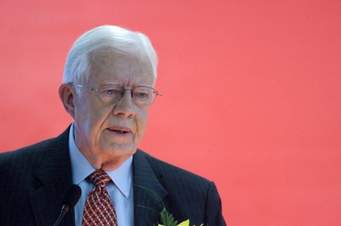
    Jimmy Carter

    Former President Jimmy Carter

    Former President Jimmy Carter pulled no punches against Donald Trump in a recent interview with The New York Times.
    The 39th commander in chief told the newspaper by phone on Monday that Mr. Trump’s Republican presidential campaign is fueled by lingering U.S. racism.
    Mr. Carter, 91, said in February that the billionaire was his favorite Republican candidate because he is “completely malleable.” The former Democrat president now says Mr. Trump “tapped a waiting reservoir there of inherent racism” to succeed.
    “When you single out any particular group of people for secondary citizenship status, that’s a violation of basic human rights,” Mr. Carter said of the Republican’s plan to deport illegal immigrants and temporarily halt Muslim immigration into the U.S.
    The newspaper also asked Mr. Carter, who is planning to hold a summit of Baptists in Atlanta, Georgia, later this summer, why Mr. Trump’s support among evangelical Christians is so strong.
    “The use of the word ‘evangelical’ is a misnomer. I consider myself an evangelical as well. And obviously, what most of the news reporters thought were evangelicals [over the years] are conservative Republicans,” the former president said.

  • Obama condemns Trump for ‘rejecting the future’ by exiting Paris climate deal

    By: Sabrina Siddiqui and Lauren Gambino, Guardian
    Barack Obama

    Barack Obama
    Barack Obama led condemnation of his successor’s decision to withdraw from the landmark Paris climate accord, which the former president’s administration painstakingly negotiated over the course of several years.
    In a statement released just before Donald Trump officially announced that the US would remove itself from the deal, Obama said the administration had joined “a small handful of nations that reject the future”. He warned that the more than 190 countries that remained participants would “reap the benefits in jobs and industries created”, but he said that US states, cities and businesses “will step up and do even more to lead the way, and help protect for future generations the one planet we’ve got”.
    The rare rebuke by Obama was testament to the magnitude of Trump’s decision. The former president has commented sparingly on the new administration, weighing in only on matters he has framed as of moral significance, such as Trump’s stymied effort to impose a travel ban on refugees and citizens from several Muslim-majority countries.
    Trump’s withdrawal from the accord was not just a blow to one of Obama’s signature achievements, but to an issue routinely dubbed by the Obama administration as the greatest threat to US national security and future generations across the globe.
    The former secretary of state John Kerry, who represented the US in the negotiations over the Paris accord, said Trump had turned America into “an environmental pariah in the world”.
    In exiting the agreement, the US joined only Syria and Nicaragua in sitting on the sidelines even as widespread condemnation poured in from foreign leaders, climate scientists and many leading US companies.
    The reaction in Washington was nonetheless split on familiar partisan lines, with Republican lawmakers near unanimously throwing their support behind Trump while Democrats vowed revenge at the ballot box.
    Republican leaders Paul Ryan and Mitch McConnell, who have long sought to thwart Obama’s environmental legacy, applauded Trump in their statements.
    “The Paris climate agreement was simply a raw deal for America,” Ryan said, adding: “In order to unleash the power of the American economy, our government must encourage production of American energy. I commend President Trump for fulfilling his commitment to the American people and withdrawing from this bad deal.”
    McConnell said Trump’s move followed through on congressional action “to rebuff then-President Obama’s regulatory rampage.”
    “When the previous administration signed America up for this unattainable mandate, we made it clear we would fight this unilateral action any way we could, and this day could not have happened soon enough,” McConnell said. “President Trump has once again put families and jobs ahead of leftwing ideology and should be commended for his action.”
    But at least some Republicans – from Florida, one of many coastal states grappling with the effects of extreme weather and rising sea levels – expressed disappointment with the president’s decision to withdraw.
    Congresswoman Ileana Ros-Lehtinen, who represents south Florida, urged the US to establish a “long term-strategy against climate change”. She also noted that Thursday marked the first day of hurricane season in the state.
    Democrats were uniformly scathing in their assessment of Trump’s decision, with Senate minority leader Chuck Schumer declaring it “a devastating failure of historic proportions”.
    “Future generations will look back on President Trump’s decision as one of the worst policy moves made in the 21st century because of the huge damage to our economy, our environment and our geopolitical standing,” Schumer said. “Pulling out of the Paris agreement doesn’t put America first. It puts America last in recognizing science, in being a world leader and protecting our own shore line, our economy and our planet.”
    Nancy Pelosi, the House Democratic leader, said Trump’s position ran counter to that of Pope Francis, who during the president’s recent visit to the Vatican presented Trump with a copy of his encyclical on climate change.
    Democrats would join efforts with states, cities and the private sector to make good on initiatives to mitigate the threat of climate change, she added, “regardless of the reckless and short-sighted actions that the White House takes”.
    Bernie Sanders, the Vermont senator who made climate change a pillar of his bid for the 2016 Democratic presidential nomination, decried Trump’s action as “an abdication of American leadership and an international disgrace”. “When climate change is already causing devastating harm, we don’t have the moral right to turn our backs on efforts to preserve this planet,” Sanders tweeted.

  • Ben Jealous confirms run for Maryland Governorship

    Former NAACP President believes his Civil Rights Record will inspire voters
    By Hazel Trice Edney


    ben jealous headshot-3.jpg Benjamin Todd Jealous

    (TriceEdneyWire.com) – Former NAACP President Benjamin Todd Jealous, also former Black press executive, is launching a political career.
    Perhaps recently best known as a surrogate for Democratic presidential candidate Sen. Bernie Sanders, Jealous confirmed this week that he is running for governor of Maryland. He cited his long record of civil rights and the diversity of the state of Maryland as being to his favor.
    “When I was president of the NAACP I learned just how quickly my neighbors here were prepared to move forward on civil rights. In one year, we abolished the death penalty, we passed marriage equality, we passed the Dream Act. I’m running for governor because I believe we’re prepared to move just as quickly in moving forward on our education, on employment, on the environment while continuing to protect civil rights,” Jealous said this week in an interview with the Trice Edney News Wire. “I’m running for governor because I believe we can do much better by our kids right now.”
    Jealous is entering a crowded field of seven other candidates for the Democratic primary to be held June 26, 2018. He believes disaffection for the scandal-laden Trump administration may cause voters to lean back toward Democratic leadership after electing Republican Gov. Larry Hogan in November 2014. Hogan is eligible to run for re-election.
    “Larry Hogan is governor of Maryland because in 2014, we had a high tide of Republican turnout and an ebb tide of Democratic turnout,” Jealous said. He pointed out that Hogan won by 60,000 votes after 125,000 Democrats who had voted in 2010 didn’t show up to vote in 2014.
    “In this era of President Trump, they can only remember having a president that is competent to serve. And now they see the impact of having a president that is quite the opposite,” Jealous said. “So long as we turn out Democratic voters who are used to voting in gubernatorial elections, there’s almost no way that he can win.”
    The election will be held Nov. 6, 2018. But first Jealous must distinguish himself among the crowded Democratic field. In that regard, he may just have a not-so-secret weapon. If he can win an endorsement from Sen. Bernie Sanders, it may bolster his chances significantly.
    “Let’s just see,” was Jealous’ only response when asked whether he expects to receive Sanders’ endorsement. Sanders won 36 percent of the vote in Maryland’s Democratic presidential primary. If Jealous can win a majority of those voters; plus a significant portion of Maryland’s 45 percent Black vote, he is a strong contender to win the Democratic nomination.
    But the key will be to excite the Democratic base to the polls. Jealous believes he has the record to do just that. Maryland has a 45 percent White constituency and 10 percent that encompasses other races. Jealous believes his background and civil rights record could attract a following similar to the “Rainbow Coalition” that was amassed during the Jesse Jackson presidential campaign, for which Jealous also worked in 1988.
    Jealous was born in Pacific Grove, Calif. But his parents, a mixed-race couple, had met in Baltimore. His father, Fred Jealous, who was White, helped integrate lunch counters in the South. His mother, Ann Jealous, worked with the Student Nonviolent Coordinating Committee in the 1960s. As a teenager, Jealous became steeped in civil and voting rights work and spent summers in Baltimore with his maternal grandparents.
    “The combination of an activist rooted in the tradition of the NAACP and the civil rights movement and an activist rooted in the Bernie camp, gives us a broad base that looks like Maryland similar to what you saw of Doug Wilder in Virginia after the Jesse Jackson campaign,” Jealous said.
    Jealous’ career has been woven with civil rights and politics. Between 2000-2004 he served as executive director of the National Newspaper Publishers Association (NNPA). Earlier in his career, he’d worked as an editor for the historic Jackson Advocate newspaper in Mississippi.
    After NNPA, he became founding director of Amnesty International’s U. S. Human Rights Program. In 2008, he became the historically youngest NAACP president at the age of 35, an office he held until 2012. He later became a venture capitalist with the Oakland, Calif.-based Kapor Center for Social Impact. He also played integral rolls in the presidential races of President Barack Obama.
    “I’m blessed to have lived my life as a progressive in the Black community who is committed to fighting for a better life for everyone in our community and ultimately for everyone in every community…It’s that life, that path that starts with Jesse Jackson ’88 and goes all the way through Bernie Sanders’ 2016 campaign,” he recounts. “It’s that life that started with my parents and my grandparents rooted in the NAACP, raised in the NAACP; ultimately leads into the labor movement and the environmentalist movement and the LGBT movement and the women’s rights movement. That’s me, that’s where I’m rooted and where this campaign is rooted.”
    If he wins, Jealous would become the nation’s fourth Black governor in modern history. The others were Virginia’s Gov. L. Douglas Wilder, elected in 1989; Massachusetts’ Gov. Deval Patrick, elected in 2006 and re-elected in 2010; and New York’s Gov. David Paterson who served two years after the resignation of Gov. Eliot Spitzer in 2008.
    Jealous, 44, has two young children to whom he often refers when expressing concerns about the future of Maryland. Reflecting on the economic deprivation that became a national spotlight during the Freddie Gray case, he accuses Hogan of having ignored Baltimore during his tenure.
    “This is a governor who has shifted millions of dollars away from public education and into voucher programs and who has toured the state with [Trump-appointed Education Secretary] Betsy Devos and has embraced Attorney General Sessions’ foolishness of trying to revive the failed war on drugs by also investing millions of dollars in building up law enforcement to go after heroin addicts as law breakers rather than as people who need to be sent to rehabilitation,” he says. “The only way to create a better future for Baltimore and its residents is to have a governor who is always for all of its residents; including Baltimore. Right now it feels too often that we have a governor who is always for all of Maryland except for Baltimore…You simply cannot starve a city that’s supposed to be the economic epicenter of the state and have the state prosper.”
    Ultimately, the voters of Maryland must be inspired enough to believe the election even matters. “It’s going to take us deciding that our children’s future, that our family’s economic future is important enough for us to turn out,” Jealous says. “And so, at the end of the day, we will do what it takes to turn out voters. Donald Trump will make that easier and Larry Hogan will make that easier still.”

  • Barack Obama urges Congress to find courage to defend his healthcare reforms

    Former president avoids mentioning Donald Trump as he implores Republicans to ‘speak the truth’ even against their own party

    By Sarah Betancourt, The Guardian
    08OBAMA-master768.jpg

     Former President Obama receives ‘Profiles in Courage Award’ from Caroline Kennedy

    For the first time since leaving office, Barack Obama addressed his landmark healthcare legislation in a speech, reminding supporters of the courage and integrity of junior congressmen that it took to pass the bill.
    Speaking at the John F Kennedy Presidential Library and Museum in Boston on Sunday night, where he was given the Profiles of Courage award, he said: “Because of that vote, 20 million people got healthcare who didn’t have it before.
    “And most of [the congressmen who voted for it] did lose their seats. But they were true to what President Kennedy defined in his book – desire to maintain the integrity that is stronger than the desire to maintain office – the faith that the right course will be vindicated. Personal sacrifice.”
    “It is my fervent hope and the hope of millions … such courage is still possible, that today’s members of Congress regardless of party are willing to look at the facts and speak the truth, even when it contradicts party positions.”
    Obama spoke of what is at stake for the millions of Americans who stand to lose coverage if a repeal passes, without naming Donald Trump specifically.
    And he implored members of Congress to demonstrate political courage even if it goes against their party’s positions.
    The former president focused much of his address on the legacy of Kennedy, as the library prepared to mark the 100th anniversary of his birth later this month. Obama noted the Kennedys had long advocated for healthcare reform, and in particular the late Senator Edward Kennedy, who died of brain cancer before the passage of the Affordable Care Act.
    Obama’s comments come a few days after the House squeaked through a partial repeal and replacement of Obamacare with a 217-213 vote, a long-promised goal of Republicans who have decried the bill since its passing.
    The former president was awarded the award by JFK’s daughter Caroline Kennedy, a former ambassador to Japan, and her son Jack Schlossberg.
    Schlossberg, 24, introduced Obama to the crowd of 700 people in a rare public speech. He said: “My life changed in 2008 because a young candidate was fired up and ready to go, and he told me, ‘Yes we can.’ Without Barack Obama, I might still be sitting on my couch, eating Doritos and watching baseball games.” He cited Obama’s policy choices on healthcare reform, nuclear disarmament and gun control as the reasons for why he deserves the award.
    The John F Kennedy Library Foundation, a nonprofit organization, created the Profile in Courage award in 1989 to honor President Kennedy’s commitment to public service. The award is named for Kennedy’s 1957 Pulitzer prize-winning book Profiles in Courage, which recounts the stories of US senators he believed risked their careers by taking principled stands for unpopular positions. This year’s event marks the 100th anniversary of Kennedy’s birth, on 29 May 1917.
    Previous recipients include former presidents Gerald Ford and George HW Bush, US Congresswoman Gabrielle Giffords and US Senator John McCain.

  • Hate groups increase for second consecutive year as Trump electrifies radical right


    Special to the Trice Edney News Wire from the Southern Poverty Law Center

    (TriceEdneyWire.com) – The number of hate groups in the United States rose for a second year in a row in 2016 as the radical right was energized by the candidacy of Donald Trump, according to the Southern Poverty Law Center’s (SPLC) annual census of hate groups and other extremist organizations.

    The most dramatic growth was the near-tripling of anti-Muslim hate groups – from 34 in 2015 to 101 last year. However fear has grown among many racial and ethnic minority groups. In a post-election SPLC survey of 10,000 educators, 90 percent said the climate at their schools had been negatively affected by the campaign. Eighty percent described heightened anxiety and fear among students, particularly immigrants, Muslims and African-Americans. Numerous teachers reported the use of slurs, derogatory language and extremist symbols in their classrooms.

    The growth has been accompanied by a rash of crimes targeting Muslims, including an arson that destroyed a mosque in Victoria, Texas, just hours after the Trump administration announced an  executive order suspending travel from some predominantly Muslim countries. The latest FBI statistics show that hate crimes against Muslims grew by 67 percent in 2015, the year in which Trump launched his campaign.

    The report, contained in the Spring 2017 issue of the SPLC’s Intelligence Report, includes the Hate Map showing the names, types and locations of hate groups across the country.

    The SPLC found that the number of hate groups operating in 2016 rose to 917 – up from 892 in 2015. The number is 101 shy of the all-time record set in 2011, but high by historic standards.

    “2016 was an unprecedented year for hate,” said Mark Potok, senior fellow and editor of the Intelligence Report. “The country saw a resurgence of white nationalism that imperils the racial progress we’ve made, along with the rise of a president whose policies reflect the values of white nationalists. In Steve Bannon, these extremists think they finally have an ally who has the president’s ear.”

    The increase in anti-Muslim hate was fueled by Trump’s incendiary rhetoric, including his campaign pledge to bar Muslims from entering the United States, as well as anger over terrorist attacks such as the June massacre of 49 people at a gay nightclub in Orlando.

    The overall number of hate groups likely understates the real level of organized hatred in America as a growing number of extremists operate mainly online and are not formally affiliated with hate groups.

    Aside from its annual census of extremist groups, the SPLC found that Trump’s rhetoric reverberated across the nation in other ways. In the first 10 days after his election, the SPLC documented 867 bias-related incidents, including more than 300 that targeted immigrants or Muslims.

    In contrast to the growth of hate groups, antigovernment “Patriot” groups saw a 38 percent decline – plummeting from 998 groups in 2015 to 623 last year. Composed of armed militiamen and others who see the federal government as their enemy, the “Patriot” movement over the past few decades has flourished under Democratic administrations but declined dramatically when President George W. Bush occupied the White House.

    The SPLC also released an in-depth profile of the Alliance Defending Freedom (ADF), an anti-LGBT hate group. Leaders of the legal advocacy organization and its affiliated lawyers have regularly demonized LGBT people, falsely linking them to pedophilia, calling them “evil” and a threat to children and society, and blaming them for the “persecution of devout Christians.” The group also has supported the criminalization of homosexuality in several countries.


  • Activists, Black Leaders anticipate what’s next as Federal Courts block Trump’s Travel Ban


    By Barrington M. Salmon

    (TriceEdneyWire.com) – Barely two weeks into his presidency, Donald Trump signed a travel ban targeting Muslims in seven countries effectively blocking citizens, visitors, students, professionals, refugees and even those who worked with the US military in Iraq from entering the United States.

    On Feb. 8, that ban was blocked by a three-judge panel of the Ninth Circuit Court of Appeals. It is a ruling that the Trump Administration could appeal to the U. S. Supreme Court or the executive order could be re-written as an attempt to meet legal and constitutional muster.

    Before the court ruling, the order denied entry to anyone from Iran, Iraq, Sudan, Syria, Libya, Somalia, and Yemen for 90 days. Trump’s action drew widespread condemnation and fierce opposition from civil rights and immigrant groups, national security experts and analysts and others deeply angered by the discriminatory nature of the ban and their concerns about the ethical and constitutional implications of the executive order. At the same time, Americans spooked by Trump’s constant assertions of an impending terror attack by praised the executive order and are pushing for stricter controls.

    Black leaders, including National Urban League President Marc Morial, say the ban opposes American values.

    “With the easy stroke of a pen, and a messy rollout, President Trump summarily stopped an entire class of people from entering the country, throwing airports into chaos and confusion, sparking spontaneous protests, delaying or halting family reunions and disrupting the lives of lawful immigrants both within and outside our nation’s borders,” wrote Morial in a statement.

    While the executive order fulfilled an oft-repeated campaign promise, administration officials and pundit acknowledged that the hurried nature of the rollout of the order and the decision by the president not to consult with affected agencies or members of Congress created unforeseen problems. This included confusion among those responsible for enforcing the order and chaos at airports as Customs and Immigrations officials detained men, women and children, put others on airplanes back to their points of origin and revoked travelers’ visas.

    The ruling of the three-member panel of judges from the US Court of Appeals, based in San Francisco, brought a semblance of calm and order by refusing to lift the emergency stay that a Seattle judge had earlier imposed.

    During oral arguments, the federal judges were unconvinced of the administration’s argument, citing among other issues, “the government’s shifting interpretations of the Executive Order and assertions of the president’s broad authority superseding that of the judiciary,” the three-judge panel wrote in the 29-page ruling. “The government has pointed to no evidence that any alien from any of the countries named in the order has perpetrated a terror attack in the United States. (And) rather than present evidence to explain the need for the Executive Order, the government has taken the position that we must not review its decision at all.”

    The panel’s ruling continued, “National defense cannot be deemed an end in itself, justifying any exercise of legislative power designed to promote such a goal. It would indeed be ironic if, in the name of national defense, we would sanction the subversion of one of those liberties … which make the defense of the Nation worthwhile.”

    Other critics of the travel moratorium – some of whom described it as “Un-American, counterproductive and possibly illegal – hailed the victory. Nihad Awad, national executive director of the Washington, DC-based Council on American-Islamic Relations, while praising the ruling, warned opponents of the measure not to get complacent.

    “We applaud this ruling as a reaffirmation of the strength and independence of our system of justice,” he said in a statement. “The decision adds to a long list of federal judges – both Republican and Democratic appointees – who found reason to block this discriminatory order. While this decision is critical, it is not the end of the legal process. Other courts across the country will be passing judgement on the order, and the US Supreme Court will likely weigh in at some point.”

    Hillary Clinton, who Trump bested to become president, posted a Twitter message saying simply, “3-0”.

    Prior to the ruling, Trump railed against judges in general and decried the politics he said suffuses the judicial system. He also blamed any judges who might rule against him as being responsible if there’s a terror attack against the United States.

    “SEE YOU IN COURT. THE SECURITY OF OUR NATION IS AT STAKE,” he tweeted immediately after the verdict.

    And to reporters at the White House Trump said: “It’s a political decision. We’re going to see them in court. It’s a very, very serious situation, so we look forward, as I just said, to seeing them in court. It’s a decision we’ll win, in my opinion, very easily.”

    Justice Department officials said in a statement that they were reviewing the decision and contemplating options. The case could be headed to the US Supreme Court which is short one justice. With the 4-4 liberal-conservative split on the High Court, it’s quite possible that the 9th Circuit ruling would reaffirm the lower court ruling. Perhaps this reality led administration officials to say that they would eschew going to the Supreme Court and pursue redress in federal courts.

    This legal saga portends what could be the first of any number of legal challenges to Trump’s controversial policies and pushback against his view that the executive has primacy over the judiciary despite constitutional checks and balances.

    The swift and furious public response to the travel ban caught authorities and activists observers by surprise.

    “The spontaneous support has been amazing. We called for a rally in Boston and 20,000 people came out. Normally, it’s like pulling teeth,” said Ibrahim Hooper, national communications director for the Washington, DC-based Council for Islamic-American Relations. “I’m not surprised at all that this has happened. He’s been telegraphing his intention to impose a complete ban since last year. We’d been expecting, anticipating some type of ban. This has had a tremendous impact on travelers, visiting grandmothers, students, and people coming and going home. It’s been a nightmare.”
  • Hillary Clinton wins Alabama Black Belt by 56,741 votes, more than Trump’s win in Michigan and Wisconsin

    By: John Zippert, Co-Publisher

    clinton


    By John Zippert, Co-Publisher

    Looking back over the final results of the 2016 Presidential election, according to Politico, Donald Trump received 306 electoral votes and 61,201,031 popular votes while Hillary Clinton received 232 electoral votes and 62,523,126 popular votes. In Alabama, Trump won by 1,306,925 to 718,084 popular votes for Clinton.
    Based on Politicos figures, Hillary Clinton won the election by 1,322,095 popular votes or a little over 1% of the total votes cast, including those for third party candidates.
    The results for the 12 county Black Belt area (including Montgomery) was 32,095 more votes for Clinton in the eleven counties (shown in the chart) and 56,741 more votes in the entire band of blue across the south central part of the state from Mississippi to Georgia.
    Trump won Michigan’s 16 electoral votes by a margin of 11,612 votes (2,279,805 for Trump to 2,268,193 for Clinton).
    He won Wisconsin’s 10 electoral votes by 27,257 (1,409,467 for Trump to 1,382,210 votes for Clinton). Trump carried Pennsylvania’s 20 electoral votes by 68,136 votes. In the three closest states, Trump’s margin of victory was 107,005 votes.
    Trump earned that 46 vote Electoral College victory by a slim margin in those three states.
    The 56,741 votes of residents of the Alabama Black Belt were more than Trump’s margin of victory in two states – Michigan and Wisconsin.
    Don’t let anyone tell you that your vote doesn’t matter or doesn’t count. Every vote counts and everyone who is not registered, or did not have the proper voter id, or was too lazy to come to vote is responsible for the results.

    Map of Alabama – counties

    http://www.politico.com/2016electionresults/
    map/president/alabama

    election-2016_layout-1

  • Hillary Clinton is now more than 2.5 million votes ahead of Donald Trump

    hillary-clinton Hillary Clinton

    It’s three weeks after the US election, but we’re only just getting a final tally (and it’s not set in stone yet) as some of the ballots took a long time to be counted. This is the current situation:

    Votes for Hillary Clinton: 65,152,310

    Votes for Donald Trump: 62,626,216

    Votes for other candidates: 7,373,248

    The Democrats are 2,526,094 votes ahead – but they won’t be in power after January 20. Due to the American ‘electoral college’ system, it doesn’t matter that Hillary won the popular vote by such a striking majority.

    Her vote share, at 1.9% ahead of Trump, is bigger than that of 10 US presidents. In most situations, it would be an impressive victory. She actually got more votes than any presidential candidate in history, except for Barack Obama.

    If all the extra people who voted for Hillary over Trump came together to form a state, that state would be more populous than New Mexico, Hawaii, Nebraska and West Virginia (and a dozen others that we didn’t have the space to list).

    Why has it taken so long to count votes? States such as California still counted postal votes even if they arrived days after the election, as long as they were mailed on election day. Other states delayed their declaration because they thought the vote could be close and they might need a recount. Problems with voting machines could lead to a delay too, as well as actual recounts.

    You generally expect that the person who wins the most votes wins the election, but that’s not how it always works in practice. You can bet that if Donald Trump had won the popular vote but lost the election, many of his supporters would have been out on the streets calling for blood. The ‘rigged system’ was a major feature of Trump’s campaign and he regularly complained that US democracy was in crisis.

    ‘The electoral college is a disaster for a democracy’, he even tweeted in 2012.And in a now-deleted tweet, he claimed in 2012 (inaccurately): ‘[Obama] lost the popular vote by a lot and won the election. We should have a revolution in this country!’

    Since that same system helped him get to power, however, he seems to have had a change of heart. Now, it’s ‘actually genius’.

    However, people who feel their vote effectively didn’t count are unlikely to agree. You’d imagine that one person, one vote, makes things equal. But actually, there are vastly different numbers of individual votes which make up one electoral college vote (the one that actually counts).

    In California, for example, it takes around half a million people to make up one electoral college vote. But in Wyoming, which will contribute three electoral votes in total, there are only around 143,000 voters for each one. In other words, a vote in Wyoming is worth around four times as much as in California.

    – See more at: http://nehandaradio.com/2016/12/02/hillary-clinton-now-winning-popular-vote-ridiculous-amount/#sthash.AlE96Jjc.dpuf


  • Omarosa Manigault named Trump’s Director of African-American Outreach

    Written By Charise Frazier

    Omirosa Manigualt and Donald Trump

    Omarosa Manigualt with Donald Trump at the convention

    Former Apprentice star Omarosa Manigault breathed new life into her career by announcing her title as Donald Trump’s campaign director of African-American outreach on live television.

    Manigault, a longtime supporter of the presumptive GOP nominee, and former Vice Chair of the National Diversity Coalition For Trump, solidified her position during a Monday interview with MSNBC‘s Craig Melvin.
    Melvin pressed Manigault on the recent polling in Ohio and her home state of Pennsylvania, where Trump’s support from African-Americans stands at an astounding zero percent. “I just spent an amazing weekend with African-Americans for Trump, about 300 of them,” she said.
    “I’m just wondering who they called because those numbers would be flawed according to the people who have come out to support, had an amazing faith-based service yet with African-Americans who support Donald Trump, had an amazing reception yesterday evening with African-Americans who support Trump,” she continued. “So I look at the data, but my reality is that I’m surrounded by people who to want see Donald Trump as the next president of the United States, who are African-American.”
    Well, the numbers don’t lie and if Manigault has any chance of sustaining success in her position, she now knows where she can start.
    Manigault pivoted to touting Trump’s economic prowess as a principle for his readiness to lead the country. Though the controversy with Trump University’s multiple lawsuits stands as a stain on Trump’s economic record, and considering the questionable tactics he’s taken with his personal finances (filing for bankruptcy, refusing to make his tax returns public when prompted), Manigault still believes her candidate has “an incredible vision for this country.”

  • Hillary Clinton goes on attack against Donald Trump in NAACP speech

    BY LISA L. COLANGELO
    NEW YORK DAILY NEWS

    Hillary Clinton addresses NAACP

    Hillary Clinton
    addresses NAACP

    Hillary Clinton made it clear Monday she isn’t about to let the GOP cast Donald Trump in a softer light at the Republican National Convention.

    During an emotional speech before the NAACP’s national conference in Ohio, Clinton painted her likely Republican opponent as a President Obama-hating, white supremacist sympathizer who was once investigated for refusing to rent apartments to African-Americans.
    “He might say otherwise if he were here, but of course he declined your invitation,” Clinton told members of the historic civil rights group. “So all we can go on is what he has said and done in the past.”
    Her comments come as Republicans are expected to launch a wave of attacks against her as part of the first day of the convention’s theme: “Keep America Safe Again.”
    Clinton, who is poised to receive the Democratic nomination for President next week, kicked off an aggressive campaign to register 3 million new voters in the coming weeks.
    “This man is the nominee of the party of Lincoln and we are watching it become the party of Trump,” she said to cheers. “That is not just a huge loss to our democracy, it is a threat to our democracy. … Donald Trump cannot become President of the United States.”
    Her voter registration campaign will include 500 events at diverse locations including minor league baseball games, college campuses and hair salons.
    “Your votes count more than ever,” Clinton told the crowd.
    Hazel Dukes, president of the NAACP New York State Conference, tried to head off GOP criticism by lauding Clinton’s service as Secretary of State.
    “She strengthened national security, championed human rights and opportunities for women and girls across the world,” Dukes said. “She was instrumental in restoring American standing in the world.”