By The New York Times
Navi Pillay, a South African human rights lawyer and international judge, was announced on Friday as the recipient of the 2026 Nobel Peace Prize for what the Norwegian Nobel Committee called her efforts to uphold a system of international law that is increasingly under attack.
Ms. Pillay has served as a judge in her native South Africa and on international courts investigating war crimes. She led a U.N. panel that determined that Israel had committed genocide against Palestinians in Gaza, a finding the Israeli government rejected.
While Ms. Pillay’s work spans decades, the committee’s decision to choose her this year carries distinct political undertones. She led a U.N. commission last year that said that Israel had committed genocide against Palestinians in Gaza, a finding that the Israeli government rejected. Ms. Pillay’s native South Africa has also spearheaded accusations of genocide against Israel in the international court system.
Though the Nobel committee did not explicitly mention Gaza in its statement honoring Ms. Pillay, its chairman, Jorgen Watne Frydnes, told reporters that her work on the U.N. commission was “an important part of the reasoning why she received the prize.”
The office of Israel’s prime minister, Benjamin Netanyahu, quickly denounced the committee in a statement, calling its members misguided and saying it had “lost its moral compass.” He also condemned Ms. Pillay’s work, accusing her of being prejudiced against Jews.
Danny Danon, Israel’s ambassador to the United Nations, told The New York Times that honoring Ms. Pillay “would not only damage the credibility of the Nobel Committee, but also tarnish the legacy of the distinguished laureates who have received this honor throughout history.”
The Nobel committee said that Ms. Pillay, 85, had been “instrumental in ensuring that war crimes, crimes against humanity and genocide are prosecuted.” Formerly the United Nations’ top human rights official, and a judge at the International Criminal Court and on an international tribunal investigating the 1994 genocide in Rwanda, she is “one of the most respected international jurists of our time,” the committee said.
“Let me dedicate this award to all the survivors of international crimes as well as to practitioners and defenders of international justice,” Ms. Pillay said at a news conference in Germany.
President Trump, who has been a staunch supporter of Israel and has openly angled for the Nobel Peace Prize to be awarded to himself, did not directly address the committee’s decision. However, he did share a post on his social media platform, Truth Social, that said that Mr. Trump, and not Ms. Pillay, was deserving of the prize.
Ms. Pillay was recognized “for her long career, from standing up for Nelson Mandela to the present-day work,” Mr. Frydnes said. Born in Durban, South Africa, to a family of Indian Tamil origin, Ms. Pillay defended Mr. Mandela and others who confronted apartheid.
The Nobel announcement came as wars rage in Europe and in the Middle East, and as the Trump administration systematically targets several of the institutions that Ms. Pillay worked on. The Nobel committee said that a global shift toward “power politics” had undermined respect for law and justice, and that the award was “a message to those who are attacking” it.
Ms. Pillay, who was at an annual conference of human rights lawyers and judges at the Nuremberg Palace of Justice when the news broke, said at a news conference that she was “still reeling with surprise.”
“We are living through an era when international law and human rights are under significant political attack,” she said, adding it was “particularly visible with the attacks on the International Criminal Court,” which the Trump administration has vowed to dismantle “brick by brick.”
Here’s what else to know: The Nobel Peace Prize is awarded annually to a person or organization that has advanced “fraternity between nations,” worked toward disarmament or promoted peace conferences, according to the 1895 will of Alfred Nobel, the creator of the prize, although the criteria have expanded. The Nobel Prizes come with a financial award, which this year amounts to about $1.2 million, and the winner is decided in secret by a committee of five people appointed by the Norwegian Parliament.
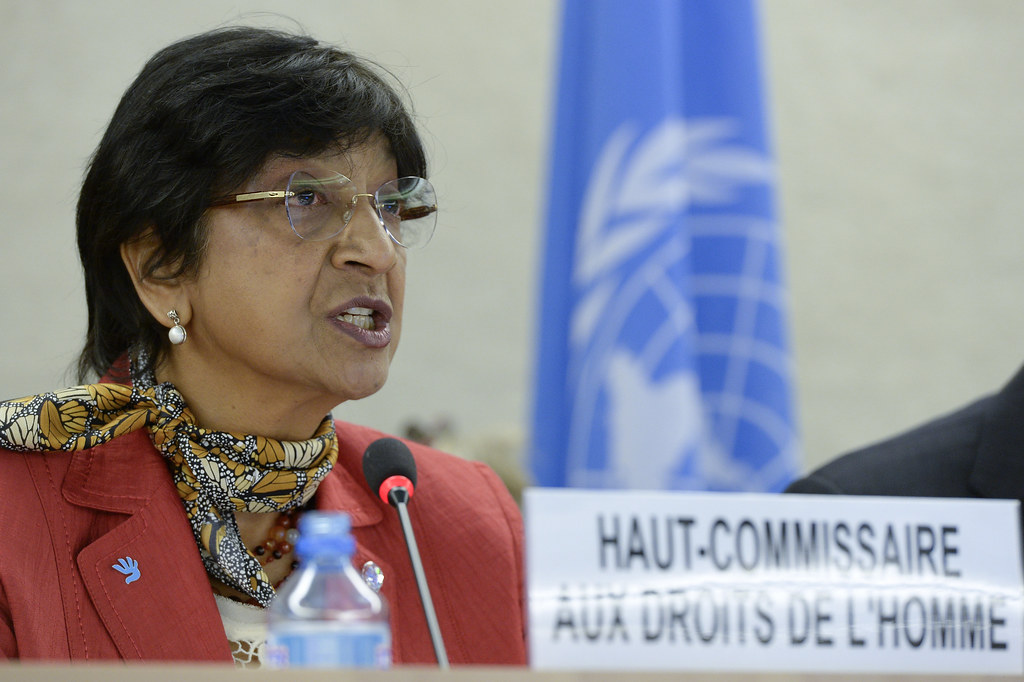
Featured Image: Navi Pillay, United Nations, High Commissioner for Human Rights during High Level Segment of the 25th Session of the Human Rights Council. 3 March 2014. (UN Photo / Jean-Marc Ferré)