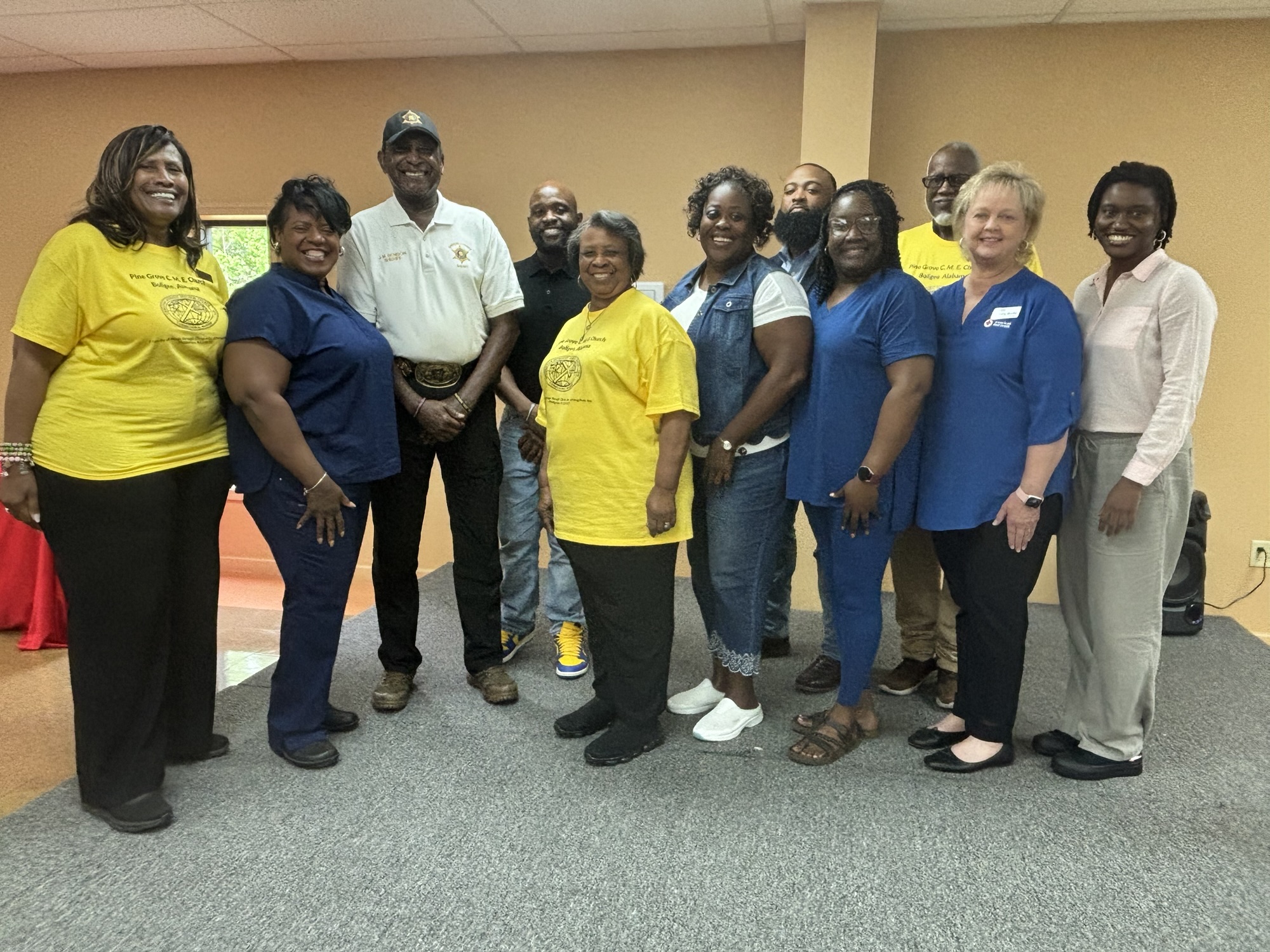
Above, Wille Esther Austin and Dollarhide Community Health Fair Presenters
by Maya Quinn, managing editor
On Saturday, April 18th, Dollarhide Community Center was full of vendors and city representatives who gathered to address a myriad of concerns in the community for their Annual Health Fair. The event was hosted by Pine Grove CME Church, Macedonia CME Church, and the Dollarhide Volunteer Fire Department. The invited presenters focused on the well-being and safety of its citizens as well as the need for higher community engagement from constituents.
Dollarhide’s community is upheld by its citizens’ dedication to one another, as many initiatives are operated on a volunteer basis. From storm relief to community resources, the citizens of Dollarhide and neighboring cities such as Boligee and Forkland strive to meet the needs of their community through benevolent commitments to one another. By working with organizations such as Greene County Community in Action Coalition, Greene County Sheriff’s Department, and the Rural Alabama Prevention Center, citizens collaborate to create programs that address concerns ranging from underage drinking to high blood pressure management. This health fair is only one of many events hosted within Greene County to better the everyday lives of all those who reside within.

The event’s program was led by Mrs. Willie Esther Austin, a member of Dollarhide’s Volunteer Fire Department and Pine Grove CME Church. Mrs. Austin welcomed guests and gave a quick summary regarding the purpose of the fair, to supply the community with health and safety resources. The program listed presenters from local governments, health organizations, and the Red Cross disaster relief. Prayers and scripture were intertwined with the program, reminding attendees that physical fitness and spiritual maturity are worth more than gold. “We do this every year,” Mrs. Austin told The Democrat.
After a prayer for good health, the fire department began the presentations with a demonstration on how to properly use an extinguisher and the importance of smoke detectors in the home. Fire Chief Keith Young reminded attendees that home fires often begin in the kitchen, so having a fire extinguisher nearby could prevent the loss of life or a home. Attendees were given the acronym PASS: Pull the pin, Aim the hose, Squeeze the trigger, Sweep the flames side to side.

The fire safety demonstration was followed by the EMS Board Director and CEO of Hills Hospital, Mrs. Loretta Wilson, giving a call to action for community members to support the ambulance services. Due to the financial and operational negligence of the previous administration, the EMS services of Greene County are threatened with closure. Wilson explained that there is only one operational emergency vehicle that serves the entire 647 square miles of the county. “We all own the emergency services,” she stated before asking for community members to offer assistance in reaching out to their commissioners and mayors. The EMS services are a nonprofit organization, meaning all proceeds and donations go directly to operating its services.
Shawn Jackson, born and raised in Forkland, AL, gave a presentation on oncology, the branch of medicine that specializes in researching and treating cancer. Jackson graduated from UAB and has been working in radiation therapy for the last 25 years. “We used to equate cancer with death,” Jackson stated before explaining that medicine has advanced in such a way that early detection is a critical factor in treatment outcomes. “The most important thing is to get your screenings,” he explained. Jackson also encouraged attendees to support members of their communities with reminders for screenings and organizing carpools so appointments are not missed or delayed. “When you hear cancer, there is no need to be afraid…remember hope.”
Special guest US Marshall and Officer Jeremy Rancher encouraged community elders to be watchful of vaping paraphernalia, as it is often masked by sweet scents that target teens and children, and underage drinking. Officer Rancher implored citizens to use him as a resource in their schools and gatherings. “Invite us out,” he began, “You never know whose life you’re gonna save.” Rancher states that his team can provide demonstrations on the dangers of drunk driving by letting teens wear impaired vision goggles while riding in ATVs. Greene County’s Sheriff Department and the Greene County Children’s Policy Council echoed the sentiment of using them as a resource as well.
Transitioning to health and wellness, Mr. Nathaniel Jones gave a testimony on the horrors of addiction. Jones explained that he was a first-generation college graduate and had a loving family, with children who excelled in school, but addiction “cares nothing about demographics” and is mind-altering. “I was in a prison mentally,” he began, “You do not want to mess with this…” Jones is now 7 years clean and talks to the youth in his community about the dangers of addiction to illegal and prescription drugs, alcohol, and smoking. Jones received roaring applause for his stories and reminded attendees to seek help from God and the church.

Dollarhide invites community members and friends to attend the community meeting every third Monday of the month at Dollarhide Community Center, located next to the fire department.