Tag: PTSD

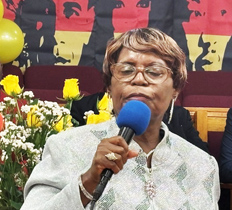
  • “5th Little Girl”, Sarah Collins Rudolph, sole survivor of the 16th Street Baptist Church bombing in Birmingham speaks at Second Baptist Church Black History program

    “5th Little Girl”, Sarah Collins Rudolph, sole survivor of the 16th Street Baptist Church bombing in Birmingham speaks at Second Baptist Church Black History program

    by John Zippert, co-owner

    On February 15, Second Baptist Church hosted a Black History program that brought Sarah Collins Rudolph to Greene County to talk about her experience as the sole survivor of the September 15, 1963 bombing, by the Klu Klux Klan, of the 16th Street Baptist Church in Birmingham. Sarah Collins Rudolph was the younger sister (aged 12 at the time) of Addie Mae Collins, one of four girls tragically killed in the bombing of the church, in the midst of the Civil Rights Movement.


    Sarah Collins Rudolph was in the ladies restroom in the basement of the 16th Street Baptist Church, with four other young ladies – her sister Addie Mae Collins, Denise McNair, Carole Robertson and Cynthia Wesley, all 14 years old. They were taking a break between Sunday School and a Youth Day program at the church.


    When the bomb exploded around 10:22 in the morning, Sarah Collins Rudolph said she had just walked across the rest room from the other four to wash her hands in the sink. The Klan placed the bomb in an outside stairway that led to the basement that was adjacent to the women’s rest room. The last thing she remembers before the blast, was Denise McNair asking her sister Addie Mae Collins to adjust a sash on her dress.


    Four of the girls were killed instantly by the blast and Sarah survived with serious injuries from the bomb, including glass and other fragments that cut her eyes, face, arms, legs and other parts of her body. She was rescued and sent to the hospital by the first church members that dug through the rumble from the explosion.


    Sarah was confined to the hospital for weeks after the explosion. She was blind in her right eye and had it replaced with a prosthetic eye. Her many cuts healed leaving visible scars both physical and psychological. She says, even today, when she hears loud noises, she revisits the terror of the bomb explosion. She relates this to PSTD experience by soldiers in war, reliving their combat experiences.Sarah was not able to attend the funerals of her sister and the other three girls because she was in the hospital. When she returned to school, she received no special counseling or other assistance to adjust to the explosion which changed her life.


    She finished high school and then worked in various capacities at industrial fabrication plants and domestic work, taking care of elderly and sick people. She married three times. She said that she eventually found a church in Birmingham that helped her to understand that by accepting Christ and his teachings could help her to live a fuller and more meaningful life.


    She testified at the trials of the three KKK members, who were eventually brought to justice for the horrendous crime of bombing the church in 1963, including ‘Dynamite Bob” Chambliss, Frank Cherry and Thomas Blanton.
    In the mid 1990’s more than thirty years after the bombing, she began giving interviews and speaking out about her life and experiences. She tried unsuccessfully to get compensation for herself and families of other victims of racial and civil rights crimes. So far she has been unsuccessful in getting any compensation from the state of Alabama or the Federal government, for her injuries and suffering from the 1963 bombing of the church.


    In her travels to speak on the bombing and being the only survivor, she met Tracy Snipe, a professor at Wright State University in Ohio, where he teaches history, politics and related subjects. Snipes collaborated with Sarah Collins Rudolph to write a book on her life including the 1963 bombing. The book is entitled “the Fifth Little Girl”. At the end of the Second Baptist Church Black History Program, participants were able to purchase copies of her book ($30.00) and have it inscribed to them by her.
    The program at Second Baptist Church was sponsored by United Purposes, and its community partners. The organization is headed by Miriam Leftwich, who organized the program and introduced Ms. Rudolph. The program also featured information on Black History, singing, poetry reading , and a liturgical dance presentation, mostly by young people to honor the guest speaker.


    This program had a very profound impact and impression on this writer and others who attended the program and were not aware that there was a fifth little girl, who survived the bombing , that has lived another more than six decades to give first-hand testimony about one of the most consequential events of the Civil Rights Movement and Black History in America.

    Sarah in the hospital with both eyes bandaged from the bomb explosion
    Sarah in the hospital with both eyes bandaged from the bomb explosion
  • Newswire : Black Americans face unequal burden as U.S. inches closer to war

    By Stacy M. Brown
Black Press USA Senior National Correspondent

    As the United States edges closer to possible military action against Iran, history signals a familiar reality for Black Americans: disproportionate risk, unequal support, and a long legacy of being asked to sacrifice more while receiving less. From World War I through Iraq and Afghanistan, Black servicemembers have routinely been overrepresented in combat roles and underrepresented in decision-making positions.
    Today, although Black Americans make up just over 13% of the U.S. population, they account for nearly 19% of active-duty Army personnel. “When the U.S. goes to war, Black Americans, whether as civilians, enlisted personnel, or military families, often carry a disproportionate share of the burden,” Liscah R. Isaboke, Esq., Managing Partner at Isaboke Law Firm, PLLC, told Black Press USA.
    “Historically, Black service members have been overrepresented in frontline and high-risk roles while underrepresented in officer ranks,” Isaboke said. “This exposure results not only in increased physical danger, but also long-term disparities in access to VA benefits, career advancement, and mental health care upon return.” That overrepresentation is linked to greater economic inequality. 

    Recruitment data shows the military draws heavily from low-income communities, and Black Americans—more likely to face systemic barriers to college and employment—are disproportionately represented among enlistees seeking stability, education, or opportunity. Once enlisted, they are less likely to be promoted into leadership roles, often due to bias in evaluation and selection processes.

    According to the VA’s National Health Study, 21.9% of deployed Black veterans screened positive for PTSD, compared to 14.1% of white veterans. Studies have shown that Black veterans are less likely to receive long-term, culturally competent mental health care and face more barriers to follow-up treatment. Military justice records also reveal that Black service members are more likely to face court-martial than their white counterparts.

    “Black Americans have historically been overrepresented in the U.S. military while being under-protected both at home and abroad,” Cazoshay Marie, a disability advocate, artist, and writer, wrote in an email to Black Press USA. “From the disproportionate impact of PTSD and other invisible war wounds among Black veterans to the lack of adequate support upon returning home, the psychological and socioeconomic costs of war weigh heavily.” “Increased military spending often coincides with the defunding of essential programs—education, healthcare, and community infrastructure—which are lifelines in our communities,” Marie said.
    Those federal divestments have long-term consequences. During the post-9/11 wars in Iraq and Afghanistan, it’s estimated that the U.S. spent over $6 trillion on military operations, interest payments, and veteran care. As those expenses ballooned, domestic programs—including housing subsidies, public education investment, and job training—faced cutbacks. Black Americans, already on the receiving end of wealth gaps and institutional neglect, felt those losses acutely.
    In their February 2024 essay “The Race Gap That Shapes American Views of War,” published in Foreign Affairs, Naima Green-Riley of Princeton University and Andrew Leber of Tulane University wrote that Black Americans have consistently been less likely than white Americans to support U.S. wars abroad. The authors cited not only political and moral skepticism but also a deeply rooted sense that these wars are carried out in the name of democracy while offering little tangible benefit to Black communities. “Black Americans are more inclined to ask: Is this war just? Will our people gain anything from it? And what are we sacrificing for a country that so often withholds justice at home?” Green-Riley and Leber wrote.

    The article pointed to cultural responses, including KRS-One’s 2008 track “Our Soldiers,” which critiques the Iraq War and opens with a siren that initially evokes U.S. policing. The song’s hook, “Frontline of the political war,” highlights a dual consciousness: the experience of fighting abroad while being targeted and marginalized at home. “As a historian of public health and policy, I can say that when the U.S. goes to war, Black Americans often shoulder a disproportionate share of both the burden and the consequences—on the battlefield and at home,”
    Dr. Zachary W. Schulz, of the Department of History at Auburn University, told Black Press USA. “Historically, military service has been a double-edged sword for Black Americans,” Schulz said. “From the Civil War through Iraq and Afghanistan, Black soldiers have fought for freedoms abroad they were denied at home. Military service offered mobility, education, and sometimes even a pathway to civil rights advocacy—as in the case of the Double V campaign during WWII—but it also exposed Black personnel to racism within the ranks, limited advancement opportunities, and post-service disparities in veteran care.”
    “Civilians are also deeply affected,” Schulz said. “Wars often fuel economic shifts and labor demands that open up jobs for Black workers—only to see those gains reversed when the war ends. Wartime policing and surveillance disproportionately target Black communities, and anti-war protest movements led by Black activists—think Muhammad Ali or Martin Luther King Jr.’s ‘Beyond Vietnam’ speech—have historically met with state suppression and public backlash.” “The impact is layered,” Schulz added. “Black Americans are overrepresented among the fighters, under-resourced in the aftermath, and frequently erased from the national narrative of sacrifice.” “We must tell the full truth,” Isaboke concluded. “Black Americans have always shown up for this country, even when this country has not always shown up for them, especially in times of war.”