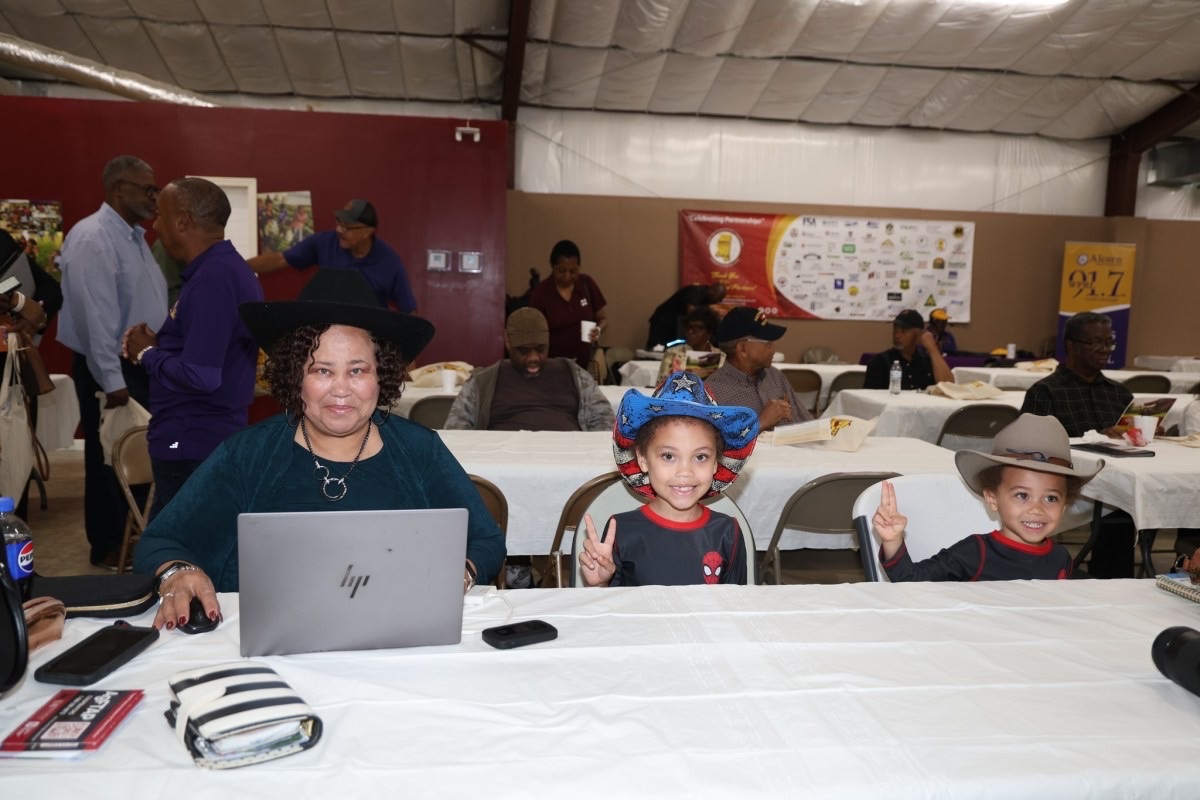
Above, Eloris Speight, former director of Alcorn’s National Policy Research Center, sits with young farmers-in-training at the conference. (Courtesy of the National Policy Research Center)
by Aaliyah Wright, Capital B News
SHANNON, Mississippi — What seemed like almost an empty building on a recent Saturday morning quickly filled with dozens of Black people — from retired federal employees to university officials and even education and land appraisal experts.
They greeted one another while signing in at the Saving Rural America Small Farmers Conference. Some hugged before grabbing breakfast. Others stopped by Alcorn State University’s table, where a live broadcast took place.
One thing all the participants and speakers had in common: They were farmers, ranchers, or worked directly with producers. Some were local to the area, located about 10 miles south of Tupelo and about 2 hours from the state capital of Jackson. Others said they drove at least three hours. Many attend the half-day conference every year, hosted by the Mississippi Minority Farmers Alliance and Coalition of Farmers.
By 8:30 a.m., they’d all taken their seats.
In a hyper-political climate where resources and support to help farmers have dwindled, this group didn’t focus on the challenges brought on by the Trump administration’s policies and changes to federal programs. Instead, they gathered to talk about how this moment is an opportunity to inspire the youth and build partnerships together. And they aren’t the only ones.
Across rural America, Black producers in agriculture shared concerns about the U.S. Department of Agriculture’s continuing efforts to eliminate grants, but they’re not exhausting their energy on navigating such challenges. From Georgia to New York and even in Kentucky, farmers are inviting their own to lead conversations, workshops, and spend time in their communities. In June, the Texas International Ranchers and Farmers will host a three-day convening for farmers and students in rural Nacogdoches.
When Tiffany Bellfield El-Amin started planning for her organization’s conference, the news hit that Supplemental Nutrition Assistance Program benefits would be delayed. Some funders could no longer support the Kentucky Black Farmers Association, the organization she founded. They realized they couldn’t really rely on the government as they once did. After conversations with farmers, they exclaimed, “We got us,” which birthed the theme for this year’s conference focusing on culture, connection, and collective power.
“The funding that we usually received was in partnership with Kentucky State University, and we realized that because of their federal funding, they wouldn’t be able to fund it, either. So ‘We got us’ got even deeper,” Bellfield El-Amin said. “[We said], ‘We’ll figure it out.’ Everybody can bring a dish. We can do this family reunion style.”
The importance of cultivating a space of collective care, addressing farmer’s needs, and knowing where the resources are is critical, she added. Some participants refused stipends. Others showed up, even though their employers couldn’t pay for them to come. Students attended, too, and got to experience the farms.
“Food was sourced locally from our Black farmer members. We had Black bourbon, Black wine and spirits. We had steppers come in from Louisville, Kentucky. We had people camp out at the farm,” Bellfield El-Amin said. “It felt like the best family reunion, like I was with all my cousins, and we’re trying to figure out how we’re going to maintain and sustain ourselves and our communities.”
Many panelists at the Shannon convening shared resources to help farmers and reemphasized their commitment to farming. As Carolyn Jones, director of the Mississippi Minority Farmers Alliance, put it, it’s time to cut the noise and “surround ourselves with positivity.”
Experts like Eloris Speight, former director of the National Policy Research Center at Alcorn State, shared information about farm business protection programs. Mississippi State University professor Kevin Kim provided an overview of projected market conditions, and Walter Jackson, an agronomy consultant and cattle rancher, told the audience about a regenerative agriculture initiative. There were also sessions led by local pastors on religion and the community and a panel on health and wellness, while other panelists brought awareness of potential business opportunities.
Take Malone Buchanan, for instance. He’s a retired forester who owns a pine timber company. He emphasized the importance of timber and how others can take advantage of foresting operations.
“Whatever county you’re in, you need to know who the movers are, who the shakers are, and you need to know where the money comes from,” Buchanan said. “I would like to grow my business with some new younger people.
The power of the next generation of farmers
Kameka Cole-Gray emphasized the importance of youth in agriculture. Cole-Gray works as the 1890 National Scholars Program’s USDA program liaison for Alcorn State and Southern University. She celebrated the students who she works with, including Gary McGhee, an agriculture economics major at Alcorn State.
McGhee doesn’t come from a farming family, but he became interested in the agriculture industry when a mentor allowed him to tour farms and learn about the business side of farming — from selling crops and livestock to owning land, he said. It pushed him to secure an internship with the USDA.
“Hearing different people’s different perspectives on agriculture means a lot to me, so I can learn more and gain as much knowledge as possible and hopefully be my own professional in the ag field,” he said. “Hopefully I get my own farm one day.”
The current climate and the reality of a declining Black farmer population hasn’t deterred McGhee from entering the profession, he said. If anything, it’s encouraged him to get his friends involved.
“It’s a lot of older Black farmers and not enough young farmers, and I think that comes from not enough exposure,” he added. “I got a lot of friends that don’t know about agriculture, but now they see me doing it and they want to know more about it.”
In the room, on this day, everyone had everything they needed to be successful, John Jones, a retired conservationist and USDA Natural Resources Conservation Service employee, told the group.
“I just want you all to keep the faith, keep hope alive, because they can’t take it away from us,” he said. “We have nothing to fear.”
