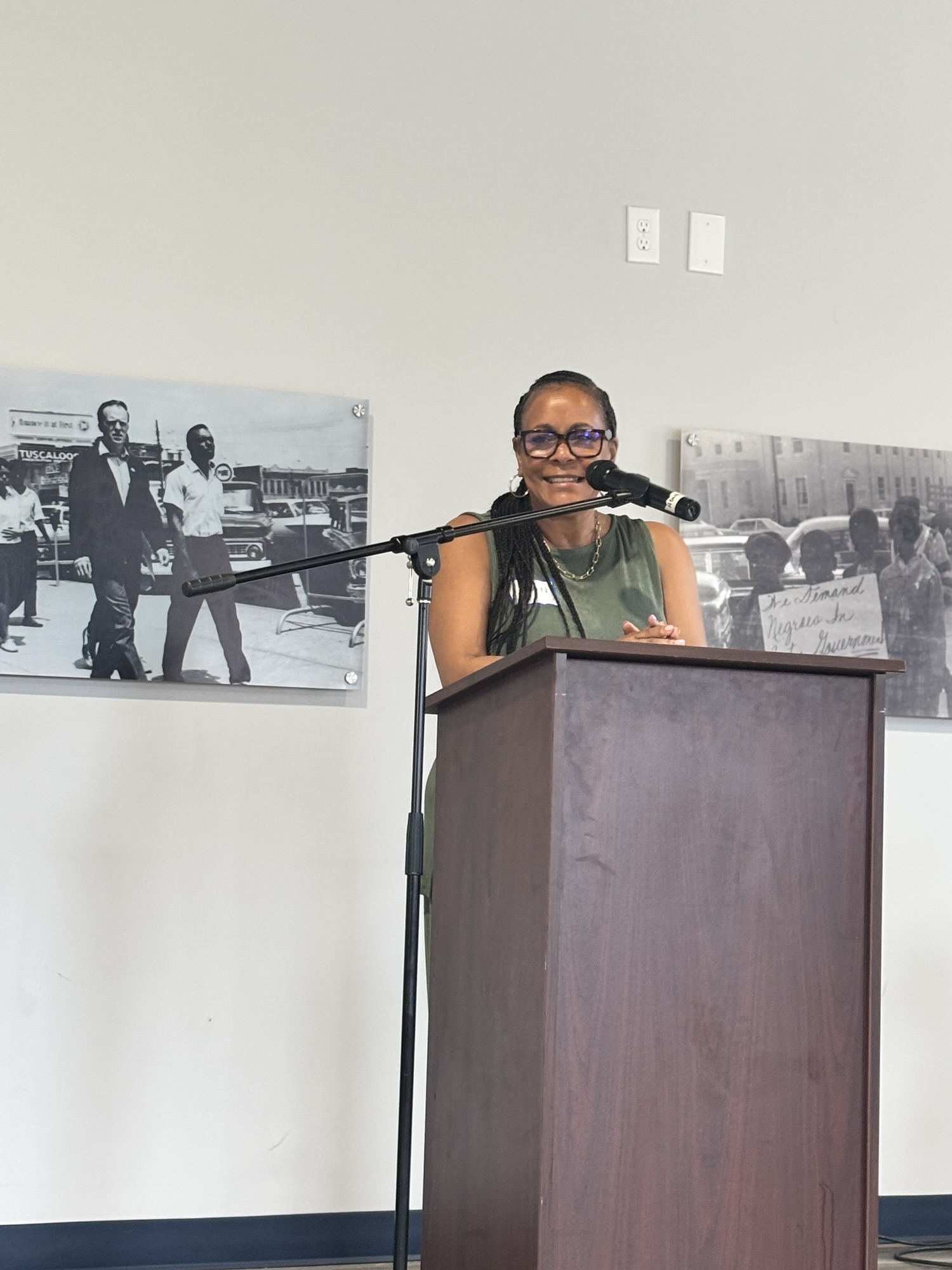
This March, Stillman College’s Civil Rights History Project supporters and coordinators hosted a luncheon to honor the legacy of James Joseph and alumni who made instrumental contributions to the civil rights movement of the 1960’s. The alumni mentioned and in attendance exemplified Stillman’s commitment to serving their community by producing exemplary leaders.
The program began with an introduction from Gordon Govens, associate professor and executive director of Social Justice Initiatives. He informed attendees that the Civil Rights History Project aims to create a gallery to honor approximately 350 Stillman students who participated in the movement. “This is life-defining work,” Govens stated before he detailed the need to expand the gallery to display the photos of every alumnus involved. Current Stillman students are researching records previously withheld from the public and oral stories. Govens and students hope to raise $150,000 for expansion and to continue the project, as older records and footage are in desperate need of restoration.
Sara Smith, the first white student at Stillman College and organizer of the Civil Rights History Tour 2026, humbly acknowledged everyone in attendance. “I was just here one semester… it was so powerful to me, Susan stated as she recounted how the opportunity to march alongside black students changed her life.
Following the welcome, keynote speaker Susan Taylor Batten, President and CEO of ABFE: A Philanthropic Partnership for Black Communities, took to the podium. She began by acknowledging former faculty member and U.S Ambassador to South Africa James Joseph as a “giant of a man.” Joseph helped initiate the local civil rights movement with the help of Stillman students. Joseph organized marches to protest segregation at the city hall from 1963 to 1964. After having his life threatened and surviving a beating by Ku Klux Klan members and state troopers, Joseph pursued a career in philanthropy that “changed the trajectory of philanthropy in this country,” by creating ABFE, originally the Association of Black Foundation Executives, with a group of Black professionals. The group promoted effective and responsible philanthropy by establishing pipelines and pathways into careers for people in Black communities who would otherwise be denied opportunities. Batten stated in her speech that Joseph knew the ABFE had a responsibility to lead and inspire others. Today, the ABFE continues to provide healing, hope, and reconciliation for those in economically disadvantaged populations.
Historically black colleges (HBCUs) like Stillman developed teachers, lawyers, clergy, and leaders who shaped the civil rights movement. HBCUs provide a haven for black students, with ideals rooted in equity for others. “When you go to Stillman, you can do anything,” alumnus Terrence Brown began in closing, “Everything I learned about people and leadership, I learned here.” Brown is currently the Director of the 16th Street Baptist Church and Visitor Center, a multipurpose facility set to open in 2027, in Birmingham.
The colors of Stillman College are navy blue and Vegas gold, chosen to represent stability, tradition, excellence, prestige, and high standards. As the only four-year HBCU in West Alabama, these colors adequately represent a university that prepares students to excel at uplifting their communities. Time spent at Stillman and networking with its alumni can ultimately change one’s trajectory.
Leave a Reply