Category: Crime

  • Newswire : Why Black History Month matters at 100 more than ever

    Abstract depiction of a diverse crowd with colorful silhouettes of faces and heads.

    By Shannon Dawson, NewsOn
    This year marks the 100th anniversary of Black History Month. As we reflect on our stories, this centennial is not only a moment of celebration but a call to urgency, a reminder that protecting, preserving, and uplifting Black history matters now more than ever.
    Let’s take a look back at how we got here and why this year carries such deep significance.
    Black History Month traces its roots back to 1926, when historian Carter G. Woodson and his Association for the Study of Negro Life and History launched Negro History Week. Woodson, the son of formerly enslaved parents, understood something radical for his time: that the absence of Black history in American education wasn’t accidental; it was structural.
    Woodson witnessed firsthand that racial discrimination was not simply a social reality; it was enforced by law. Segregation was codified across nearly every aspect of public life, with states mandating separate transportation, schools, and public spaces for Black and white Americans. From buses and trains to classrooms, water fountains, hospitals, and even courtrooms, these laws institutionalized inequality and shaped daily life, reinforcing a system designed to exclude and marginalize Black communities.
    In response to this reality, Woodson created Negro History Week, driven by a sense of urgency and the belief that change had to begin with education. He was determined to ensure that Black children, and the nation as a whole, were exposed to Black history. Woodson chose the second week of February to coincide with the birthdays of Abraham Lincoln and Frederick Douglass, figures long honored within Black communities.
    Negro History Week was not born in a vacuum. The 1920s marked a flourishing of African American cultural expression through the Harlem Renaissance, as noted by the National Museum of African American History & Culture. Writers such as Langston Hughes, Georgia Douglas Johnson, and Claude McKay explored the joys and struggles of Black life, while musicians like Louis Armstrong, Duke Ellington, and Jimmy Lunceford captured the rhythms of a changing urban America shaped by the Great Migration. Visual artists, including Aaron Douglas, Richmond Barthé, and Lois Mailou Jones, created powerful images that celebrated Black identity and offered affirming representations of the African American experience.
    Woodson hoped to build on this momentum, using Negro History Week to further spark curiosity, pride, and sustained engagement with Black history and to challenge a national narrative that erased Black contributions, giving Black communities a way to tell our own stories in classrooms, churches, and civic spaces.
    Teaching Black history was an act of resistance against a society invested in forgetting.
    What began as a week quickly grew beyond Woodson’s original vision, not because the work was finished, but because it became clear that a week was never enough. By the 1960s and ’70s, amid the Civil Rights and Black Power movements, educators and students pushed for broader recognition. In 1976, the U.S. officially designated February as Black History Month, with President Gerald Ford recognizing the month, according to AP News. 
    The expansion reflected both progress and tension. On one hand, Black history gained national visibility. On the other hand, it risked being contained, treated as an add-on rather than as foundational to American history. The month became a compromise: acknowledgment without full integration.
    Still, communities used the space creatively, building archives, hosting lectures, preserving oral histories, and insisting that Black history was not a niche subject, but central to understanding the nation itself.
    This February, we mark the 100-year anniversary of this incredible commemoration, and the work of preserving, protecting, and honoring Black leaders and communities is far from finished. Reaching this milestone is not just symbolic; it’s urgent. We are living in a moment where Black history is actively being censored in schools and other educational institutions, where DEI initiatives are under attack, and where deliberate historical erasure is becoming policy, not coincidence.
    In 2025, President Donald Trump signed “Ending Radical Indoctrination in K–12 Schooling” (Executive Order 14190), an executive order aimed at removing what it labels “specific ideologies” from public education and reorienting schools toward so-called “patriotic education.” In practice, the order significantly restricts how Black history, and particularly the history of slavery and systemic racism, can be discussed in classrooms. By redefining discussions of equity and racism as “discriminatory,” it creates a chilling effect on honest teaching. That we are living in a time when truth itself is treated as a threat should alarm us all.
    Across the country, school districts are banning books, limiting how race can be discussed, and reframing accurate history as “divisive.” The Bluest Eye by Toni Morrison and All Boys Aren’t Blue by George M. Johnson are just a few of the many works that have been targeted. These aren’t isolated decisions; they are part of a broader effort to control the narrative of America’s past, and we can’t let it happen. 
    While Black history should be taught and celebrated year-round, Black History Month remains a powerful and necessary space to ensure our stories are told truthfully and to push back against policies designed to erase the contributions and sacrifices Black Americans have made.
    The centennial forces an essential question: What happens if we stop telling these stories? The answer is already visible. When Black history is minimized, inequality becomes easier to justify. When contributions are erased, power appears natural rather than constructed.
    Remembering Black history, publicly, loudly, and accurately, is not nostalgia. It is a defense against revisionism. It is a refusal to allow the past to be rewritten to serve the present.
    And finally, Black history must move beyond February. The goal has always been year-round integration, where Black experiences are woven into how we teach literature, science, politics, labor, and culture, rather than reduced to a single month.
    If the first 100 years were about fighting to be seen, the next 100 must be about refusing to be confined. Black history isn’t a supplement. It’s a foundation, and the future depends on how well we protect it.

  • Newswire : New Postal Service rule could quietly void ballots and delay healthcare

    Newswire : New Postal Service rule could quietly void ballots and delay healthcare

    By Stacy M. Brown
NNPA Newswire Senior National Correspondent

    A quiet clarification by the United States Postal Service is drawing renewed scrutiny after health care advocates and voting rights observers warned that the change could carry serious consequences for millions of Americans who rely on postmarks to meet legal deadlines.
    Under new USPS guidance that took effect late last month, the date printed on a postmark no longer reflects when a letter or ballot is dropped into a mailbox. Instead, the postmark now reflects the date the mail is first processed at an automated sorting facility, which can occur days after the item is mailed. The Postal Service says the change is intended to clarify how postmarks are applied, particularly as transportation schedules and regional processing systems evolve.
    For voters in states that count mail-in ballots based on postmark deadlines, and for patients navigating appeals, authorizations, and Medicare paperwork, the distinction is anything but academic.
    “In recognition of the importance that the election laws in some states place on postmarks, it has been the longstanding policy of the Postal Service to try to ensure that every return ballot mailed by voters receives a postmark, whether the return ballot is mailed with postage pre-paid by election officials or with a stamp affixed by the voter,” officials wrote in a release. “A voter can ensure that a postmark is applied to his or her return ballot by visiting a Postal Service retail office and requesting a postmark from a retail associate when dropping off the ballot.”
    The issue gained wider attention after a detailed explanation circulated to millions of viewers on social media from the account @cjnlegalnurse, a health care advocate who outlined how the rule shift moves risk away from institutions and onto individuals.
    “The postmark rule changed quietly, and it affects voting and health care. Let me explain what just happened at USPS because this is not minor and it’s not theoretical,” the user said. “So as of this week, the United States Postal Service clarified that a postmark date is no longer tied to when you drop your mail off. It’s tied to when that mail is first processed by an automated facility.”
    As the user explained, a letter placed in a mailbox on Monday may not reach a sorting center until Wednesday, making Wednesday the official postmark. For ballots and legal filings governed by strict deadlines, that delay can mean rejection despite timely mailing.
    “Many states say a mail-in ballot counts if it’s postmarked by election day,” the user said. “Under this rule, you can mail your ballot before election day and still have it postmarked after. So that’s not voter fraud, that’s logistics quietly overruling intent.”
    USPS guidance confirms that most postmarks are now applied at large processing plants rather than local post offices and that mail may sit before receiving a postmark due to updated transportation schedules. The agency recommends that customers with deadline-sensitive mail bring items directly to a post office counter and request a manual local postmark.
    Health care advocates say the implications extend far beyond elections.
    “Health care runs on mail deadlines, appeals, prior authorizations, Medicare notices, and prescription paperwork,” the user said. “If an appeal has to be postmarked by a certain date and USPS processes days later, it looks late. So late appeals get denied. Denied appeals delay care.”
    The user said the shift places the burden squarely on individuals navigating already complex systems.
    “In nursing and health care advocacy, timing is everything,” the user said. “And this rule shifts the risk from the institution back to the patient. The system didn’t get faster, the rules just got tighter.”
    “So if you’re mailing anything time-sensitive now, ballots or health care documents, dropping it in a box is not enough,” the user said. “Go inside the post office for deadline mail. Ask for a manual postmark or receipt. Use certified mail for appeals and legal documents, and do not rely on blue mailboxes for last week’s deadlines. So, this isn’t panic; it’s adjustment.”

  • Newswire : Don Lemon made the headlines, but Georgia Fort’s arrest shows no journalist Is safe

    A professional portrait of a woman in a pink blazer and a man in a tuxedo, both posing confidently against a grey background.

    Georgia Fort and Don Lemon

    By Stacy M. Brown
 NNPA Newswire Senior National Correspondent

    Famed journalist Don Lemon may draw the headlines, but Emmy-winning independent reporter Georgia Fort and Trahem Jenn Crews and Jamael Lydell Lundy were also taken into custody as federal agents moved against four Black journalists whose only apparent offense was documenting protests critical of the Trump administration’s immigration crackdown.
    Lemon, a veteran broadcaster and longtime critic of President Donald Trump, was arrested late Thursday night in Los Angeles after livestreaming an anti-ICE demonstration connected to a January protest at a St. Paul, Minnesota, church. A short time later, Fort, a respected Minnesota-based journalist, was arrested by federal agents in her home state for reporting on the same protest, according to public statements and court records.
    Los Angeles Mayor Karen Bass said the arrests signal a dangerous escalation by the Trump administration rather than any attempt to ease tensions following the fatal shootings of civilians by federal agents in Minnesot. She said Lemon was simply doing his job when agents arrested him and stressed that Fort’s detention made clear this was not an isolated incident but a broader assault on press freedoma.
    Federal authorities revived charges tied to a protest at Cities Church in St. Paul after a magistrate judge had already declined to approve arrest warrants against Lemon and others, citing insufficient evidence. Prosecutors then pursued indictments through a grand jury, a move civil liberties advocates say appears designed to sidestep judicial scrutiny and chill coverage of protests against ICE operations.
    Fort documented her own arrest in a brief livestream as agents arrived at her door, telling viewers she was being taken into custody for filming the protest as a member of the press. Her arrest, announced publicly by Attorney General Pam Bondi, placed an Emmy-winning journalist alongside protesters in a case the administration has described as a coordinated attack.
    Civil rights leaders said the symbolism was unmistakable. Rev. Al Sharpton, founder and president of the National Action Network, said Lemon’s arrest marked a direct blow against the First Amendment and warned that journalists critical of the president were being singled out.
    Press freedom advocates echoed those concerns. Lisa Gilbert, co-president of Public Citizen, said the arrests represent a constitutional crisis for journalism in the United States, adding that reporters have the right to document and share information with the public without fear of retaliation.
    Mayor Bass said she contacted the U.S. attorney to demand information about Lemon’s status and warned that arresting journalists for entering a church while reporting crosses a line the Constitution was written to prevent. “It’s an egregious assault on constitutionally protected First Amendment rights,” Bass said.

  • Tennyson Smith announces candidacy for re-election for Commissioner, District #2

    A well-dressed man with a gray beard, wearing a suit and tie, standing in front of a brick wall.


    To the Citizens of Greene County and Voters of District 2. When I took the oath of an elected official years ago, I pledged to do my best to help improve Greene County and District 2. Today, I am pleased to say, I have done my best to uphold that pledge. Each decision and vote were made with you, the citizens, and voters of District 2, in mind. I am seeking reelection as Greene County Commissioner of District 2 in the May 19, 2026 Primary Election.
    *I am dedicated to the task that is before me.
    *I am available to you whenever you need me.
    * I operate an Open-Door Policy; no appointment is needed to see me.
    *I will continue to return each of your calls and check on and resolve all concerns and problems.
    Vote to re-elect experienced, Knowledgeable and Ready to Serve!

  • Mayor Corey Cockrell and Eutaw City Council hold meetings

    By John Zippert,
    Co-Publisher

    This is a report of the Eutaw City Council regular meeting on January 27, 2026, and a Community Informational Meeting, the next day on January 28, 2026 also at Eutaw City Hall.
    The January 27th meeting of the Eutaw City Council dealt with routine business. The Council approved a 020 Restaurant Retail Liquor License for Main Street Grill. Representatives of Main Street Grill were present and thanked the Council for its support.
    The Eutaw City Council also agreed to approve payments for required training courses provided on on-line for the Mayor and Council members. The Council also approved a $200 registration fee for Councilwoman Carrie Logan to attend the National League of Cities Conference in Washington, D. C. On March 16-18, 2026. Later in the meeting, the Council approved registration and travel expenses if other council members wanted to attend this NLC Conference.
    The Eutaw City Council reappointed James Powell to the Eutaw Housing Board. They also approved payment of monthly bills.
    Mayor Cockrell in his report recognized Julia Carter, the new Water Clerk, who will be handling billing and collection for the Water Department. The Mayor also explained he was working on steps to improve the conditions of the City Hall, tennis courts, National Guard Armory and Robert H. Young Community Center (formerly Carver School) and other City owned facilities so they could be fully utilized by city residents.
    The January 28, 2026 Community Meeting, was one of several that the Mayor has set up around the city to provide information to residents, most of the City Council members also attended this meeting.
    The first item on the agenda dealt with the operation of the Water Department. The Mayor asked anyone with complaints about the quality of water, coloration, or billing to contact him and the Water Department in City Hall to correct the problems. Payment plans can be developed for high water bills, caused by leaks. Insurance is also available, at moderate cost, to cover leaks on the resident’s side of the meters. Mayor Cockrell urged everyone to pay their water bills on time, to avoid late charges, and allow the system to operate properly.
    The next agenda item concerned improving the community appearance by not littering and not putting furniture, appliances, electronic devices or other large materials by the side of the road. The Mayor said the City was arranging a schedule to pick up furniture and other large items.
    Before placing any items, other than tree limbs and other organic yard waste, on the side of the road, contact City Hall and arrange for pick-up. A ‘Community Clean-up Day’ will be held on Saturday, April 11, 2026 to help pick up litter and beautify the city.
    The Mayor also advised that the Police Department would be enforcing ’Noise Ordinances’ which prohibit playing loud music, especially at night, when other residents and neighbors are asleep. The Mayor introduced Kendrick Howell, Chief of Police who said he was running a ‘community oriented police force’ with an open door policy and was ready to meet with citizens and businesses to improve public safety in the city.
    The Mayor also mentioned his efforts to repair and improve major city owned buildings so that they could be fully utilized for activities to improve quality of life for residents. The next Community Meeting will be held February 11 at the Presbyterial Church Fellowship Hall.

  • Newswire : Philadelphia sues after slavery exhibits were taken down from President’s House site

    Newswire : Philadelphia sues after slavery exhibits were taken down from President’s House site

     Staff dismantling slavery exhibit in Philadelphia

    The lawsuit says the National Park Service removed the displays referring to slavery “presumably pursuant to the mandate” of an executive order from President Donald Trump.

    By Joe Kottke and Phil Helsel NBC News

    The city of Philadelphia sued the Department of the Interior and the acting director of the National Park Service on Thursday over reports that slavery exhibits were being dismantled in the city’s historic district.
    The suit, filed in federal court, seeks a preliminary injunction to restore the exhibits at the President’s House Site, part of Independence National Historical Park.
    The lawsuit says that “the National Park Service has removed artwork and informational displays at the President’s House site referencing slavery, presumably pursuant to the mandate” of Executive Order No. 14253, which President Donald Trump signed in March. 2025.
    The city said in the suit that it learned Thursday that the educational panels that referred to slavery had been removed.
    “Removing the exhibits is an effort to whitewash American history,” Philadelphia City Council President Kenyatta Johnson said in a statement Thursday. “History cannot be erased simply because it is uncomfortable. Removing items from the President’s House merely changes the landscape, not the historical record.”
    NBC Philadelphia aired video Thursday that shows people with crowbars taking down panels, one of which reads “The Dirty Business of Slavery.”
    The suit says the city was given no notice about the change to the President’s House.
    It calls the removal of the displays “arbitrary and capricious.”
    “Defendants have provided no explanation at all for their removal of the historical, educational displays at the President’s House site, let alone a reasoned one,” the lawsuit says.
    White House spokesman Davis Ingle said Trump “continues to fulfill his promise to restore truth and common sense to the United States and its institutions.” 
    “President Trump is ensuring that we are honoring the fullness of the American story instead of distorting it in the name of left-wing ideology,” Ingle said in a statement. 
    A spokesperson for the Department of the Interior, which oversees the National Park Service, said “all federal agencies are to review interpretive materials to ensure accuracy, honesty, and alignment with shared national values” while it implements Trump’s executive order.
    “Following completion of the required review, the National Park Service is now taking appropriate action in accordance with the Order,” the spokesperson said in a statement.
    The National Park Service did not immediately respond to NBC News’ requests for comment late Thursday.
    Trump’s executive order directs the Department of the Interior in its materials not to include “descriptions, depictions, or other content that inappropriately disparage Americans past or living (including persons living in colonial times).”
    It instructs the department to “instead focus on the greatness of the achievements and progress of the American people or, with respect to natural features, the beauty, abundance, and grandeur of the American landscape.”
    The order, titled “Restoring Truth and Sanity to American History,” has been criticized.
    The American Historical Association said it “egregiously misrepresents the work of the Smithsonian Institution,” which the executive order criticized by name.
    “Historians explore the past to understand how our nation has evolved. We draw on a wide range of sources, which helps us to understand history from different angles of vision,” the group said March 31.
    “Our goal is neither criticism nor celebration,” it said. “It is to understand — to increase our knowledge of — the past in ways that can help Americans to shape the future.”
    The President’s House is a site where President George Washington resided in Philadelphia, and he brought slaves who were in the home, according to the lawsuit and the National Park Service’s webpage about the site. President John Adams also lived there.
    A spokesperson for the National Parks Conservation Association said the dismantling of the exhibit is “an insult to the memory of the enslaved people who lived there and to their descendants.” and “sets a dangerous precedent of prioritizing nostalgia over the truth.”
    The House of Representatives urged the National Park Service in 2003 to recognize the slaves there. The agency and the city entered into a cooperative agreement in 2006 to establish an exhibit about the site, the suit says.
    A memorial and panels about slavery at the President’s House have been up since it opened in 2010, according to the suit.
    The Black Journey, a group that conducts walking tours in Philadelphia about Black history, said removing the panels can’t erase the past.
    “The Black Journey is outraged and deeply disappointed by the removal of this important and irreplaceable piece of American history,” Raina Yancey, president and CEO of The Black Journey, said in a statement. 
    Yancey said the group will continue to lead weekly tours and pursue its mission “to tell the full and truthful history of our ancestors,” saying “no political action will silence this history.”
    She added that since the removal occurred, she has heard from fellow tour guides and individuals who have taken tours. 
    “Their messages make it clear: the public will not accept the erasure of history, and neither will we,” she said.
    U.S. Rep. Brendan Boyle, D-Pa., whose district includes part of Philadelphia and the President’s House, also condemned the removal.
    “Philadelphia and the entire country deserve an honest accounting of our history, and this effort to hide it is wrong,” he said in a statement.
    CAIR-Philadelphia Executive Director Ahmet Tekelioglu said the civil rights organization “stands in solidarity with the City of Philadelphia, advocacy groups, civil rights leaders, and historians.”
    Tekelioglu said the exhibit’s removal “has drawn widespread condemnation from community leaders, historians, and elected officials who argue that understanding the full scope of American history — including the brutal reality of slavery — is critical to our collective progress.”
    During the Trump administration, the National Park Service has made other changes that have backtracked on previous information.
    In February, before the executive order, the National Park Service website for Stonewall National Monument’s web page was changed to erase references to transgender and queer people.
    The Stonewall Inn is the site of a milestone in the fight for gay rights, recognition and the fight to end persecution by authorities.

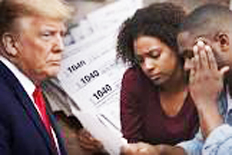
  • Newswire : New Trump Tax Law locks in gains for the rich, leaves Black households behind

    Newswire : New Trump Tax Law locks in gains for the rich, leaves Black households behind

    By Stacy M. Brown
NNPA Newswire Senior National Correspondent

    President Donald Trump’s new tax law is now in force, and as the 2026 filing season begins, economists say the damage is not theoretical. It is already written into the tax code. The legislation locks in and expands Trump’s 2017 overhaul while layering on new provisions that funnel wealth upward, raise taxes on millions of low-income Americans, and deepen racial inequities that have defined the U.S. economy for generations.

    “This massive tax-and-spending package does more to transfer wealth upward than any other single piece of legislation in decades while penalizing lower-income Americans and cutting public benefits,” the Institute on Taxation and Economic Policy said in its analysis of the law.

    According to ITEP, the poorest 40 percent of Americans will pay more in taxes under the new law, while the middle fifth receives only marginal relief. The richest 1 percent, however, will take home more benefits than the bottom 80 percent combined in 2026. The racial divide is stark. High-income households are disproportionately white, while Black and Latino families are far more likely to be concentrated in income groups that lose ground.

    At the center of the imbalance is the expanded pass-through business deduction, increased from 20 percent to 23 percent. Treasury Department data show that nearly all of the $1 trillion in tax cuts generated by this provision over the next decade will flow to the top 1 percent. Hispanic taxpayers, who account for 15 percent of the population, receive about 5 percent of the benefit. Black taxpayers, 11 percent of the population, receive roughly 2 percent.

    The law also sharply weakens the estate tax by permanently raising the exemption to $15 million for individuals and $30 million for married couples, indexed to inflation. Economists say the change all but eliminates the tax for ultra-wealthy families while locking in racial disparities tied to inherited wealth. White families are about three times as likely as Black families to receive an inheritance, and the median inheritance for White families is roughly 25 percent higher.

    Supporters of the law point to larger tax refunds expected this year as proof that working Americans are benefiting. The Tax Foundation estimates individual income taxes were reduced by $129 billion for 2025, with as much as $100 billion likely to be paid out through higher refunds during the 2026 filing season. Average refunds could rise by several hundred dollars, and in some cases close to $1,000.

    But analysts say those refunds are largely the result of delayed withholding adjustments, not sustained gains in wages or financial security. Many low-income filers, particularly those with little or no tax liability, receive little to nothing. ITEP said provisions marketed as help for working families continue to bypass the poorest households, many of them Black.

    The child tax credit was raised to $2,200 per child, yet it remains only partially refundable and far below its 2021 level. Millions of very low-income families are still excluded. Census data show that nearly one in five Black and American Indian people lived below the poverty line in 2024, placing them among those least likely to see any benefit.

    The law offsets tax cuts at the top by reducing funding for health care, food assistance, and other programs relied upon by working families. Economists warn that the long-term costs will fall heaviest on younger Americans. Millennials and Gen Z, the most racially diverse generations in U.S. history, will inherit higher deficits and fewer public resources.
    The Internal Revenue Service began accepting 2025 returns on Jan. 26 and expects to process roughly 164 million filings this year.

    New deductions for overtime, tips, auto loan interest, and seniors are now available, though many phase out well before reaching higher income levels. Analysts note that administrative readiness does not change who ultimately wins and loses under the law.

    ITEP said Congress had options that would have protected working families without deepening inequality, including limiting tax extensions to households earning under $400,000 and restoring the expanded child tax credit. That approach would have delivered larger tax cuts to the bottom 60 percent of Americans at a fraction of the cost.

    “This law harms the economic well-being of poor and working families of all races, especially people of color,” ITEP said. “The new tax and spending law doesn’t meet the basic test of fairness, and it falls tremendously short.”

  • Newswire : Trump Administration scrambles to blame Alex Pretti for his own death; Undermining 2nd Amendment in the process

    Makeshift memorial to Alex Pretti, at the site of his death in Minneapolis, Minnesota

    By Zack Linly, NewsOneInsert

    It’s quite possible that the Trump administration has finally flown too close to the sun, regarding its latest narrative of observably false propaganda against the latest victim of a killing by immigration cops in Minnesota.
    When 37-year-old Alex Pretti was gunned down by ICE agents while trying to protect a woman an agent had pushed to the ground and started pepper-spraying for no discernible reason, the Trump administration began its usual routine of trying its best to get ahead of the media by smearing the victim and claiming the agents were in imminent danger and in fear of their lives.
    White House Deputy Chief of Staff Stephen Miller, who has falsely claimed that immigration agents have“immunity” from prosecution, called Pretti a “domestic terrorist” and an “assassin” who “tried to murder federal agents” in a tweet that was re-tweeted by Vice President JD Vance, according to CNN.
    Homeland Security Secretary Kristi Noem told reporters Saturday that Pretti “impeded the law enforcement officers and attacked them,” and that he “had a weapon on him, and multiple dozens of rounds of ammunition; wishing to inflict harm on these officers, coming, brandishing like that.”
    Minneapolis Police Chief Brian O’Hara refuted Noem’s claim about Pretti “brandishing” his gun — which he carried legally, and which video clearly shows that he never even touched, let alone brandished — saying, “I don’t have any evidence that I’ve seen that suggests that the weapon was brandished.” Noem also said in a Fox News interview Sunday that Pretti was “laying hands on law enforcement,” which video footage also shows is simply untrue.
    Border Patrol commander Gregory Bovino — who has been at the center of clashes between immigration cops and protesters almost everywhere agents have been deployed, and has been ripped to shreds multiple times by federal judges for violating their orders restricting certain uses of force and for lying about protest violence to justify it — claimed it “looks like” Pretti “wanted to do maximum damage and massacre law enforcement.” He also claimed Pretti “assaulted federal officers” during an interview with CNN’s Dana Bash, but when asked where in the viral video footage that happened, Bovino had no answers.
    Make no mistake, they lied on Renee Nicole Good the same way, expecting us to ignore video footage that showed her attempting to drive away from ICE agents before she was shot and killed by one, in favor of nonsense about her attempting to weaponize her vehicle against ICE, which is the same lie DHS told after agents shot Marimar Martinez as she sat in her vehicle, and after agents shot Richard LA, the TikTok influencer who documents ICE activities, in Los Angeles. In both cases, criminal charges against the victims were dropped because evidence proved the government was lying.
    This time, the Trump administration has gotten so desperate to smear Pretti the same way that it’s even going against conservative America’s sacred pro-Second Amendment doctrine by essentially claiming Pretti had no right to be armed.
    Perhaps this is why even Republican senators are calling for a fuller investigation into Pretti’s death.
    Meanwhile, Democratic senators are now vowing to oppose funding for homeland security over federal violence in Minnesota, threatening to cause yet another government shutdown on President Donald Trump’s watch.
    Has any administration ever been the cause of all of its own issues the way this one has? It just keeps shooting itself in the foot and blaming everyone else.

  • Newswire : Midnight Friday deadline nears as Congress risks another shutdown

    By Stacy M. Brown
    NNPA Newswire Senior National Correspondent

    The federal government is once again facing a shutdown deadline, with funding set to expire at midnight Friday, January 30, just two months after the nation emerged from a prolonged lapse that disrupted lives far beyond Washington.
    That October to November shutdown left deep scars across the country. Families who rely on federal nutrition programs saw benefits delayed, reduced, or halted altogether. Some households receiving SNAP and WIC assistance stopped getting benefits entirely, while others received only partial payments. Many of those families are still struggling to recover, juggling rent, utilities, and food costs after weeks of instability caused by the funding lapse.
    Despite those recent consequences, Senate Republicans are moving ahead with plans to advance a sweeping funding package as a single vote, even as Democrats warn that no workable agreement has been reached.
    A Senate Republican leadership aide told NBC News that GOP leaders intend to press forward.
    “Government funding expires at the end of the week, and Republicans are determined to not have another government shutdown,” the aide said. “We will move forward as planned and hope Democrats can find a path forward to join us.”
    Democrats say discussions with Republicans and the White House have not produced a viable solution. A Senate Democratic leadership aide said outreach has occurred but “have not yet raised any realistic solutions.”
    The timeline remains tight. The House is on recess for the week, making it unlikely that any revised package requiring another vote could be approved before the deadline. Severe winter weather has also disrupted congressional schedules, further narrowing the window for negotiations as the clock runs down.
    Senate Majority Leader Chuck Schumer said Democrats will block the current Department of Homeland Security funding bill, tying the standoff to broader concerns about immigration enforcement and public safety nationwide.
    “Senate Democrats will not allow the current DHS funding bill to move forward.,” Schumer stated. “The appalling murders of Renee Good and Alex Pretti on the streets of Minneapolis must lead Republicans to join Democrats in overhauling ICE and CBP to protect the public. Senate Republicans must work with Democrats to advance the other five funding bills while we work to rewrite the DHS bill.”

  • Democratic Executive Committee submits list of local Greene County candidates for the upcoming May primary

    Lorenzo French, Chairman of the Greene County Democratic Executive Committee gave this list of candidates who qualified for local office in Greene County for the upcoming May 19, 2026, primary election.
    Some of these candidates are unopposed, which means that they will not be on the ballot in the May primary and that they will go directly to the November General Election ballot as the candidate of the Democratic Party. If they do not have opposition from the Republican Party or an independent candidate, then they will be automatically elected or reelected to their position.
    This list of Democratic candidates for local office in Greene County, are shown below. A separate list of statewide candidates including Governor, Legislators, Judges, U. S. Senator and Congress will be available from the Alabama Secretary of State.

    Sheriff:
    Johnathan Benison
    Delanglo M. Hall
    Beverly Spencer

    Commission: District 1
    Garria Spencer
    Michael E. Gaines
    Larry D. Smith

    Commission: District 2
    Tennyson Smith
    Kelvins Scott

    Commission: District 3
    Latasha Johnson
    Jacqueline Stewart
    Trey Diveley
    Williams Mack III

    Commission: District 4
    Allen Turner, Jr.
    unopposed

    Commission: District 5
    Roshanda Summerville
    Welsey Hodges

    Revenue
    Commissioner

    Arnelia Shay Johnson
    unopposed

    Board of Education
    District 3

    Veronica Bookie
    Richardson
    Cheryl Morrow

    Board of Education District 4
    Leo Branch
    Willie Ester Davis

    Board of Education District 5

    Joe Webb
    Carrie Dancy

    Coroner
    Ronald K Smith
    unopposed

    District Judge
    Robert  Lee
    Tonjula Carey