Feb. 3, 2020 (GIN) – The African Growth and Opportunity Act (known as “AGOA”) which aimed to assist the economies of sub-Saharan Africa and improve economic relations between the U.S. and the region is out of step with the new trade deals of the Trump administration. Inotherwords, time’s up. A new economic plan is on the drawing board and African leaders suspect it’s a Trumpian take it or leave it deal. Kenyan President Uhuru Kenyatta is expected to be the first to sign on to the bilateral “free-trade agreement” at a Rose Garden meeting with President Donald Trump in Washington this week. It will be America’s first such deal with a sub-Saharan nation and replace the 20 year old AGOA that expires in 2025. AGOA, which provides 39 sub-Saharan African countries duty-free access to the U.S. for about 6,500 products ranging from textiles to manufactured items, has come under increasing criticism in Washington, which wants fast-growing African economies to open up to US goods and services. But the model agreement has few fans among African leaders who have a preference for multilateralism as they move towards an African Continental Free Trade Agreement which comes into force in July. “The Trump administration wants to do bilateral deals, not multilateral deals,” said Aubrey Hruby, in an interview with the Financial Times. Macharia Kamau, Kenya’s principal secretary for foreign affairs, hinted at the risks for Kenya’s fragile, sometimes flailing, economy. “They could easily swamp our markets into oblivion, he said. “Any deal cannot b at the expense of our local capabilities, which are nascent at best.” Meanwhile, in late-breaking news from Kenya, flags are flying at half mast for Daniel arap Moi who served as Kenya’s president from 1978 to 2002. He died peacefully this week at Nairobi Hospital, according to his son Senator Gideon Moi. He was 95 years old. Moi was an autocratic leader who ruled for more than 20 years. “Our nation and our continent were immensely blessed by the dedication and service of the late Mzee Moi; who spent almost his entire adult life serving Kenya and Africa,” President Uhuru Kenyatta said in a statement. He came to power in 1978, upon the death of President Jomo Kenyatta, having been vice-president until then. Diplomats said an attempted coup four years later transformed him from a cautious, insecure leader into a tough autocrat. President Uhuru Kenyatta has declared a period of national mourning to last until the funeral day, with the national flag being flown at half mast.
By Lauren Victoria Burke, NNPA Newswire Contributor
Congresswoman Karen Bass, Chair of the Congressional Black Caucus
In an effort to emphasize measurable policy change with tangible direct action, members of the Congressional Black Caucus will be convening the Congressional Black Caucus National Black Leadership Summit on February 3rd and 4th. The Summit with include over 400 Black leaders from around the country to discuss critical issues of the day, including the 2020 Census and voting rights. The event was created to “test the strength of our democracy and determine the fate of our nation’s most prominent institutions.” The event has been defined as “an emergency convening” during a crucial year that includes a pivotal presidential contest. The CBC is organizing the National Black Leadership Summit in partnership with civil rights, labor and social justice organizations. The event will take place in the U.S. Capitol Visitor Center in Washington, DC. “We want to make sure people across the country have their voices heard over this day and a half convening. There’s going to be a specific ask of our communities. Very shortly after we will be convening on how to implement that specific ask,” said Rep. Bonnie Watson-Coleman (D-NJ) at a January 29 press conference on Capitol Hill in Washington reviewing the details of the summit. “I want to be clear. We stand up, we give back and we get things done. We believe in the people we serve so we are excited that people will come from all over this nation to join us. We know that we have an administration in office that is not standing with us and not fighting with us. We decided that we needed a movement,” said Rep. Joyce Beatty (D-OH). The Congressional Black Caucus is now 55 members, the largest CBC in history and the largest Caucus in Congress. “We have suffered through the last three years of this administration where we have watched gains that we have made over the last several decades either at risk or an attempt to dismantle. That is why the year 2020 is extremely important. I’m proud of the work of the CBC,” said Rep. Karen Bass (D-CA) who is the current Chair of the Congressional Black Caucus. When asked what was special about this particular event compared to other before it, Rep. Watson-Coleman told reporters, “I don’t know where to begin. This is an emergency urgent convening because we look at all of the policy and the attempts regarding this administration, whether it’s access to health care, whether it’s public education, or housing or the climate. Whatever the issue is we have seen negative and disparate impact on the Black community. “There have been so many distractions involved because we have an entertainer in charge in the White House who serves to distract from the evil and mean things being done,” added Rep. Watson-Coleman. There have been many gatherings, convention and convening over the past several decades. But the National Black Leadership Summit has been emphasizing the need for a specific and active push to create substantive policy change in a way events in the past have not. Each year in September, the CBC Foundation convenes an Annual Legislative Conference for what may sound like a similar event to some. But the CBC 2020 National Black Leadership Summit has been defined as a more specific effort to meld policy talk with related action. Lauren Victoria Burke is an independent journalist for NNPA and the host of the podcast BURKEFILE. She is also a political strategist as Principal of Win Digital Media LLC. She may be contacted at LBurke007@gmail.com and on twitter at @LVBurke
No matter who you are, or where you live, there’s a central concern that links consumers all over the country: the ever-rising cost of living. For many consumers, the combined costs of housing, transportation, food, and utilities leave room for little else from take-home pay. From Boston west to Seattle, and from Chicago to Miami and parts in between, the rising cost of living is particularly challenging in one area: housing. Both homeowners and renters alike today cope as best they can just to have a roof over their families’ heads. The nation’s median sales price of a new home last September in 2019 was $299,400, according to the U.S. Census Bureau. Even for an existing home, the St. Louis Federal Reserve noted its median price in December was $274,500. For renters, the cost of housing is also a serious challenge. Last June, the national average rent reached $1,405, an all-time high. But if one lives in a high-cost market like Manhattan, Boston, Los Angeles, or San Francisco, a realistic rental price is easily north of $3,000 each month. Now a new report from Harvard’s Joint Center for Housing Studies (JCHS) finds that the American Dream of homeownership is strained even among households with incomes most would think adequate to own a home. From 2010 to 2018, 3.2 million households with earnings higher than $75,000 represented more than three-quarters of the growth in renters in its report entitled, America’s Rental Housing 2020. “[F]rom the homeownership peak in 2004 to 2018, the number of married couples with children that owned homes fell by 2.7 million, while the number renting rose by 680,000,” states the report. “These changes have meant that families with children now make up a larger share of renter households (29%) than owner households (26%).” To phrase it another way, America’s middle class is at risk. Consumer demographics that traditionally described homeowners, has shifted to that of renters. And in that process, the opportunity to build family wealth through homeownership has become more difficult for many — and financially out of reach for others. “Rising rents are making it increasingly difficult for households to save for a down payment and become homeowners,” says Whitney Airgood-Obrycki, a JCHS Research Associate and lead author of the new report. “Young, college-educated households with high incomes are really driving current rental demand.” Included among the report’s key findings: · Rents in 2019 continued their seven-year climb, marking 21 consecutive quarters of increases above 3.0%; · Despite the growth in high-income white renters, renter households overall have become more racially and ethnically diverse since 2004, with minority households accounting for 76 percent of renter household growth through 2018; and · Income inequality among renter households has been growing. The average real income of the top fifth of renters rose more than 40 percent over the past 20 years, while that of the bottom fifth of renters fell by 6 percent; · “Despite the strong economy, the number and share of renters burdened by housing costs rose last year after a couple of years of modest improvement,” says Chris Herbert, Managing Director of the Joint Center for Housing Studies. “And while the poorest households are most likely to face this challenge, renters earning decent incomes have driven this recent deterioration in affordability.” This trend of fewer homeowners has also impacted another disturbing development: the nation’s growing homeless population. Citing that homelessness is again on the rise, the JCHS report noted that after falling for six straight years, the number of people experiencing homelessness nationwide grew from 2016–2018, to 552,830. In just one year, 2018 to 2019, the percentage of America’s Black homeless grew from 40% to more than half – 52%. That independent finding supports the conclusion of the Department of Housing and Urban Development’s report to Congress known as its Annual Homeless Assessment Report. While some would presume that homelessness is an issue for high-cost states like California, and New York, the 2019 HUD report found significant growth in homeless residents in states like Alabama, Louisiana, Mississippi, Virginia, and Washington as well. According to HUD, states with the highest rates of homelessness per 10,000 people were New York (46), Hawaii (45), California (38), Oregon (38), and Washington (29), each significantly higher than the national average of 17 persons per 10,000. The District of Columbia had a homelessness rate of 94 people per 10,000. And like the JCHS report, HUD also found disturbing data on the disproportionate number of Black people who are now homeless. For example, although the numbers of homeless veterans and homeless families with children declined over the past year, Blacks were 40% of all people experiencing homelessness in 2019, and 52% of people experiencing homelessness as members of families with children. These racial disparities are even more alarming when overall, Blacks comprise 13% of the nation’s population. When four of every 10 homeless people are Black, 225,735 consumers are impacted. Further, and again according to HUD, 56,381 Blacks (27%) are living on the nation’s streets, instead of in homeless shelters. The bottom line on these research reports is that Black America’s finances are fragile. With nagging disparities in income, family wealth, unemployment and more – the millions of people working multiple jobs, and/or living paycheck to paycheck, are often just one paycheck away from financial disaster. Add predatory lending on high-cost loans like payday or overdraft fees, or the weight of medical debt or student loans, when financial calamity arrives, it strikes these consumers harder and longer than others who have financial cushions. And lest we forget, housing discrimination in home sales, rentals, insurance and more continue to disproportionately affect Black America despite the Fair Housing Act, and other federal laws intended to remove discrimination from the marketplace. The real question in 2020 is, ‘What will communities and the nation do about it?’ For Keeanga-Yamahtta Taylor, an assistant professor of African-American studies at Princeton University and author of the new book, “Race for Profit: How Banks and the Real Estate Industry Undermined Black Homeownership”, federal enforcement of its own laws addressing discrimination and acknowledging the inherent tug-of-war wrought from the tension of public service against the real estate industry’s goal of profit, there’s little wonder why so many public-private partnerships fail to serve both interests. In a recent Chicago Tribune interview, Professor Taylor explained her view. “You don’t need a total transformation of society to create equitable housing for people,” said Taylor. “We have come to believe that equitable housing is just some weird thing that can’t happen here, and the reality is that we have the resources to create the kinds of housing outcomes that we say we desire.” “The way to get that has everything to do with connecting the energy on the ground to a different vision for our society — one that has housing justice, equity and housing security at the heart of it,’ Taylor continued. “The resources and the money are there, but there’s a lack of political will from the unfortunate millionaire class that dominates our politics… I think, given the persistence of the housing crisis in this country, we have to begin to think in different ways about producing housing that is equitable and actually affordable in the real-life, lived experiences of the people who need it.” Amen, Professor Taylor. Charlene Crowell is the Center for Responsible Lending’s communications deputy director. She can be reached at charlene.crowell@responsiblelending.org.
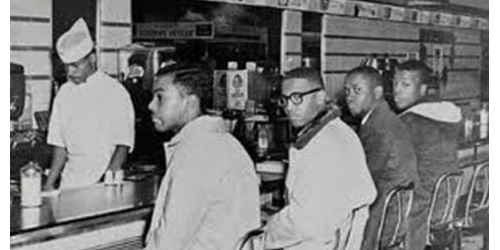
Greensboro students sit-in at Greensboro lunch counter
On Feb 1, 1960, four African American college students from the North Carolina A&T State University quietly sat down at the whites-only Woolworth’s lunch counter in Greensboro, North Carolina and ordered coffee. It was a planned move by the four students, designed to attract media attention to the issue of segregation. Denied service, as was the custom in those dark days, the four continued to peacefully occupy their seats and refused to leave until the store closed that night. The peaceful protest inspired others to join in for daily protests. By Feb 5, 300 students were present at the store. On Saturday, February 6, over 1,400 North Carolina A&T students met in the Harrison Auditorium on campus. They voted to continue the protests and went to the Woolworth store, filling up the store. During the sit-ins, white customers heckled the black students. North Carolina’s official chaplain of the Ku Klux Klan, George Dorsett, as well as other members of the Klan, were present. The brave freshmen from NCA&T, who would later be adorned with the iconic label of the “Greensboro Four”, consisted of David Richmond, Franklin McCain, Joseph McNeil, and Ezell Blair Jr. (Jibreel Khazan). The sit-ins soon spread to nearby towns and other Southern cities. Sales at the boycotted stores dropped by a third, leading Woolworth to abandon segregation policies; the dining area in most stores were desegregated after July 25, 1960. The Greensboro sit-in was not the first such event, but it catalyzed a much larger nonviolent sit-in movement across the country, which played a definitive role in the fight for civil rights. In its wake, segregation of public places became illegal under the Civil Rights Act of 1964. The Woolworth Department Store in Greensboro was subsequently converted into the International Civil Rights Center and Museum (Woolworth went out of business in 1997). The street south of the building is named February One Place. Today, the site of the Woolworth store where the sit-in took place is now the International Civil Rights Center and Museum.
Jan. 27, 2020 (GIN) –The World Bank’s executive board cancelled expected action on a $500 million loan to Tunisia where teenage girls can be expelled from school because they are pregnant. The Bank had been under pressure from rights activists and held a last-minute emergency meeting this week with Tanzanian and international human rights organizations. The activists demanded that the loan be frozen until the country passes a law guaranteeing the rights of pregnant girls to attend regular secondary school and ending mandatory pregnancy tests. According to a World Bank document, about 5,500 girls were not able to continue their secondary education due to adolescent pregnancy and young motherhood in 2017. Around a quarter of Tanzanian girls between 15 and 19 years of age are mothers or pregnant. The percentage of teenage girls who have given birth or who were pregnant increased to 27% in 2016. The activists objected to recent statements by President John Magufuli, such as when he said that “Girls who give birth should not be allowed to return to school” because “after getting pregnant you’re done.” “With all the work we have done to emancipate Africa’s girl-child from the shackles of discrimination and violation, a sitting president turns around to “re-victimize” and treat their situation like a terrible infectious disease which other girls must be protected from,” said Rwandan feminist Dinah Musindarwezo of the Kenya-based African Women’s Development and Communication Network, or ‘Femnet’. A World Bank spokesman said that a reworked loan program should ensure that girls and boys who drop out, including pregnant girls, would have alternate education options for themselves. Concerned Citizens of Tanzanian Civil Society in their letter to the Bank board seen by the Financial Times, the activists had warned that “awarding $500 million at this time would be a slap in the face of girls and women who are treated in this way, and will be taken as a full-throated endorsement of this violently misogynist regime.” “When girls are denied the opportunity to education, it limits their chances to other opportunities including decent employment, leadership and information. Girls who drop out of school are also likely to end up in child marriages,” they wrote. Initially, the loan was recommended for approval by Bella Bird, the World Bank’s Country Director for Tanzania, Burundi, Malawi and Somalia. Bird is expected to step down on Friday, according to a source at the bank.
Portraits of President Brack Obama, along side First Lady Michelle Obama
Portraits of former President Barack Obama and former First Lady Michelle Obama will go on display at the Art Institute of Chicago as the first stop in a five-city tour beginning in the summer of 2021. Chicago is where the Obamas began their historical ascension to the White House. The paintings, on loan from the Smithsonian’s National Portrait Gallery, are Kehinde Wiley’s painting of President Obama and Amy Sherald’s portrait of Michelle Obama. The former First Lady, a Chicago native who grew up on the city’s South Side, visited the museum with her family. The Art Institute also was the site of the couple’s first date. Wiley and Sherald are the first African American artists commissioned by the National Gallery to create official portraits of a President and a First Lady. Wiley placed President Obama in a chair against a backdrop of flowers, including chrysanthemums, Chicago’s official flower. Sherald painted the First Lady against a light-blue ground, gazing directly at the viewer. After the Art Institute, the portraits will travel to The Brooklyn Museum, Los Angeles County Museum of Art, High Museum of Art in Atlanta and the Museum of Fine Arts in Houston.
By Stacy M. Brown, NNPA Newswire Senior Correspondent @StacyBrownMedia
Entrance to Mississippi State Penitentiary
The conditions at Mississippi’s Parchman prison makes it one of the worst detention facilities in the world, according to reform advocates and human rights organizations. Death and violence are rampant, many inmates are without beds, and electricity, plumbing, and fundamental human rights are absent. At the same time, mold, roaches, mosquitos, and rodents far outnumber the more than 5,000 inmates. On Tuesday, January 14, hip-hop superstar Jay-Z sued the head of the Mississippi Department of Corrections and the warden on behalf of 29 prisoners who have complained that officials have done nothing to stop the violence at Parchman. In the suit filed in U.S. District Court in Greenville, Mississippi, Jay-Z addressed the recent deaths at the prison. “These deaths are a direct result of Mississippi’s utter disregard for the people it has incarcerated and their constitutional rights,” the mogul said in the court filing. The suit names Department of Corrections Commissioner Pelicia Hall and Mississippi State Penitentiary Superintendent Marshall Turner as defendants. Earlier this month, hip-hop stars T.I., and Yo Gotti called on the governor to close the prison or to address the issues adequately. “This is unacceptable,” T.I. wrote on his Instagram page. “The conditions in the prisons operated by the Mississippi Department of Corrections are absolutely inhumane and unconstitutional,” Yo Gotti wrote in a letter to the governor Phil Bryant, a Republican. “To see this happen so close to my hometown of Memphis is truly devastating. That’s why we’re calling on Mississippi state leaders to take immediate action and rectify this issue. If they don’t right this wrong, we’re prepared to take legal action to provide relief for those that are incarcerated and their families,” Gotti stated. In an alarming 2019 report on Parchman and other Mississippi prisons, The Marshall Project found that gang activity isn’t limited to some of the people incarcerated. They discovered that some prison employees, including some high ranking officers and managers, are affiliated with one of two gangs, the Vice Lords or Gangster Disciples. The reasons vary. “Some staffers said gang loyalty gives some officers a measure of protection; since gangs have a lot of control, they can prevent certain attacks,” The Marshall Project reported. “Others say gang affiliation began before employment; according to lawsuits, testimony, and interviews, gangs directly recruit women to apply for correctional officer jobs.” In a tweet, Pro Publica officials stated, “Understaffed and underfunded, Mississippi’s #ParchmanPrison recently received media attention for its grisly violence, gang control, and subhuman living conditions. Lawmakers have known about these issues for years — and have done nothing to fix it.” Earlier this month, five inmates were killed after allegedly trying to escape. Video captured by cellphones, which are routinely smuggled into the prison, surfaced online this month appearing to show inside Parchman and the conditions in which inmates live. One shows individuals in orange and white prison uniforms walking through piles of trash and dirty water. Mold is apparent, and there’s no electricity, heat, plumbing, and many inmates sleep on concrete because there aren’t enough beds. “We sleeping on straight concrete. There are no mats,” one person on the video states. The individuals than demonstrate that there’s no running water by trying to flush toilets and opening faucets and showers. In another video, two inmates also complain about the lack of running water. “Please get us some help,” they plead.In still another video, an inmate appears to breakdown emotionally as he sits in an area where prisoners have disposed of their feces. In the heart of the Mississippi Delta, the prison, once a plantation that was home to hundreds of slaves, has a long history that’s intertwined with Mississippi’s racist past. In 1901, the state government of Mississippi established Parchman Penitentiary, taking advantage of an opportunity to continue to profit off of cheap Black labor, much like Whites had done for generations before, while also continuing to exercise violent control over the descendants of former slaves. Historians at the University of North Carolina said Parchman was modeled after a traditional southern plantation, for-profit prison in Sunflower County was segregated until 1971. “While a small farm held White convicts, Black inmates labored on Parchman’s massive, twenty-thousand-acre plantation, where they picked cotton, chopped wood, and plowed fields under the control of armed guards,” the historians stated. Today, of the more than 5,000 inmates at Parchman, more than 60 percent are African American. The prison has an 11-to-1 inmate to guard ratio, and no one is safe. “I will be requesting that the U.S. Attorney General launch an investigation into the ongoing failures in safety, security, health, and environmental standards within the Mississippi Department of Corrections,” stated U.S. Rep. Bennie Thompson (D-Miss.). “This is unacceptable,” Thompson wrote on Twitter.
(TriceEdneyWire.com) – Even if watching Perry Mason or Law and Order have been your only contact with the criminal justice system you would know real trials have witnesses and documents which the fraudulent Republican-controlled impeachment shenanigans are determined not to allow. But now there is a political hand grenade that could blow the lid off the GOP’s schemes to block important witnesses to provide testimony or documents that could shed negative light on the President. This new bombshell is the release of allegations in former national security adviser John Bolton’s book manuscript that President Trump had illegally tied military aid to Ukraine contingent on probes into vice president Joe Biden, Trump’s most feared political rival. In Bolton’s not yet published book, this account is not hearsay but allegedly first hand conversations that Bolton had with Trump and key advisers, such as Secretary of State Mike Pompeo. Bolton’s lawyers have said their client is ready to testify in the Senate impeachment trial. And if he does, Bolton, who has a 40 year-career in foreign service, just might be that white knight in shining armor the Democrats are hoping for. In fact, the GOP Senators’ refusal to hear Bolton and other key White House officials will only add more credibility that the trial was a sham to hide a corrupt president and will not fare well with voters, which polls said 70 percent wanted the trial to include witnesses and documents. The mustachioed Bolton has been described potentially as the president’s worst nightmare. Trump has directed all executive-branch officials not to comply with congressional subpoenas. Most senior White House officials have complied with Trump’s gag order, but since Bolton has resigned his position, he could testify, but it is a safe bet the Senate won’t allow it. Here are some of the comments Bolton has already made that could boil up Trump’s already hot water; Bolton reportedly told some “all in the loop” Trump aides that he did not want to be part of “whatever drug deal” certain other officials were “cooking up” in Ukraine. Bolton has also described Rudy Giuliani as Trump’s personal bagman who spearheaded what witnesses have described as operating a backdoor channel in Ukraine, as a problem. Bolton was also reportedly opposed to the smear and intimidation campaign Giuliani and Trump carried out against Marie Yovanovitch, the US’s ambassador to Ukraine, who was trying to block some of the irregularities. Former senior administration officials have told news sources that people in Trump’s orbit were frightened over what Bolton might divulge, but others feel Bolton might pull back because he has much to lose depending on how he plays his cards. . First of all, billionaires and organized crime elements that reportedly are part of Trumps’ inner circle have the resources to buy loyalty, handsomely award their friends, and gravely punish their enemies. Bolton has a Political Action Committee that wealthy donors use to support Republicans who support Bolton’s hawkish foreign policy experts, according to the Washington Examiner. If Bolton turns on Trump all that cash will dry up and since Trump is certain not to be convicted by the GOP controlled Senate, why should Bolton damage his future by issuing a potentially damaging blow? We should have learned by all the hopes that were dashed by Robert Mueller’s probe which although important was undercut by Atty. Gen. Barr, which Mueller didn’t fight. The GOP top echelon are part of the same eco-system, sharing friends, funds and futures. Could Bolton really exist outside the GOP bubble? Furthermore, if the Senators refuse to allow Bolton to testify within the trial, Bolton’s book will be even more of a money-making best seller. And after the trial Trump will have free reign to continue his criminal activities to help him remain in office. So the only loser here is truth, which in the GOP climate really doesn’t matter.
(TriceEdneyWire.com) – Sports fans in the United States and around the world – plus people who are not necessarily sports-oriented – are mourning the sudden death of NBA legend Kobe Bryant at the age of 41. Two years removed from retirement after 20 years in the NBA, the five-time NBA champion and Los Angeles Lakers superstar was settling into retirement and immersing himself in sports, entertainment, his family and business ventures when he was killed in a helicopter crash, Sunday, Jan. 26, near Calabasas, Calif. The crash also killed eight other passengers, including his 13-year-old daughter, Gianna, a budding basketball phenom. IN addition to millions of adoring fans, he leaves to mourn him Vanessa Laine Bryant, his wife of 19 years, and three other daughters: Natalia Bryant, 17, Bianka Bryant, 3, and Capri Bryant, 7 months. The group was on their way to Bryant’s Mamba Sports Academy in Thousand Oaks, Calif., where Bryant was to coach a game in which Gianna was to play. Federal investigators are trying to determine what specifically caused the crash which occurred in dense fog. Bryant’s death has triggered an outpouring of grief, shock and disbelief among devastated players, fans, celebrities and just those who equated his name with excellence. A common theme offered by tributes is that he had transcended basketball and had become larger than sports. “Kobe was a legend on the court and just getting started in what would have been just as meaningful a second act,” tweeted President Barack Obama. “To lose Gianna is even more heartbreaking to us as parents. Michelle and I send love and prayers to Vanessa and the entire Bryant family on an unthinkable day.” President Trump deflected from his tweeting on impeachment to call the reports on the basketball star “terrible news”. He later released a tweet that critics observed was strikingly similar to President Obama’s: “Kobe Bryant, despite being one of the truly great basketball players of all time, was just getting started in life. He loved his family so much, and had such strong passion for the future. The loss of his beautiful daughter, Gianna, makes this moment even more devastating,” Trump tweeted. “Melania and I send our warmest condolences to Vanessa and the wonderful Bryant family. May God be with you all!” Many struggled to find deeper meaning in the sudden death of a person so beloved who had become a symbol of excellence. “I didn’t know him well. I only met him a couple of times,” said former Vice President Biden on the presidential campaign trail in Iowa as reported by the Washington Examiner. “It makes you realize that you gotta make every day count, every single solid day, every single day count.” Jalen Rose, a former college and professional basketball player and sports analyst with ESPN described his friend, Bryant, in terms beyond basketball. “He is remembered for his dedication to his craft, educated, speaker of multiple languages, father, husband, disciplined hardworking, always gracious and respectful,” he said in a tribute. “He was always the hardest working guy in the room, smartest guy in the room … he was Industry tastemaker, gave so much to humanity and is gone too soon.” Kobe Bryant was born in Philadelphia, the only boy and youngest of three children of former NBA player Joe Bryant and Pamela Cox Bryant. He was first drafted by the Charlotte Hornets in 1996 straight out of Lower Merion High School. Through hard work and extraordinary dedication to the game, he was seen as a transcendent player, unquestionably one among the best to ever play the game of basketball. But his success impacted beyond the game. In post-game retirement, he inspired hundreds of thousands of young people to aim high, push past their limits, whether it was on a court, a football pitch or in the creative arts. Kobe, who won five NBA titles and who was an 18-time All-Star, won an Oscar for Best Animated Short in 2019 for the film “Dear Basketball.” The six-minute film is based on a poem Bryant wrote in 2015 announcing his retirement from the NBA. Bryant wrote and narrated the short, in which he shares his love of the sport for basketball. Bryant considered himself to be a storyteller and had been moving into the film and entertainment industry since his retirement from basketball in 2016. He wrote, produced and presented a series for ESPN called Detail, in which he explained the intricacies of athletes in their respective sports. His multimedia company, Granity Studios, produced the ESPN+ series Detail and the podcast “The Punies.” In addition, he helped create four sports fantasy children’s books. According to media reports, the second volume of The Wizenard Series: Season 1, is set to hit bookstores on March 31. Still it was basketball for which he will always be world renown. Sports lawyer and businessman Michael Huyghue said an icon of the industry has been lost. “What he stood for is an early example of an athlete transcending his sport,” said Huyghue, author, sports agent and president of Michael Huyghue and Associates, LLC. “His work in the community, building a brand, his eclectic nature and speaking several languages are a part of his legacy. “He was a very rare breed. He set the bar at a place where a lot of athletes could aspire to.” Sports Journalist Elton Hayes, Jr. said what sticks out to him is his involvement with children and young people. “I have been watching all these years. He’s a global icon,” said Hayes, who writes for CNHI News in State College, Pennsylvania. “What sticks out after retirement is the role he played with kids. He showed us his paternal side and the passion he had for women’s basketball. The WNBA is the sister organization to the NBA but there are discrepancies in salary and viewership. He was an active participant and took several women under his wing. I would consider him an ambassador for Women’s basketball…I think a part of his legacy is the impact on a generation of aspiring athletes. With his Mamba Foundation, we will continue to see his legacy grow and will continue to see the impact.” For the past two years, Bryant had focused on coaching Gianna’s AAU team. “Coaching youth sports is so important to take very seriously because you’re helping the emotional [development] of young kids,” he said in a recent interview. “So it’s understanding not to be overcritical and understanding that [there] are going to be mistakes.” And in an interview with People magazine, published online two days before his death, Bryant said he launched Granity Studios “as a way of teaching valuable life lessons to the next generation, with whatever they hope to do. The goal is to encourage children to develop their own inner magic and believe they can achieve the impossible and do so in a fun way.” Bryant added, “Storytelling has always been an interest of mine, so the transition was an exciting one. I’m being challenged in a completely new way and have really loved the opportunity to exercise my creative muscles.” Nearly everyone killed in the crash shared a love for basketball, reported the Los Angeles Times. They were Bryant and Gianna,”a budding basketball player who was ready to follow in her father’s footsteps; baseball coach John Altobelli, his wife Keri and their basketball-playing daughter Alyssa; mother and daughter Sarah and Payton Chester; Mamba Academy basketball coach Christina Mauser and pilot Ara Zobayan,” the Times reported. The 41-year-old Bryant played his entire 20-year career with the Los Angeles Lakers. The NBA named him Finals MVP twice and League MVP in 2009. He was an 18-time NBA All-Star. Bryant was the fourth-leading scorer in NBA history with 33,643 points. He retired in 2016. Bryant is survived by his wife, Vanessa, 37, and their daughters Natalia, 17, Bianka, 3, and Capri, 7 months. Bryant lived in Orange County, California, outside of Los Angeles. Born in 1978 in Philadelphia, Pennsylvania, Kobe Bryant spent his early years in Italy where his father Joseph Washington “Jelly Bean” Bryant played basketball for seven years.
By Stacy M. Brown, NNPA Newswire Senior Correspondent @StacyBrownMedia
NNPA’s Ben Chavis speaks with Cuban delegation
National Newspaper Publishers Association (NNPA) President and CEO Dr. Benjamin F. Chavis, Jr. joined experts and academics from the United States and Cuba in Havana to seek strategies, solutions, and projects they hope would help rekindle relations between the countries. “The majority of the people of the United States want better relations with Cuba, and that is the will that must prevail,” stated Chavis, who counted among the delegation of 30 American scholars who attended the 18th edition of the Series of Academic Conversations on Cuba in the Foreign Policy of the United States of America. Sponsored by the Research Center on International Policies and the Raul Roa Higher Institute for International Relations, the conference highlighted how the Trump Administration has setback U.S.-Cuba relations after former President Barack Obama worked toward a more agreeable relationship. Here’s the text of Dr. Chavis’ full keynote address: On behalf of the National Newspaper Publishers Association (NNPA), the national trade association of the Black Press of America representing 225 African American owned newspapers across the United States of America, I bring to each of you our expressions of solidarity and comradeship in the ongoing international struggle for freedom, justice, equality for all of humanity throughout the world. Today’s conference is very important not only for the people of Cuba and for the people of the United States, but also this dialogue and these discussions over the next days here in Havana will have a positive impact, I believe, on improving the quality of life for all people throughout the world who especially cry out for freedom. I stand before you as a longtime freedom fighter, former U.S. political prisoner, journalist and as the President and CEO of the NNPA, but most importantly, I stand before you as your Brother and as your Comrade in our joint struggle and global movement for freedom and justice. The truth is if we all together can work to improve relations between the United States and Cuba, that success will bring benefits to all people in this region of the world and to all people in all regions of the world. Why is it that still in 2019, the United States is still imposing a “Blockade on Cuba?” Why? Whose interests are being served in this prolonged and unjust economic, political, and social blockade of Cuba by the United States? It is not in the interests of the people of Cuba for the blockade to continue. And it is not in the interests of the people of the United States for the blockade to continue. Therefore, my first point to emphasize today is that the most effective expression of international solidarity between the people of the Cuba and the people of the United States requires and demands an immediate end to the United States blockade of Cuba. The U.S. blockade of Cuba is a contradictory relic of the past, but it is a present day reminder of the awful, sinful, counterproductive, and devastating realities of international imperialism, exploitation and racism. I can state without fear of reprisal that the Black Press of America does not support the blockade of Cuba. We demand an end to the blockade immediately. We want to help improve relations between our two nations. I say “our” two nations because, as a descendant of Africa living, striving and struggling in the United States, whenever I am in Cuba, I not only feel at home, I know that I am at home here in Cuba because of what Cuba has done and continues to do for Africa and for all African people throughout the African Diaspora, as well as what Cuba continues to do today internationally to improve healthcare for all of humanity throughout the world. Several weeks ago, I spoke at the Embassy of Cuba to the United States on November 25, 2019 noting the anniversary when H.E. Comrade President Fidel Castro made his transition to eternal life. I noted then, and I want to repeat it here as part my intervention and statement to this outstanding gathering of colleagues and those who are interested in improving international relations. The Cuban Revolution led by Fidel Castro was one of the most important and effective revolutions of the 20th Century against imperialism, colonialism and racism. Today at the end of the second decade of the 21st Century, the Cuban Revolution led by Fidel Castro’s enduring legacy, government, values, commitments, achievements and vast social and economic transformations continue to set a righteous and transformative ideal for the rest of the world to learn from and to follow. This past November 25th , I reminded the people gathered at the Cuban Embassy in Washington, DC, that when Fidel Castro dispatched thousands of courageous Cuban troops to Angola in southern Africa in the 1980’s, it permanently changed and reversed the tragic oppressive trajectory of imperialism, neocolonialism, and the brutal Apartheid South Africa’s quest to dominate and control all of southern Africa. My remarks today are not just from reading the books of history that are in fact important to read for all who stand for the liberation of humanity from the systems and structures of oppression. But my remarks are from being an actual firsthand witness to history being made and continuing to be made by the contributions and interventions of Cuban to the liberation of humanity. I witnessed and had fellowship with Cuban soldiers in Angola in 1988 in the aftermath of the heroic victory of the Battle of Cuito Cuanavale in southern Angola. I vividly remember as an African America Christian clergy going down into the fresh war-zone foxholes with Cuban soldiers who were deployed on the frontlines near Cuito Cuanavale. We broke bead together. We prayed together. We fought for freedom together against the imperialistic enemies. And we won an historic victory together against the racism and oppression of “apartheid” for the benefit of Angola, South Africa and Namibia that permanently changed the course of history in southern Africa. In fact, that strategic and consequential victory of Angolan, Namibian, and African National Congress soldiers fighting alongside Cuban troops against the apartheid armed forces inside of southern Angola at the battle of Cuito Cuanavale actually led to the eventual release of Comrade Nelson Mandela from prison in South Africa. That is a piece of history that sometimes does not get reported or appreciated in the so-called mainstream media in the United States. I am proud that the Black Press of America: African American owned newspapers, digital companies, social media channels, radio stations and other broadcast media does continue today to report and distribute the news about Cuba and about all of our people throughout the African Diaspora. And, of course, the Republic of Cuba is a nation that is a vital and strategic part of the African Diaspora that sometimes is misunderstood, undervalued, and at times not referenced sufficiently in the local, national, and international media. My point here, before moving on, is that history is important. We should learn from history. What are the lessons of history that we all have to remind ourselves of today with respect to success of the Cuban Revolution? What is the lingering relevance of White Supremacy and race in American foreign policy as well as its domestic policy when it comes to Cuba and the rest of the Diaspora? The purpose of this conference goes beyond the articulation of contemporary analyses, new research data, and the stated quest for overcoming the new and old challenges to improve relations between Cuba and the United States. I therefore state the following additional six points to further our dialogue and conversations about the current state of affairs, policies, challenges, opportunities and responsibilities for the conference to outline possible solutions to advance the interests of the people and government of Cuba in the wake of the continuation of the U.S. blockade, as well as the new sanctions and restrictions on this island nation. Cuba’s national and international contributions to improving healthcare and medical research, in addition to the academic and professional provision of free medical education for thousands of aspiring and evolving medical doctors and post-graduate medical researchers. Cuba has emerged as a world leader in the healthcare and medical education sectors. Thus, the U.S. embargo and new travel restrictions stand as an obstacle to advances in healthcare and medical education for Cubans, Americans and for all of humanity. Hight quality education in Cuba is accessible and affordable to all of its citizens from pre-K through post-graduate school. In the U.S. education is not accessible nor affordable for all of its citizens from pre-K through post-graduate school. Instead of imposing more economic sanctions and social restrictions on Cuba, the U.S. should try to learn from the success of the Cuban educational system. We propose that the Black Press of America and the Cuban Press Agencies find ways and means to work collaboratively to better mutually inform the people of the United States and the people of Cuba on the vital issues that are being outlined in this conference to enhance the policies and relations between the United States and Cuba. We call for the establishment of a Free Trade Zone and free trade policies the United States and Cuba, as well as the repeal of the Helms-Burton Act that targets and discriminates against the economic, political and social interests of the people and government of Cuba. We call for a bilateral focus between the United States and Cuba on the issues and challenges that millennials face with respect to youth leadership development programs and joint projects that have as a goal of increasing mutual understandings and affirmations of the interests of the youth of Cuba and United States to help improve overall bilateral relations. Last but not least, are the opportunities and responsibilities to foster, promote and coordinate cultural exchange programs between the United States and Cuba. Both nations are rich with cultural genius and talent that should be more forthrightly mutually shared and affirmed by both Cuba and the United States. Basta la repression! Basta la imperialism! Basta la racism! Viva Cuba and United States Relations! Viva Fidel! Viva la revolution! A luta continua! Victoria es cert! Thank you for listening. God bless.