Oct. 14, 2019 (GIN) – “Love is greater than modern weapons like tanks and missiles… Love can win hearts, and we have seen a great deal of it today here in Asmara.”
Not many political leaders would admit to a vision of love over war and that may be why Abiy Ahmed, Prime Minister of Ethiopia, was the clear favorite for this year’s Nobel Peace Prize.
At 43, Dr. Abiy Ahmed Ali highly impressed the Norwegian Nobel Committee not only for his eloquence but for his accomplishments as the fourth prime minister of the Federal Democratic Republic of Ethiopia since his election in April 2018.
He sparked an historic rapproachement with neighboring Eritrea, restoring ties that had been frozen since a 1998-2000 border war. His comment, shown above, was followed by a long embrace between the two national leaders that was seen by millions. He also helped mediate a dispute between Kenya and Somalia and was helped bring together the leaders of Sudan and South Sudan for talks.
Domestically, the prime minister introduced a series of sweeping political and economic adjustments, including granting amnesty to thousands of political prisoners, discontinuing media censorship and dismissing several high-profile figures suspected to be guilty of corruption.
He gave many Ethiopians a better life and brighter future, remarked the Chair of the Norwegian Nobel Committee Berit Reiss-Andersen. His efforts at peace between Ethiopia and Eritrea inspired hopes of regional security and stability, remarked U.N. Secretary General Antonio Guterres, and his leadership “set a wonderful example for others in and beyond Africa looking to overcome resistance from the past and put people first”.
Praise has poured in from all corners of the continent. African Union chief Moussa Faki described Abiy’s award as a source of “great pride” – “a collective win for Ethiopians, and a call to strengthen our resolve in making Ethiopia … a prosperous nation for all”.
“It is not only great news for the Ethiopian prime minister,” said Sophie Moekoena, news editor of the South African Broadcasting Corporation, “but also for the continent. When I heard who were the contenders for this prize (including Donald Trump), I knew that this one was going to Africa.”
Nobel Committee Chair Reiss-Andersen acknowledged that “no doubt” this year’s prize would be seen by some as “being awarded too early” but stressed the commission’s belief that it was “now” that Abiy’s efforts deserved recognition and needed encouragement.
Still, Abiy’s work was “far from done”, said an Amnesty International spokesperson, and cautioned that still-present tensions within Ethiopia, a mosaic of ethnic, linguistic and religious groups, “threaten instability and further human rights abuses”.
Indeed, Abiy’s attempts to introduce reforms have been accompanied by a surge in violence – often along ethnic lines amid long-simmering tensions – that has partly been blamed for the displacement of an estimated three million people. The prime minister, himself, has already survived an apparent assassination attempt.
The Greene County Alumnae Chapter of Delta Sigma Theta Sorority, Inc. held its 9th Annual Breast Cancer Awareness Walk, Saturday, October 5, 2019 in Eutaw. The event began with a continental breakfast held at the fellowship hall of Second Baptist Church in Eutaw. Dr. Marcia Pugh, CEO of the Greene County Health System, delivered inspiring remarks on the impact of the disease cancer as one of the greatest killers. She cautioned that education and early detection are most significant in combating the disease. The sorority members and community guests proceeded in an awareness march from the church to the Thomas E. Gilmore Square in the center of town. Prayers were lifted and balloons were released in honor of all affected by cancer. The event was a project of the Physical and Mental Health Committee of the Greene County Chapter, where Johnni Strode-Morning serves as Committee Chairperson, Miriam Leftwich as Committee Co-Chair and Isaac Atkins as Chapter President.
At its regular meeting on Tuesday, October 8, 2019, the Eutaw City Council approved a ‘Job Fair’ for Love’s Truck Stop to be held at the Community Center, in the old Carver High School, on October 16,17, and 18. Love’s is planning to open its Truck Stop and Travel Center on Thursday, October 24, 2019, at the Interstate 40 exit on Highway 20/59. Mayor Steele said the company is still looking for employees for the restaurant and tire shop. The facility will include three eating places: Hardees, Chester’s Chicken and Godfather’s Pizza. Love’s plans to operate 24/7 and needs 60 to 70 full and part time workers to operate. Representatives of Love’s will be present next week to receive resumes and hold interviews with people needing a job. The Eutaw City Council approved a proclamation honoring Head Start Awareness Month and the local program sponsor Community Service Programs of West Alabama. The Council tabled a number of issues and placed them on the agenda for its October 15 Work Session. These items included: pay adjustments for city employees, a promissory note with the Greene County IDA for funds loaned for several projects, and a budget for the coming fiscal year. Councilman Joe Lee Powell said the City Council Finance Committee would meet after the Working Session on October 15 to discuss these issues.
The Council also postponed action on demolishing a dilapidated house at 116 Park Street until City Attorney Zane Willingham can do more research on this matter. The Council also postponed action on a DOT Rebuild Alabama Act grant to refurbish West End Avenue until the Mayor provides an estimate of engineering costs for the project.
The grant does not require any matching funds from the City but does require the City to provide for the cost of engineering plans and specifications.
The Council asked the City Attorney to develop an advertisement for bids, to be placed in both newspapers, for repairing the streets in King Village, for approval at the next meeting.
Councilman Bennie Abrams announced that the Greene County Fire Association would hold its annual awards banquet on Friday, October 11 at 7:00 PM at the Carver Community Center gymnasium. Tickets are still available for this event.
In the public comments section of the meeting, Darlene Robinson reported that October is Breast Cancer Awareness Month and that the Deep South Community Cancer Network, in conjunction with UAB Medical School was working at the grassroots level to help people to get testing and screening for early detection of all types of cancers.
Oct. 7, 2019 (GIN) – If you think you’re hearing more Swahili, Yoruba, Amharic or Twi coming from your neighbor’s home, you’re right!
Newly released data from the U.S. Census Bureau finds African languages are among the top ten fastest growing languages spoken at home in the U.S.
The Census list features three groups of African languages: Swahili and other Central/Eastern/Southern African languages; Yoruba, Twi, Igbo, and other Western African languages; and Amharic/Somali.
Although African immigrants make up a small share of the nation’s immigrant population, their overall numbers have doubled every decade since 1970, according to the Pew Research Center.
Africans now make up 39% of the total foreign-born black population, up from 24% in 2000.
Despite President Trump’s unkind comments about African countries, African migrants continue to seek refuge in the U.S. In June 2019, U.S. Customs and Border Patrol officials recorded an unprecedented rise in African migrants at the U.S.-Mexico border, arriving at a rate of 30 to 40 people a day. A majority of these asylum seekers are from the Democratic Republic of the Congo and Angola.
This is not a trend that is expected to change drastically anytime soon.
North America is a top destination for the continent’s mushrooming under-30 population, particularly those between the ages of 18 and 25 who want to leave. This desire to migrate is highest in West and Central Africa.
Nigeria, Ghana, South Africa, Tanzania, Senegal and Kenya are among the principal countries of origin for sub-Saharan African migrants to Europe and the United States, which explains why Swahili, Yoruba and Igbo are leading the African cohort on the Census Bureau’s list of fastest-growing languages.
Swahili is the major African language spoken in the U.S. And for the first time, the country will, in the upcoming 2020 census, print guides in three additional African languages—Igbo, Yoruba, and Twi. The previous census in 2010 had guides printed in five African languages all of which were from East and South Africa.
By Stacy M. Brown, NNPA Newswire Correspondent @StacyBrownMedia
The climate crisis is real. From the devastating of extreme weather events made worse by climate change to the public health implications of increased pollution like heightened asthma attacks, communities are feeling the impacts of this crisis first and worst. Experts said real solutions to the climate crisis is needed now to protect the long-term well-being of communities, and for future generations. “With the Trump administration rolling back environmental and public health safeguards, I am deeply concerned that we are running out of time to do something about this crisis,” said Dana Swinney, a New York-based public relations expert who works with several green organizations across the country. Information provided by Swinney’s firm noted additional climate crisis health impacts on African Americans, including: · Number of African Americans that report having asthma: 2.6 million · Black children are 4.5 times more likely to be hospitalized for asthma than white children · Black children are ten times more likely to die from asthma than white children. · The increased health burden of particulate air pollution on African Americans compared to the American population overall: 54 percent · Sixty-eight percent of African Americans live within 30 miles of a coal-fired power plant. · 7 million African Americans live within a county that is home to a refinery. · “There is a familiar phrase that goes something like this: if you’re not at the table then you’re on the menu,” said Michelle Mabson, a staff scientist for the Healthy Communities Program at Earthjustice.
Mabson is also a volunteer chief advocacy officer for Black Millennials for Flint.
“Far too often it is our communities – Black and Brown communities – that are not prepared enough, resilient enough, or adaptive enough when climate disasters hit,” Mabson said.
“We look at the devastating impacts from Hurricane Katrina, and more recently Hurricane’s Maria, Harvey, and Dorian, and we see communities that look like ours, nearly destroyed,” she said.
“It is imperative for us to be at the table when decisions, like rebuilding and increasing adaptive community capacity, are discussed so we can get the resources we need to be prepared for the impacts from the next storm. Make no mistake, the next one is on its way, and we can no longer afford to react once it’s here – we’ve got to be prepared,” Mabson said.
African Americans must heavily engage in climate justice and environmental conversation taking place globally, said Heather McTeer Toney, the national field director at Mom Clean Airforce.
More than half of the African American population live in the south, where they’re four times more likely to be hit with catastrophic flood, hurricane or other extreme weather-related event, Toney said.
“As the impacts of climate change increase, more and more of our communities are devastated. Moreover, An NAACP study found that African American communities are subjected to air that is 40 percent more polluted than other communities,” Toney said.
“When combined with the health impacts such as asthma, cancer, and heart disease; addressing the climate crisis is vital to our continued existence and protection of our children’s future,” she said.
Toney added that it’s not too late to act. “Climate action is the social justice movement of our time. African-Americans should demand action from state, local and federal leaders on climate action now,” Toney said.
“We must support 100 percent clean energy and require equity in policy that promotes a clean energy economy. We prepare for extreme weather emergencies by working with our churches and community organization to develop action plans for severe weather events,” she said.
Further, “we must talk about ways to become more resilient and sustainable in our home, churches, and schools. We must vote often and always for candidates that talk about climate action now. Our voices are necessary for this movement, and together we can ensure climate safety for generations to come,” Toney said.
Kim Noble, the director of operations for Green The Church, said environmental justice touches on many issues, including climate, the economy, health, social, and racial injustices.
African Americans learned about racism and injustices at an early age, and some know what being marginalized feels like, Noble said. “We have folks in environmental justice communities that feel that way every day,” she said.
“When we’re having conversations about the environment, climate change, pollution, and climate policy, we have to include the people who are most impacted – our black and brown families,” Noble said.
“For far too long, our communities have been on the receiving end of the devastating impacts of climate change and pollution. For example, our communities tend to live near power plants and other types of polluting plants which emit toxic air into the environment. These are making our families sick,” she said.
Joshua Brown, a key witness in the murder trial of Amber Guyger, was found shot to death
The NAACP Legal Defense and Educational Fund is pushing for an independent investigation into the murder of Joshua Brown, a key witness in the recent trial of Amber Guyger, a former Dallas cop, who shot to death Botham Jean and was sentenced to 10 years in prison for his murder.
In another development, Dallas police on Tuesday produced Avery L. Moore, assistant chief for investigation and tactical, to refute LDF’s assertions. Moore is Black and because of this, his comments may seem more believable to some Blacks and some whites. Police, however, have a history of planting evidence and using unreliable jailhouse informants to solve cases and win convictions. CNN first broke the story and other networks, including NPR quickly followed.
Moore claims Brown was murdered during a botched drug deal involving three other men. One of the men who was wounded has been hospitalized. The other two men are on the run, Moore said. Police raided Brown’s apartment, and they claimed they found large quantities of drugs and cash.
Moore’s announcement attempts to blunt wide-spread speculation that police assassinated Brown because the department’s initial reaction was to protect Guyger by using Dallas area media to smear Jean, an accountant. Moore alluded to the speculation without being specific during a news conference.
The media depicted Jean as a drug addict. Jean used medical marijuana to treat symptons of Attention Deficit Hyperactivity Disorder or ADHD.
It remains to be seen if the Dallas Police Department is believed because of the long history of bad blood between the police and the black community. The LDF is calling for a federal investigation, which reflects the sentiment of Dallas’s black residents.
An unknown assailant or assailants shot to death Brown in the parking lot of a Dallas apartment building. His body was found Friday. Brown died of multiple gunshot wounds.
“The circumstances surrounding the murder of Mr. Brown cries out for answers. Most importantly, it demands an independent investigation of how and why he was killed,” said Sherrilyn Ifill, LDF’s president and Director-Counsel. “We urge state or federal authorities to follow the trail of misconduct left by this case and fully investigate the circumstances surrounding Mr. Brown’s death. “ Dallas police attempted to protect Guyger by shutting off her camera attached to her uniform.
Brown, who lived in the apartment across the hall from Jean and could hear him singing gospel every morning, contradicted Guyer’s testimony. Guyger mistakenly went into Jean’s fourth-floor apartment located in the South Side Flats building, believing it was hers.
Guyger’s apartment is directly below Jean’s. Jean was sitting on the couch watching television and eating vanilla ice cream. When Guyer entered the apartment, not noticing it was not hers, she testified Jean did not obey her commands.
The deadly shooting occurred September 6, 2018.
But Brown, who was listening through his apartment door’s peephole, testified that he never heard Guyger issue any commands, according to LDF. “His testimony was critical to Officer Guyger’s conviction, including establishing that officer Guyger did not shout verbal commands or warnings before shooting Botham Jean,” LDF said.
The murder of Botham Jean has raised troubling concerns from the beginning of the investigation, and now the deeply alarming and highly suspicious murder of Joshua Brown increases the urgency of an immediate, independent investigation of every aspect of these tragic killings, the LDF said in statement issued Sunday.
Like LDF, Lee Merritt, Brown’s family attorney, is also calling for an independent investigation of his client’s deadly shooting,
     In the South in the years before the Civil War, it would have been difficult to find a more zealous advocate for slavery than Henry Lewis Benning. He was a firebrand from Georgia and an early advocate of Southern secession. As his public stature rose, Benning became an increasingly ardent voice for the creation of a pro-slavery Southern republic. He helped draft Georgia’s ordinance of secession, which took the state out of the Union just before the Civil War.

     Benning was such a powerful force for secession that Georgia sent him as the state’s representative to persuade Virginia to secede as well. In a speech in Virginia in early 1861, Benning revealed in unflinching terms his belief that secession was the only way to save slavery in the South. Georgia had seceded, he said, because of “a deep conviction on the part of Georgia that a separation from the North was the only thing that could prevent the abolition of her slavery. … If things are allowed to go on as they are, it is certain slavery is to be abolished. By the time the North shall have attained the power, the black race will be in a large majority, and then we will have black governors, black legislatures, black juries, black everything. Is it to be supposed that the white race will stand for that? It is not a supposable case. … War will break out everywhere like hidden fire from the earth.”
Virginia seceded, and Benning went on to become a general in the Confederate Army.
Today, Benning would be a long-forgotten footnote to the history of Southern white supremacy — if not for the U.S. Army. That’s because the Army honors Benning above almost any other military officer in American history. Fort Benning, in Georgia, one of the most important military installations in the United States, is named for him.
Benning’s qualifications for having one of America’s most iconic Army bases named after him? He was a Confederate and he was from Georgia.
     Fort Benning is just one of 10 Army bases named for Confederates, a legacy of the Jim Crow era in the South, when many of today’s largest bases were built in rural Southern areas where the Army could accumulate large tracts of cheap land with the kind of terrain and climate needed for training.

     Eager to expand rapidly during the periods around World War I and World War II, the Army placated white Southern community leaders by naming newly constructed bases after Confederates, usually generals with some local connection. The Army didn’t seem to care who the bases were named after as long as they won local cooperation to build them fast.

     “In times of crisis, the Army was going to work with the local people who had power and influence, and they would go along with them on what to name the bases,” observed David Cecelski, a North Carolina historian who has written extensively about slavery and civil rights.

     But today, 100 years after some of those bases were built, they retain their Confederate names. And in an era of protests against Confederate statues and monuments in cities and towns across the South, the U.S. Army has faced almost no resistance to its steadfast determination to keep those names in place.

     There have been no significant protests targeting bases named for Confederates. Either protesters don’t realize who the bases are named for, or they are unwilling to confront such big, powerful targets. Yet the base names were products of the same reassertion of Southern white supremacy that prompted the erection of many Confederate statues and monuments.
      Fort Benning, for example, was built in 1918, at the height of Jim Crow, when lynching and other white violence against black people throughout the South was widespread. “All of those Confederate statues were really symbols of white supremacy, and they were put up in the late 19th and early 20th centuries, not right after the Civil War,” noted Catherine Lutz, an anthropologist at Brown University and author of a book about the relationship between Fort Bragg and Fayetteville, where the base is located. “They were symbols of resurgent white supremacy, and they were also warnings.”

     Questions about the base names have occasionally been raised with the Army. But officials have always sought to dismiss such concerns by arguing that the bases are named to honor American soldiers, and that changing the names would upend tradition.

     The issue briefly flared in the aftermath of the 2015 shooting of worshippers at a black church in Charleston, South Carolina, by a white supremacist. Protests followed in Charlottesville, Virginia, over whether that town’s statue of Confederate Gen. Robert E. Lee should be removed, prompting a backlash from white supremacists and neo-Nazis, who organized the “Unite the Right” rally there in August 2017.

     The rally turned deadly when a white supremacist deliberately plowed into a crowd of counterprotesters, killing 32-year-old Heather Heyer. That tragedy brought national focus to the question of what should be done about public monuments, statues, and other representations honoring the pro-slavery Confederacy at a time of increasing diversity in the United States.

     In the aftermath of Charlottesville, the Army faced specific questions about the fact that two streets at Fort Hamilton, an old base in Brooklyn, were named for Confederates. Rep. Yvette Clarke, a Democrat who represents large swaths of central and south Brooklyn, asked the Army to change the names of Stonewall Jackson Drive and General Lee Avenue at Fort Hamilton.

     “These monuments are deeply offensive to the hundreds of thousands of Brooklyn residents and members of the armed forces stationed at Fort Hamilton whose ancestors Robert E. Lee and Stonewall Jackson fought to hold in slavery,” Clarke said in a statement at the time. The Army refused, and an Army official wrote that renaming the streets would be “controversial and divisive.”

     Since the skirmish over the street names at Fort Hamilton died down, the Confederate names of Army bases have received little public attention despite a surge in white supremacist violence this year, including the mass shooting in El Paso in August.

     Congressional Democrats, who now control the House of Representatives, may take action on the issue this year, but it is not clear how forcefully they will push, especially at a time when impeachment is overshadowing everything else in the House. A spokesperson for Clarke said that she plans to introduce legislation soon that would mandate the renaming of military bases named for Confederates, similar to a measure she proposed in 2017.

     Meanwhile, Rep. Adam Smith, a Washington state Democrat who is now chair of the House Armed Services Committee, which oversees the Pentagon, appears to be quietly pushing for changes in the process by which bases are named. In 2017, after the “Unite the Right” rally, Smith joined Clarke and several other members of Congress in signing a letter to then-Defense Secretary Jim Mattis calling for the renaming of bases named after Confederates. Now Smith and House Democrats are pushing for a provision in the legislation covering the Pentagon’s budget that would require new “military naming conventions,” congressional officials say, but it is unclear whether they would require the renaming of existing bases or would only apply to future installations. It’s also not clear whether the Pentagon will continue to resist any change.

     The Army’s current position that it is merely celebrating American soldiers and upholding tradition ignores the ugly truth: Many bases are named for Confederates who were ardent white supremacists in the South before, during, and after the Civil War.

     Fort Bragg, in North Carolina, is a good example. Built in 1918, the base is named for Braxton Bragg, a Confederate general. Not only was Bragg considered to have been one of the most incompetent generals in the Civil War, he was also a major slaveowner.

     Bragg was born in Warrenton, North Carolina, where his father used slaves in his contracting and construction business. Long before the Civil War, Bragg’s mother shot and killed a free black man who said something to her that she didn’t like. She was arrested but acquitted by a jury.

     In 1856, just five years before the start of the Civil War, Bragg bought a sugar plantation in Louisiana where he owned 105 slaves. After acquiring the plantation, Bragg wrote to his wife that the slaves were “a fair lot, the children very fine and of a pretty age and just getting to the field.”

     After the outbreak of the Civil War, an Irish journalist wrote that Bragg told him that “slaves were necessary for the actual cultivation of the soil in the South; Europeans and Yankees who settled there speedily became convinced of that; and if a Northern population were settled in Louisiana tomorrow, they would discover that they must till the land by the labor of the black race, and that the only mode of making the black race work was to hold them in a condition of involuntary servitude.”

     Then there’s Fort Gordon, in Georgia, built in 1941 and named for John Brown Gordon, a Confederate general who is widely believed to have been the head of the secretive Ku Klux Klan in Georgia following the Civil War. After he was elected to the U.S. Senate, Gordon helped forge an infamous political deal in which white Southern politicians agreed to break a prolonged deadlock over the outcome of the 1876 presidential election by not blocking the Republican candidate, Rutherford B. Hayes, from assuming office. In return, the Republicans agreed that they would remove federal troops from Southern states, effectively ending Reconstruction.

     Fort Rucker, in Alabama, is named for Edmund Rucker, who served the Confederacy as an officer under Nathan Bedford Forrest. Forrest’s cavalry was responsible for the massacre of 300 Union soldiers, most of them black, at Fort Pillow in Tennessee in 1864, which today is considered one of the worst atrocities of the Civil War. After the war, Forrest became the first grand wizard of the Ku Klux Klan and also went into business with Rucker in a railroad-building project, according to a recent biography of Rucker.

     While the Army may not have cared much about the names of its bases when they were built, white Southern leaders certainly understood their political significance. Federal bases named for Confederates helped maintain the romantic illusion of “the Lost Cause” and the notion, popularized by the film “Birth of a Nation” and the novel “Gone with the Wind,” that the South had fought to preserve a pastoral way of life rather than to maintain the brutality of slavery.

     That reading of Southern history was clearly a factor in the naming of Fort Benning. When it was built in Columbus in 1918, the local Rotary Club asked the Army to name it after Benning, who was buried there. To celebrate the base’s opening, a parade was held, featuring Benning’s 65-year-old daughter. As she rode through town, in a car flying the American flag, an older woman in the crowd – a woman whose own granddaughter called her an “unreconstructed rebel” – shouted, “I’m ashamed of you, riding down Broad Street behind that old rag!”
Montgomery voters have elected the capital city’s first Black mayor in a two-to-one landslide.
Montgomery County Probate Judge Steven Reed defeated television station owner David Woods in Tuesday’s runoff, far exceeding his margin in the first election six weeks ago.
With 46 of 48 precincts in, Reed had 32,511 votes, or 67%. Woods had 15,891 votes, or 33%.
Speaking to cheering supporters packed shoulder-to-shoulder at a victory party, Reed talked about uniting the city and helping it reach its potential.
“We have been focused from day one about the things that make us better, the things that unite us,” Reed said. “And this is what I see in this crowd, and this is what I see in the results of tonight is a unified Montgomery. And let the record show that.”
Reed didn’t talk about being Montgomery’s first Black mayor but did talk about the election as a chance for defining change.
“Today is about the vision,” Reed said. “The vision we have for people far beyond this room. Some of the people who could not be here. But it encompasses and it connects all of them. And that’s what we have been saying and that’s what we want to make sure we continue tomorrow, and the next day and the next day. Because that is what is going to define this city. And that’s what’s going to define this election.
‘It’s not going to be about the first. It’s not even going to be about the best. It’s going to be about the impact that we make on the lives of others.”
Reed had led a field of a dozen candidates in the Aug. 27 election, getting about 42% of the vote. Woods ran second with about 24%.
Reed will replace Todd Strange, who did not seek reelection. Strange has been mayor since 2009.
Changes in the mayor’s office don’t come often in the 200-year-old Alabama capital city. Before Strange, Bobby Bright held the position for a decade after defeating incumbent Emory Folmar, who was mayor from 1977 to 1999.
Reed is the son of Joe Reed, the longtime leader of the Alabama Democratic Conference, the state’s predominant Black political organization.
Sep. 28, 2019 (GIN) – In a new low water mark for Zimbabwe’s troubled economy, two million people in Zimbabwe’s capital have now been left without water after the government ran out of foreign currency to pay for imported water treatment chemicals.
Zimbabwe’s capital city shut its main water works on Monday, potentially leaving the city dry and raising the risk of water borne diseases.
The Harare water shortages follow months of drought in rural areas and fast-falling water levels in polluted dams around the country. Amid reports of soaring diarrhea cases in the capital, concern is growing over the possible spread of cholera and typhoid – dozens died in cholera outbreaks in Zimbabwe last year.
An El Nino-induced drought has reduced water levels in the country’s dams, including Kariba, which supplies the biggest hydroelectric plant and hit the capacity of cities and towns to supply water to residents.
Harare City Council deputy mayor Enock Mupamawonde told reporters that the local authority required at least 40 million Zimbabwe dollars ($2.7 million) a month for water chemicals but it was only collecting 15 million Zimbabwe dollars in monthly revenue.
It is devastating to say the least,” Mupamawonde told reporters, urging President Emmerson Mnangagwa’s government to declare the water crisis a national disaster.
Wealthier residents are able to buy tankers of water for a price well beyond the means of most people.
According to the IMF, inflation in Zimbabwe is now the highest in the world.
Despite the nation’s hardships, questionable spending continues at the highest levels of power. President Mnangagwa reportedly took a bloated entourage of 90 people to last month’s U.N. General Assembly in New York, including Zanu PF youths who took part in an anti-sanctions demonstration there on Monday.
Mnangagwa’s wife, Auxilia, reportedly flew to the US separately with her own sizable delegation, which included her security team, officials from her Angels of Hope charity organisation and a crew of journalists from the state media.
Both teams are reported to be enjoying hefty allowances funded by Treasury, at a time the government has been asking the citizenry to endure the pain induced by its austerity measures, which have severely eroded incomes and impoverished the majority of the population.
Meanwhile, Zimbabwean ex-leader Robert Mugabe was buried in his home village of Kutama on Saturday. His family chose a private funeral after a weeks-long dispute with the administration.
A priest asked God to take pity on the independence fighter as the family of the longtime Zimbabwean leader buried him Saturday at his rural home. They chose a private service after a weeks-long dispute with the administration that forced him from power.
For more than a decade, economists, lawmakers and others have heralded the nation’s economy. Often citing how unemployment has declined as new jobs have been created, or Wall Street trading and major bank profits rising, some might be led to believe that all is well in America.
But as Sportin’ Life in the folk opera “Porgy and Bess” sang, “It ain’t necessarily so.”
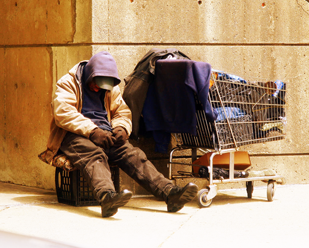
On Sept. 16, California Gov. Gavin Newsom joined by state officials representing cities and counties wrote a letter that urged President Donald Trump to recognize homelessness as a “national crisis decades in the making that demands action at every level of government to alleviate California’s homeless.
Carson’s Sept. 18 reply said in part, “California cannot spend its way out of this problem using Federal funds…More vouchers are clearly not the solution the State needs. To address this crisis, California must reduce its regulatory burdens on housing.”
Advocates for homeless and low-income people strongly disagreed with Carson’s assessment. “We know that the number one cause of homelessness is the lack of affordable housing,” said Megan Hustings, managing director of the National Coalition for the Homeless.
“Consumers are already struggling with crushing debt from student loans and medical expenses, or facing triple-digit interest rates when they attempt to access small-dollar loans,” noted Marisabel Torres, director of California Policy with the Center for Responsible Lending, “When they also have to pay some of the highest housing costs in the nation, it is unfortunately unsurprising that there are such large numbers of homeless people in many of California’s large cities.
“California’s homeless may be the largest by state, but the problem is a national one that deserves to be recognized and acted upon,” Torres said.
In 1987 there was an expression of national will to respond to America’s homeless through enactment of the McKinney Homeless Act. That statute created the U.S. Interagency Council on Homelessness dedicating the ongoing support of 19 federal agencies to prevent and end homelessness. HUD is one of the participating agencies. The Council on Homelessness even has a written plan, “Home, Together,” that lays out federal remedies over the fiscal years of 2018-2022.
Charlene Crowell is the communications deputy director with the Center for Responsible Lending. She can be reached at Charlene.crowell@responsiblelending.org. This post originally appeared in The Washington Informer.