Category: Politics

  • Newswire: Court Rejects Alabama House Map, Calling It Unfair to Black Voters

    Newswire: Court Rejects Alabama House Map, Calling It Unfair to Black Voters

    by Emily Cochrane and Abbie VanSickle, The New York Times

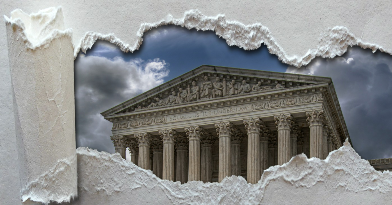
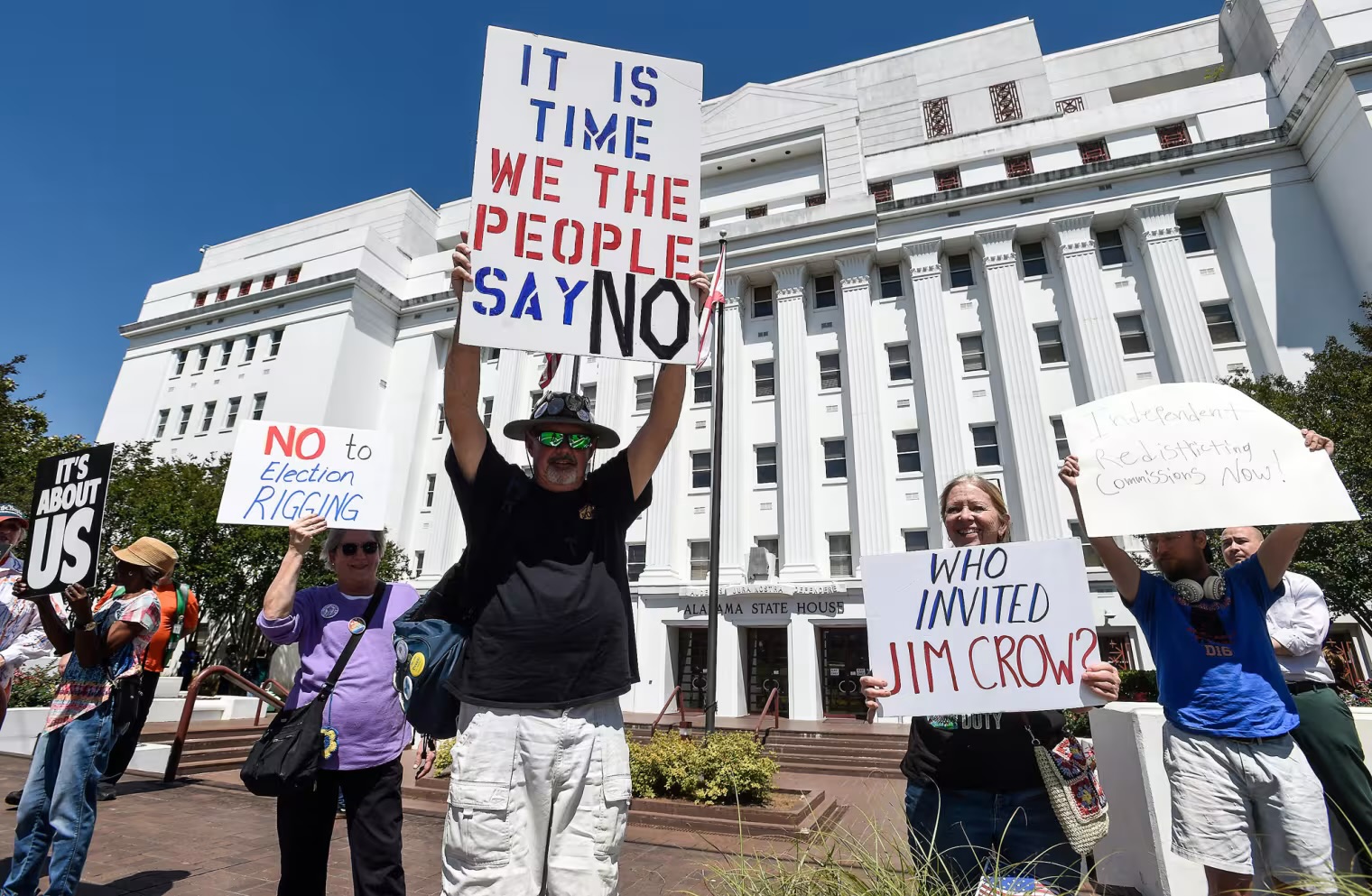
    A panel of federal judges on Tuesday rejected Alabama’s effort to use a new voting map for the November midterm elections, saying that the districts discriminated against Black people and could not be used so shortly before a vote.

    Alabama’s attorney general, Steve Marshall, said he would immediately appeal to the Supreme Court, which last month ruled that a Louisiana congressional map drawn to create two majority-Black House districts was an unconstitutional racial gerrymander. Gov. Kay Ivey, a Republican, has already set special primaries in August in four House districts that would be affected by her state’s new congressional map.

    The ruling further confuses the electoral landscape across the South, as Republican-led legislatures have raced to implement new district lines after the Supreme Court narrowed the Voting Rights Act of 1965. It also demonstrates how the ruling from the nation’s highest court has further muddled how lower courts interpret the landmark civil rights law.

    If the case makes it to the Supreme Court, it will be the first major test of the high court’s new standard for challenging congressional maps. The lower court judges made clear that they had reviewed the arguments through the lens of the Supreme Court’s Voting Rights Act ruling last month but maintained that the state’s map failed under the new standard by intentionally discriminating against Black voters.

    “We cannot see our way clear to requiring Alabamians to cast their votes in the 2026 elections under a districting plan tainted by intentional race-based discrimination,” the panel of three judges wrote in a lengthy ruling. It also warned against causing voters additional confusion by trying to use a new map before the November elections. 

    The court, the panel wrote, was “painfully aware of the gravity of our ruling.” But, it added, “we do not find the issue particularly complex or close.”

    The decision out of the Birmingham-based federal court was issued by Judge Stanley Marcus, who was nominated to the bench by former President Bill Clinton; and by Judges Anna M. Manasco and Terry F. Moorer, both named to their posts by President Trump. (Judge Marcus typically sits on the U.S. Court of Appeals for the 11th Circuit, in Atlanta.)

    Mr. Marshall, the attorney general, said he was “disappointed, but not at all surprised” by the ruling.

    “Know this,” he added, “in my mind, it is not a matter of whether we win this case, only when.”

    In the 79-page ruling, the judges said they faced a difficult choice. They could either greenlight a map they had already concluded was intentionally discriminatory, or they could block that map for the current election. 

    The judges wrote that they did “not lightly intrude in state affairs,” but that their previous review had left them “in no doubt” that Alabama’s map “intentionally discriminated based on race in violation of the Constitution.”

    The panel explained that it had reviewed the case under the Supreme Court’s updated standard, which appears to allow partisan gerrymandering but sets a high standard to challenge maps for race discrimination.

    The judges wrote that the “enormous record” around the drawing of the districts “contains no evidence of a partisan motive.” Their ruling, they wrote, marked a rejection “in the strongest possible terms” of Alabama’s “attempt to finish its intentional decision to dilute minority votes with a veneer of legislative regularity.”

    The decision also wrestles with two issues that have arisen in other states scrambling to redraw their maps in the middle of the primary season: the burden on election officials and the potential for significant voter confusion.

    In tackling these two arguments, the court cited what is known as the Purcell principle, a doctrine that federal courts should generally avoid changing rules too close to an election to avoid voter confusion. When Alabama changed its maps recently, the court argued, voter confusion spiked.

    Citing testimony from the Alabama director of elections, Jeff Elrod, the court said “it will take a chaotic, decentralized, and herculean effort for officials in his office and fourteen counties to reassign voters” to new districts. 

    While the decision was carefully tailored to apply only to specific questions about the redistricting procedures in Alabama, the whiplash in the state could ripple outward. State senators in South Carolina on Tuesday plan to continue to debate a new congressional map that could eliminate the last majority-Black district in the state, even as early voting begins. 

    Alabama has been tangled in litigation over its congressional map for years and had been barred from redistricting until after the 2030 census. Black voters have argued that the state has unfairly undercut their power at the ballot box. More than one in four residents of Alabama are Black.

    But in June 2023, the court stunned many legal watchers by siding with the argument that Alabama had violated the Voting Rights Act and needed to draw a second district with a majority of Black voters or come “close to it.”

    Shortly after, lawmakers returned to Montgomery, the state capital, and drew a new map. But wary of pitting incumbent Republicans against one another, the legislature approved a map that increased the percentage of Black voters in one district to about 40 percent, from about 30 percent.

    This panel of federal judges struck down that map and ordered an independent special master to draw district lines. The master’s map was used in 2024, paving the way for the election of Representative Shomari Figures, a Black Democrat. And it was this map that the federal court said should remain in place for the November elections. 

    “This is a significant step in the right direction, but there is still a long way to go before this fight is settled,” said Mr. Figures in a statement on Tuesday morning.

    Representative Barry Moore, a Senate candidate who currently represents one of the districts that could change under the new map, decried “another example of unelected bureaucrats trying to override the will of Alabama voters and punish our state for standing its ground.” 

    After last month’s Supreme Court decision rejecting Louisiana’s congressional map, Republicans in Southern states saw an opportunity to redraw districts that had core blocs of Black voters who repeatedly elected Democrats, adding to an ongoing gerrymandering battle launched by President Trump and his allies in Texas.

    In Alabama, state officials instead pushed to use the 2023 map, a move the Supreme Court cleared the path for earlier this month. However, it still left the decision up to the federal panel of judges, the same one that rejected the congressional map.


    Nick Corasaniti contributed reporting.

    Featured image credentials: Wes Frazer for The New York Times

  • Newswire: They Can’t Win On Policy, So They’re Rigging The Rules

    Newswire: They Can’t Win On Policy, So They’re Rigging The Rules

    by Ashley Marshall, Co-Founder and Brittany Cheatham, Director of Communications with Forward Justice

    As America approaches its 250th birthday, we can look around us and see all the ways our democracy and society have been enriched by becoming more inclusive. Yet, recent regressions in law and policy are attempting to cement us to a reality where only wealthy, white men have a voice, a vote, or access to political power. Attacks are not happening in isolation; they are coordinated attempts to silence the people and destroy the bedrock of our democracy to keep its promises from being truly realized.


    Last week, the Supreme Court issued its decision in Lousiaina v. Callais, a 6-3 ruling along ideological lines that struck down Louisiana’s congressional map that added a second majority-Black district, and in doing so, gutted Section 2 of the Voting Rights Act. Then, on May 6, the Supreme Court shot down a request to delay the order. We cannot be more clear: this was not a ruling about one state’s map. It marks a fundamental shift in the constitutional understanding of equality, voting rights, and officials’ power to wage “lawfare” against their constituents. We see this ongoing erosion of voting rights by all branches of government, and instead of upholding the constitution and ensuring checks and balances, this court continues to eviscerate precedent and progress, demonstrating their allegiance to party over people. 


    For over four decades, Section 2 of the Voting Rights Act operated on a clear principle: when electoral systems produce racially discriminatory results, they violate federal law, even when proof of discriminatory intent is absent. Congress amended the VRA in 1982 to make this clear because they knew that lawmakers who want to suppress Black votes rarely announce it. 


    Thirteen years ago, in Shelby County v. Holder, the Supreme Court stripped the federal government of the ability to block discriminatory voting changes before they could take effect, and promised that Section 2 of the Voting Rights Act would remain a safeguard. That safeguard is now effectively gone. Since the Shelby decision, for over a decade, the North Carolina General Assembly has waged a death by a thousand cuts campaign against voting rights in the state- always under the cover of administrative process, election integrity, or partisan fairness. A federal court found that North Carolina’s redistricting plan was one of the largest racial gerrymanders ever encountered, and their voter suppression legislation was found to target Black Americans “with almost surgical precision,” in our lawsuit, NAACP v. McCroy.  


    In NC NAACP v. Hirsch, our photo voter ID lawsuit in North Carolina, voters were told that the Voter ID Exception Form would be a safeguard for those without IDs. Now that a court has issued a ruling in the case, officials are working to eliminate that exception form. We continue to see this same ploy: Remove protections under the guise of “race-neutrality,” point to insufficient remedies as solutions, and then strip away those remedies. What remains in the wake of this scheme are entire communities- taxpayers, parents, essential workers- who are shut out of their democracy and silenced, although they continue to be the core of their communities. 


    Ignoring the impact of race is a continuation of decades of racist disenfranchisement and centuries of white supremacy and policy violence, aimed at the very people whose forced labor built — and continues to build — this country. We cannot be “race neutral” in a country that was founded on racist ideology and expect true progress, equity, and repair. There must first be acknowledgment, but what we continue to experience is erasure, disregard, and persistent devastating harm.


    Without federal oversight and protections, instead of changing their deeply unpopular policies, officials are methodically changing their electorate. They are attempting to handpick their voters so they can remain in power while silencing those who disagree with them, and our courts continue to uphold this assault at every level. Instead of dogs, water hoses, poll taxes, and batons, the tools of suppression today are gerrymandering, voter ID requirements, and legislation like the SAVE Act. The targets have always been the same: Black and brown voters, poor people, women, students- the very people whose organizing has driven the most transformative change this country has ever known.


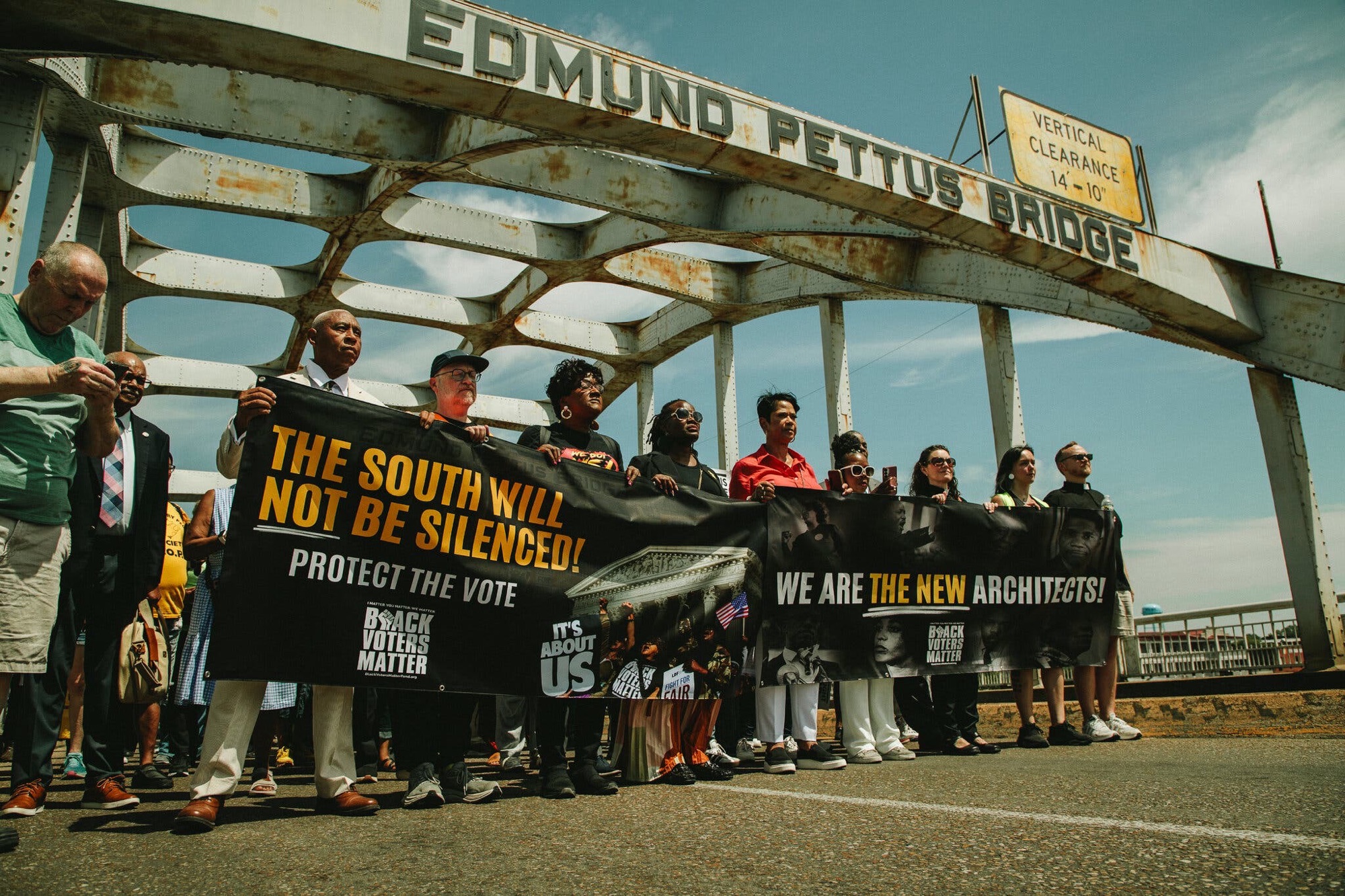
    We know the South drives policy and change throughout this nation, and we have been here before. Some of the most transformative policies in this country have come from the organizing done right here in the South. An Analysis by Fair Fight Action and Black Voters Matter found that the Callais ruling could eventually lead to a redistricting wave that could help Republicans flip as many as 19 majority-minority seats currently held by Democrats. This ruling has cleared a path for this dangerous practice to spread across the South and beyond, but we will continue the legacy of Southern organizing that has always moved this nation forward.


    We launched the POV NC tour to connect with, educate, and empower voters across this state in the face of exactly this kind of assault. We heard from people in counties across North Carolina who all want the same thing: to be heard, and to have officials who enact policies that are just, equitable, and for the people. These are not unreasonable expectations; they are the foundational promise of democracy. We are still fighting unfair maps right here in North Carolina. We are still fighting photo voter ID. We filed an appeal the same day this ruling came down, and we are not stopping. 


    Fear of the people and fear of being accountable to the people are driving this wave of “lawfare” and policy violence. Many elected officials know they cannot win based solely on their policies and results, so they are changing the rules. They are more focused on power and gamesmanship than the needs of the people, and they know we can see through the facade. Their fear is its own acknowledgment of our power and progress.


    Our democracy is on life support because of relentless attacks from the very people who are supposed to uphold and steward it. But we know that it has always been the power and work of the people to heal, rebuild, and reimagine when those in power fail us. This fight is not over. Full, equitable access to our democracy is our right. We will continue building power and resources in our communities. We will continue to mobilize and demand accountability. We will rise from the ashes of the democracy they are trying so desperately to burn down, and we will build anew- and that new democracy will be rooted in humanity, equity, and most of all, love.

  • Newswire: Promising Practices in Early Learning for Black Boys

    Newswire: Promising Practices in Early Learning for Black Boys

    from BlackPressUSA, by Oakland Starting Smart and Strong

    Educators across the United States are increasingly recognizing that early childhood classrooms play a critical role in shaping how children see themselves, relate to others, and experience opportunity. Yet for many young Black boys, those experiences are too often shaped by inequitable systems, unconscious bias, and policies that fail to support their growth and potential. A new toolkit, 10 Promising Practices in Early Learning for Black Boys, offers a roadmap for educators and early learning programs seeking to create more equitable, affirming, and culturally responsive environments for Black children.  


    At the center of the framework is the importance of building trusting relationships. The toolkit emphasizes that educators must actively listen to families, learn about their cultural values, and communicate genuine care for children’s well-being. Families should feel that teachers respect their experiences, understand their goals for their children, and see their strengths rather than deficits. Educators are encouraged to communicate clear messages to Black boys and their families: that children are safe, valued, heard, and capable contributors to the classroom community.  


    One major recommendation involves “individuating,” or dedicating intentional one-on-one time with Black boys. Rather than focusing on what children cannot do, educators are encouraged to observe their interests, strengths, creativity, and curiosity. Positive affirmations—both verbal and nonverbal—are emphasized as essential tools for reinforcing confidence and belonging. Teachers are urged to celebrate children’s progress and hold high expectations while consistently affirming their brilliance and potential.  


    The toolkit also highlights the need for culturally and linguistically responsive classrooms. Traditional curricula often fail to reflect the experiences and identities of Black children, leaving many students disconnected from classroom content. Educators are encouraged to adapt curriculum materials so Black boys can see themselves represented in books, activities, discussions, and lessons. The guide describes this as creating both “windows and mirrors” — opportunities for children to see themselves reflected while also learning about the experiences of others.  


    Family engagement is another major theme throughout the report. The toolkit calls for schools and early learning programs to build meaningful partnerships with families and actively involve fathers and father figures. It notes that many Black fathers have historically felt excluded or undervalued in educational settings. Educators are encouraged to ask fathers how they would like to participate and then create opportunities for involvement and leadership.  


    Importantly, the report urges educators to reject “deficit-based” thinking about families. Instead of focusing on stereotypes or assumptions, teachers should discuss children’s strengths, talents, and dreams with caregivers. Families should be treated as partners in developing educational goals and supporting student success.  


    The toolkit also addresses the role of structural racism and implicit bias in education. It calls for educators to deepen their understanding of white supremacy culture, privilege, colorism, and the ways bias affects Black boys disproportionately. Teachers are encouraged to participate in anti-racism training, engage in ongoing self-reflection, and examine how media, personal experiences, and social messaging influence their perceptions of Black children.  


    Another significant focus is trauma-responsive care. The report emphasizes that behavior should be understood as communication rather than defiance. Educators are urged to move away from labeling children as “challenging” and instead consider whether behaviors may stem from trauma, stress, disability, or unmet emotional needs. Teachers are encouraged to practice self-regulation techniques and respond calmly and compassionately to difficult situations.  


    Finally, the toolkit calls for broader institutional and policy changes. Schools and early learning programs are encouraged to examine disciplinary practices, eliminate harsh punishments such as suspensions and expulsions, and invest in mental health supports and culturally responsive professional development. Administrators are urged to collect meaningful equity data and include Black boys’ voices in evaluating school progress and goals.  


    Ultimately, 10 Promising Practices in Early Learning for Black Boys presents a vision of education rooted in equity, dignity, and belonging. It argues that when educators intentionally affirm Black boys’ identities, challenge systemic inequities, and partner authentically with families, early learning environments can become places where every child has the opportunity to thrive.  


    Learn more at www.oaklandsmartandstrong.org/promisingpracticesportfolio.html 

  • What to know about Trump-Xi summit with trade, Taiwan and Iran on the agenda

    What to know about Trump-Xi summit with trade, Taiwan and Iran on the agenda

    by E. Eduardo Castillo and Huizhong Wu, AP News

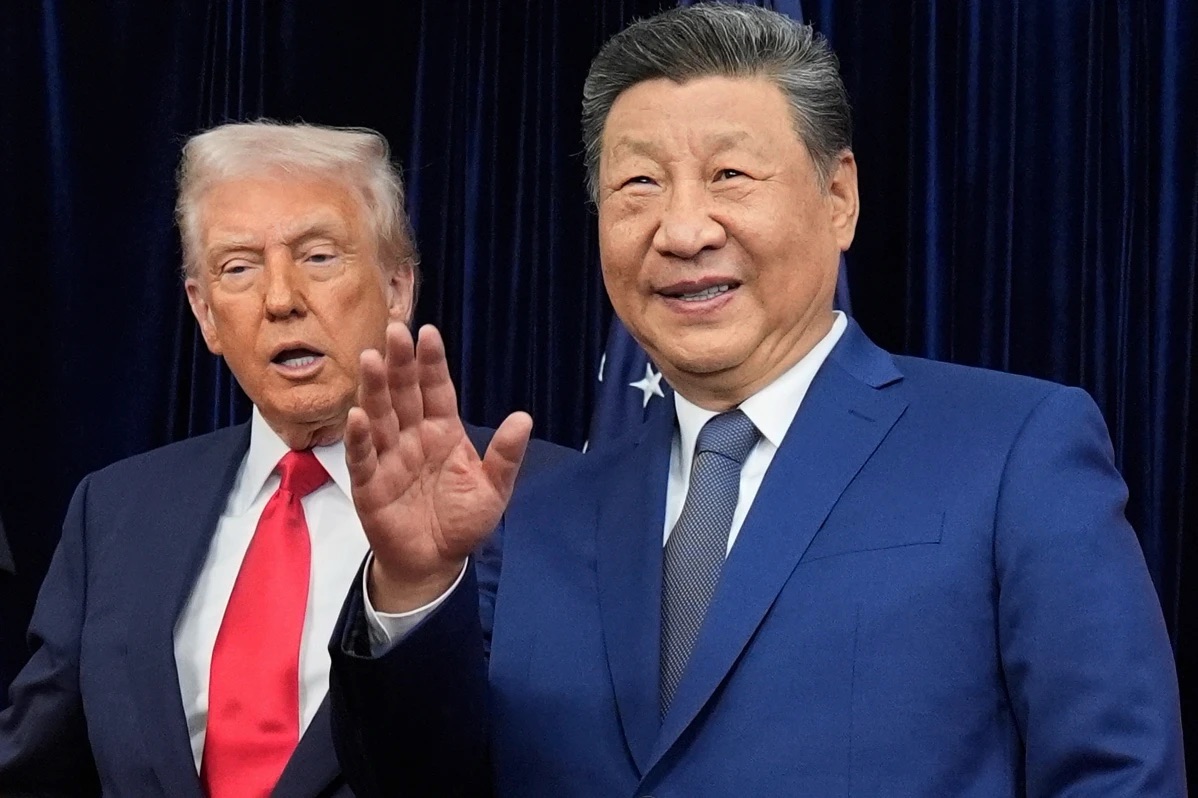
    BEIJING (AP) — As Presidents Xi Jinping and Donald Trump prepare for a highly anticipated summit, both China and the United States say their ties have been broadly stable in recent months — and they are planning on keeping it that way.

    But many issues are at stake in one of the world’s most consequential relationships, with no easy end in sight. 

    Few expect major breakthroughs to the long-running frictions between China and the U.S., which range from competition in technology to the thorny question of Taiwan, whose main ally is the U.S. Ending the war with Iran is likely to be added to the agenda, with Beijing being one of the unofficial mediators in the conflict.

    “On both sides there is a consensus that U.S.-China stability is important,” said Henrietta Levin, senior fellow for the Freeman Chair in China Studies at the Center for Strategic and International Studies in Washington. “Once you get past the question of stability, the ‘what’s next’ in the relationship gets a little more complicated, and so for that reason, the most likely thing to come out of the meeting is very little.”

    Here’s what to know about the summit:

    There may be a trade deal, but not a resolution

    The China-U.S. trade war started with Trump’s first term, but turned up a notch in April last year, on Trump’s so-called “Liberation Day,” when he announced 34% tariffs on all Chinese goods. China retaliated with counter tariffs and other measures, such as restrictions on rare earth exports. Tariffs reached as high as 145% in the escalating back and forth.

    The two sides, realizing the sky-high tariffs weren’t sustainable, then called for a trade truce, halting many of the punitive economic measures. The two leaders met in South Korea in Octoberand extended the truce for another year. China promised to purchase soybeans from American farmers, while the U.S. dropped tariffs by more than half.

    “China’s strategy was to promote stability by fighting back,” said Fudan University professor Zhao Minghao, an expert in international relations. “Both sides could very well issue a comprehensive trade agreement this time. But this doesn’t mean the war is over, and the agreement will have conditions.”

    Last year’s trade truce did not resolve any of the bigger picture issues, and it did not mean a return to how things were. China now has a new export permit requirement for rare earth exports that it can tighten at any time.

    Further, this time around, “there’s been a lack of the intensive type of engagement that has characterized past summits,” said Wendy Cutler, vice president of the Asia Society, and a former trade negotiator for the U.S. 

    China in April issued new regulations that built out a framework for identifying and countering foreign measures targeted at Chinese companies. Under the new rules, for example, China’s Ministry of Commerce told impacted companies, such as one petroleum refinery that bought Iranian crude oil, to ignore U.S. sanctions. 

    Although some say the sides could announce a continuation of the trade truce, they note they have continued to take targeted actions. “It’s a fragile truce,” said Cutler.

    The White House said Sunday they are also planning to discuss creating a new “Board of Trade” to keep their countries talking on economic issues.

    China’s ability to buy high-tech chips is still a thorny issue 

    The U.S. imposed restrictions on exports to China of advanced computer chips and related tech, such as the machines to make the chips, as early as Trump’s first term in office. 

    Nvidia, a California company and the leading designer of advanced chips, has pressed Trump to allow it to export them to China. Nvidia founder Jensen Huang has argued that selling the chips will build reliance on American tech for Chinese AI firms.

    But the increasing list of restrictions on chip exports may only push China deeper in its drive for self-reliance. “China’s attitude has changed subtly, it seems more focused on advancing its domestic chip industry rather than continuing to rely on advanced chips from the United States,” Zhao said in written comments. 

    China sees Taiwan as the ‘biggest risk’ in ties with the US

    Two weeks before the meeting, Chinese Foreign Minister Wang Yi said in a call with U.S. Secretary of State Marco Rubio that the bilateral relationship has remained generally stable, but Taiwan remains the “biggest risk” to their ties. China signaled again on Thursday that Taiwan would be a top priority for discussion. 

    Few expect a resolution to the Taiwan issue, lingering since China and Taiwan split in a civil war in 1949. While Beijing claims Taiwan, the island is a self-ruled democracy. 

    Tensions have only risen since Taiwan first elected Tsai Ing-wen as president in 2016. Her Democratic Progressive Party says Taiwan is functionally independent and its own sovereign state. Beijing has broken off communication with Taiwan’s government, and in recent years, started sending warplanes and warships closer to the island in almost daily drills. 

    The island’s current president, Lai Ching-te, is also from the DPP. Beijing has criticized Lai repeatedly, even depicting him as a “parasite” in propaganda imagery for its military exercises. 

    The U.S. is required by law to ensure Taiwan can defend itself but officially maintains a position of what has been called strategic ambiguity, leaving the question of whether the U.S. would get involved militarily if China decided to reclaim Taiwan by force. Trump has also said recently that he discussed arms sales to Taiwan with Xi, which led to further questions of whether the U.S. would support Taiwan

    “One possibility is that China and the U.S. can take the strategy of a sort of ‘reciprocal restraint’, such as reducing the number of American arms sales to Taiwan, in exchange for fewer military exercises from the mainland aimed at Taiwan,” said Zhao.

    The US wants China to put pressure on Iran

    As the world awaits an end to the war in Iran that has shaken the global economy, the conflict is likely to surface in the talks. 

    China has openly criticized the United States and Israel over the war. In addition, given its close political and economic ties with Iran, it is seen by some as an unofficial mediator that could influence Tehran. So far, Beijing has remained cautious, preferring to not get deeply involved.

    “I don’t think China has any interest in solving the problems the U.S. has created for itself in the Middle East,” Levin, of the Center for Strategic and International Studies, said. 

    A few days before the trip, U.S. Treasury Secretary Scott Bessent called on China to pressure Iran to open the Strait of Hormuz, and said that by buying Iranian oil, Beijing is funding terrorism.

    “Let’s see if China — let’s see them step up with some diplomacy and get the Iranians to open the strait,” Bessent said on Fox News. “Iran is the largest state sponsor of terrorism, and China has been buying 90% of their energy, so they are funding the largest state sponsor of terrorism.”

    Wu covers Chinese culture, society, and politics for The Associated Press, as well as the country’s growing overseas influence from Bangkok. She was previously based in Taiwan and China.

  • Supreme Court lets Alabama speed adoption of congressional map eliminating a majority-Black district

    Supreme Court lets Alabama speed adoption of congressional map eliminating a majority-Black district

    by Lawrence Hurley, NBC News

    WASHINGTON — The Supreme Court on Monday removed an obstacle to Alabama’s using a new congressional map in this year’s election that would eliminate one of the state’s two majority-Black districts.

    The court, over the objection of its liberal members, sent litigation over the Republican-drawn map back to the lower court, which could speed up the state’s effort to use its map.

    The state has been battling civil rights plaintiffs over its congressional map for years, with a focus on whether a second majority-Black district was required to comply with the 1965 Voting Rights Act.

    The latest flurry of court filings came in light of the Supreme Court’s ruling on April 29 in a case from Louisiana that undermined a key provision of the law, making it much easier for states to draw districts that dilute minority voting rights.

    The court fast-tracked the Alabama case a week after a similar decision in the Louisiana dispute. Both decisions are a boon to Republicans, who are locked in a redistricting war with Democrats triggered by President Donald Trump, with control of the House at stake.

    In a dissenting opinion, liberal Justice Sonia Sotomayor said the court action was “inappropriate and will cause only confusion as Alabamians begin to vote in the elections scheduled for next week.”

    The Alabama litigation includes a claim that the state’s favored map intentionally discriminates against Black voters, a finding that may not be affected by the Louisiana ruling, Sotomayor added.

    Alabama’s appeal of the lower court ruling that invalidated its map was on hold at the Supreme Court while it decided the Louisiana case. As soon as the ruling was issued, Alabama Attorney General Steve Marshall asked the justices to act quickly on its appeal so the state can move forward with using its preferred map.

    The Legislature has already passed legislation, signed into law by Republican Gov. Kay Ivey, that would push back the state’s primary elections, which were originally due to take place May 19.

    The Alabama litigation dates to the map the state drew immediately after the 2020 census, which included one majority-Black district. The state, which has a population that is more than a quarter Black, has seven congressional districts.

    Civil rights plaintiffs successfully challenged that map, winning a surprising ruling at the Supreme Court in June 2023.

    The state then sought to try again, drawing a new map — the one the state currently wants to use — that still included one majority-Black district, but the Supreme Court rejected that effort, too, in September 2023. 

    That led to a court-drawn map with two majority-Black districts’ being used in the 2024 election. Democrats won both races.

  • Cory Booker Unveils ‘Keep Your Pay Act’ To Make First $75K Of Income Tax-Free

    Cory Booker Unveils ‘Keep Your Pay Act’ To Make First $75K Of Income Tax-Free

    by Shannon Dawson, NewsOne

    New Jersey Senator Cory Booker has announced a new tax proposal called the Keep Your Pay Act, which he introduced in the Senate on March 9. If passed, the bill would be a game changer for Americans, helping citizens to keep their hard earned cash in their pockets come tax season. 

    The Keep Your Pay Act argues for no federal income tax for the first $75,000 in income. 

    According to a press release, at the centerpiece of the plan is a straightforward idea: the first $75,000 of income would be tax-free for households filing jointly, with proportional tax relief for single filers and heads of household. Booker’s proposal would more than double the standard deduction for taxpayers.

    Under current guidelines from the Internal Revenue Service, the standard deduction for 2025 is $15,750 for single filers or those married filing separately, $31,500 for married couples filing jointly or a qualifying surviving spouse, and $23,625 for heads of household. 

    If Booker’s proposal were enacted, many married taxpayers would pay no federal income tax on the first $75,000 they earn. According to NBC News, individual (Single) filers would receive a standard deduction of $37,500 while head of household would receive a standard deduction of $56,250 under the legislation.

    The Child Tax Credit would expand under the bill if passed.

    The Keep Your Pay Act would also expand the Child Tax Credit through the American Family Act. Under the plan, the credit would increase to $3,600 per child ages 6 to 17 and $4,320 for children under six. It would also include a $2,400 “baby bonus” in the year a child is born to help families cover the high upfront costs of welcoming a newborn. The credit would be fully refundable so that families with lower incomes can still receive the full benefit.

    It would also boost age eligibility for the Earned Income Tax Credit.

    In addition, the plan would expand the Earned Income Tax Credit through the Tax Cut for Workers Act. The measure would extend eligibility to younger workers ages 19 to 24 and older workers 65 and above—groups that are currently excluded from receiving the full benefit—while also tripling the value of the credit to deliver additional relief to workers without children in the home.

    Booker says the proposal would be fully paid for by closing tax loopholes used by wealthy individuals and large corporations and requiring them to pay a larger share. Measures could include raising the corporate tax rate, strengthening corporate tax rules, increasing taxes on stock buybacks, tightening limits on deductions for executive compensation, and addressing other tax avoidance strategies.

    “The tax system is rigged, we all know this,” Booker told supporters in a video shared to his X account on March 9. “It’s rigged against working people and all full with things that help people with a lot of money—whether it’s corporations or billionaires—avoid paying taxes.”

    Why is Cory Booker proposing this?

    The plan is designed as a sweeping response to a range of economic concerns, including rising costs and wages that have struggled to keep pace with essentials such as housing and health care.

    “You should keep more of your money,” Booker added in his video shared Tuesday, March 2.

  • ANSA makes endosements for local races

    ANSA makes endosements for local races

    Alabama New South Coalition (ANSA) has endorsed the following candidates for the May 19, 2026, Primary Election:

    • Greene County District Judge – Tonjula Carey
    • Greene County Sheriff – DeAngelo Hall
    • Greene County Commission District 1 – Garria Spencer
    • Greene County Commission District 2 – No endorsement
    • Greene County Commission District 3 – Jacqueline Stewart
    • Greene County Commission District 5 – Roshonda Summerville
    • Greene County Board of Education District 3 – No endorsement
    • Greene County Board of Education District 4 – Leo Branch
    • Greene County Board of Education District 5 – Joe N.Webb
    • Alabama House of Representatives #72 – Curtis Travis
    • Governor – Doug Jones.
  • Stewart announces candidacy for Greene County Commissioner District 3

    Stewart announces candidacy for Greene County Commissioner District 3

    My name is Jacqueline Stewart, and I’m running for Greene County Commissioner, District 3. I’m running because I believe our community deserves strong leadership, responsible decisions and a clear vision for the future. This county is more than just where we live, it’s our home.

    MOVING FORWARD WITH YOU IN MIND

    Like many other counties, we are facing real challenges maintaining our roads, supporting public safety, and making sure our tax dollars are spent wisely.

    If elected, my priorities are simple and focus on what matters most to you.

    • Infrastructure – we all know the conditions of our roads and I will make sure that our roads and bridges are properly maintained.
    • Public Safety – Our law enforcement, firefighters and EMS deserve our full support. I would make sure that they have the resources they need to keep our community safe and provide us with services.
    • Economic Development – Work with the Industrial Board to attract good jobs while supporting our local businesses. Work alongside the hospital and school board to assist in any way possible.
    • Transparency and accountability – I will always be open, accessible and willing to listen

    I would like to continue the leadership and dedication of Commissioner Corey Cockrell. His commitment to serving this community, especially our senior citizens, our youth, and our county. He has laid a strong foundation and I’ m committed to that vision.

    I’m not running to make promises I can’t keep. I’m running to work hard, listen carefully, and make decisions that put our community first.

    Together we can move forward.

    On May 19, 2026, I ask for your support, your vote, and your trust to elect me as Greene County Commissioner, District 3.

  • Newswire: SCOTUS Callais Decision Delivers Major Blow To Black Voting Rights

    Newswire: SCOTUS Callais Decision Delivers Major Blow To Black Voting Rights

    Above, Janai Nelson, President and Director-Counsel of the NAACP Legal Defense Fund, speaking at a “Fight for Fair Maps” rally.

    by Anoa Changa-Peck, NewsOne

    For months, voting rights advocates have warned that the Supreme Court would use its decision in Louisiana v. Callais to strip away Section 2 of the Voting Rights Act, further eroding freedom. 

    And they were right. 

    Decided along ideological lines, Wednesday’s 6-3 decision blocked a Black-majority congressional district in Louisiana just weeks before voters head to the polls. A second Black-majority congressional district was created after voters and organizers fought for fair representation after the 2020 Census. 

    As NewsOne previously reported, Wednesday’s decision comes after the Supreme Court gave an anti-voting rights group a second chance to make its case. Originally heard in March, 2025, the case was rescheduled for rehearing in October, giving opponents of fair maps more time to invent reasons to deny Black voter power. 

    The majority opinion attempts to narrowly tailor the case to Louisiana only. Instead, by many accounts, Callais aids the Republican plan to lock up power for the next generation. 

    Joel Payne, spokesperson for MoveOn Civic Action, said the Court’s decision gave Republicans the green light to continue Trump’s “desperate power grab.”

     “Suppressing voters is another way for Trump and Republicans to rig the system so they can keep stacking the deck for billionaires and the Epstein class and avoid accountability for their failed leadership,” Payne said in a statement. “MoveOn members will fight this naked MAGA power play to hoard more power and wealth for themselves and the billionaires that fund their campaigns.” 

    Almost immediately after the Callaisrelease, Florida House Republicans passed an even more extreme gerrymander than the state’s current congressional map. In many ways, Florida’s move is a replay of the aftermath of the 2023 decision Shelby County v. Holder, when Texas and North Carolina rushed to pass racially discriminatory laws previously blocked under the Voting Rights Act. 

    Pro-democracy advocates have consistently stressed the need for full voting rights and fair maps to ensure communities have a say in the issues impacting their lives. Affordable housing, healthcare access, the cost of living, gun safety, and fundamental fairness require leadership that listens to and considers people’s needs. 

    Becky Pringle, president of the National Education Association, highlighted the importance of educators being committed to basic values of fairness and equity as a part of teaching responsible citizenship. 

    “People died to protect and advance this right,” Pringle said in a statement. “The reason we have voting rights laws in America is to remedy discrimination against voters of color. If the Supreme Court does not recognize the need to continue upholding this basic value of one person, one vote, then Congress must stop stalling and pass the John Lewis Voting Rights Advancement Act.”

  • Newswire: RFK Jr. set to face Bill Cassidy in back-to-back Senate hearings

    Newswire: RFK Jr. set to face Bill Cassidy in back-to-back Senate hearings

    RFK Jr. talking with Senator Bill Cassidy

    by Berkeley Lovelace Jr., NBC News

    Health Secretary Robert F. Kennedy Jr. heads to Capitol Hill on Wednesday on a potential collision course with the Republican who helped put him in the job: Sen. Bill Cassidy of Louisiana.

    It will be Kennedy’s first appearance in nearly a year before the Senate Health, Education, Labor, and Pensions Committee, which Cassidy chairs. The senator, who is up for re-election, cast the key vote to confirm Kennedy last year after securing a series of promises from Kennedy, including that he would preserve federal vaccine recommendations and regularly appear before the committee.

    Kennedy has not kept those promises; Cassidy has limited his criticism of the health secretary to posts on social media and press statements.

    Cassidy, however, has been vocal in his support of vaccines, including during the March confirmation hearing for Dr. Casey Means, President Donald Trump’s pick for surgeon general. Means is a Kennedy ally who has questioned vaccines. Cassidy has not yet scheduled a vote to advance Means’ nomination.

    Wednesday’s hearing will mark Kennedy’s first appearance before Cassidy since a confrontational Senate Finance Committee hearing in September and could offer the clearest sign yet of how the senator plans to handle those concerns. A spokesperson for Cassidy declined to comment on what the senator plans to ask Kennedy.

    Kennedy is also expected to face questions from Sen. Thom Tillis, R-N.C., who is retiring next year and has said he plans to speak more freely about his views, including on members of Trump’s Cabinet. (Tillis voted to confirm all members of Trump’s Cabinet in 2025.)

    Kennedy will appear before the Finance Committee in the morning and the HELP Committee in the afternoon.

    In January, Kennedy overhauled the childhood vaccine schedule, reducing the number of recommended diseases for children to be vaccinated against from 18 to 11 — a move Cassidy later said in a post on X would “make America sicker.” The changes removed recommendations that all babies should be protected against hepatitis A, hepatitis B, RSV, dengue, and two types of bacterial meningitis.

    In March, a federal judge blocked those changes and put on hold the new members Kennedy appointed to the Centers for Disease Control and Prevention’s vaccine advisory committee. The administration hasn’t yet appealed the ruling. But Kennedy signed off on new rules for the committee that could make it easier to work around the court’s decision.

    Dorit Reiss, a vaccine policy expert at the University of California Law School, San Francisco, said she hopes that Cassidy will hold Kennedy accountable.

    “There’s a raging measles outbreak,” Reiss said. “Kennedy may have given lukewarm endorsements to the MMR vaccine but, as far as I know, hasn’t made any efforts to call on people to vaccinate or to do anything practical to reduce the risk.”

    Kennedy has already testified at five congressional hearings over the last week. He has faced blistering criticism from Democrats over his vaccine policy and overhaul of federal health agencies. At one hearing, Kennedy said the U.S. has “done better” at preventing measles than any other country.

    “Judging by Secretary Kennedy’s recent testimony to Congress, he is likely to continue to gaslight the Senate Finance and HELP committees,” said Lawrence Gostin, director of the O’Neill Institute for National and Global Health Law at Georgetown University. “He continues using terms like ‘world-class science,’ ‘rigorous evidence,’ and ‘radical transparency,’ when in fact he has done the opposite.”

    In an emailed statement, Andrew Nixon, a spokesperson for the Department of Health and Human Services, called what Gostin said “a baseless accusation that doesn’t match reality.”

    Another potential wild card for Kennedy is Tillis, a Republican who is not seeking re-election, Reiss said.

    During the September hearing, she noted, Tillis suggested that Kennedy had broken his promises on vaccines, saying, “I do also believe that some of your statements seem to contradict what you said in the prior hearing.”

    “The fact that you’re a Republican doesn’t mean that you need to blindly accept [Kennedy’s actions],” Reiss said.

    A spokesperson for Tillis did not immediately respond to a request for comment.

    Kennedy could also face questions about his recent comments to overhaul the U.S. Preventive Services Task Force, a federal panel that makes recommendations on preventive services, including cancer screenings, as well as on Trump’s executive order meant to spur research into psychedelics.