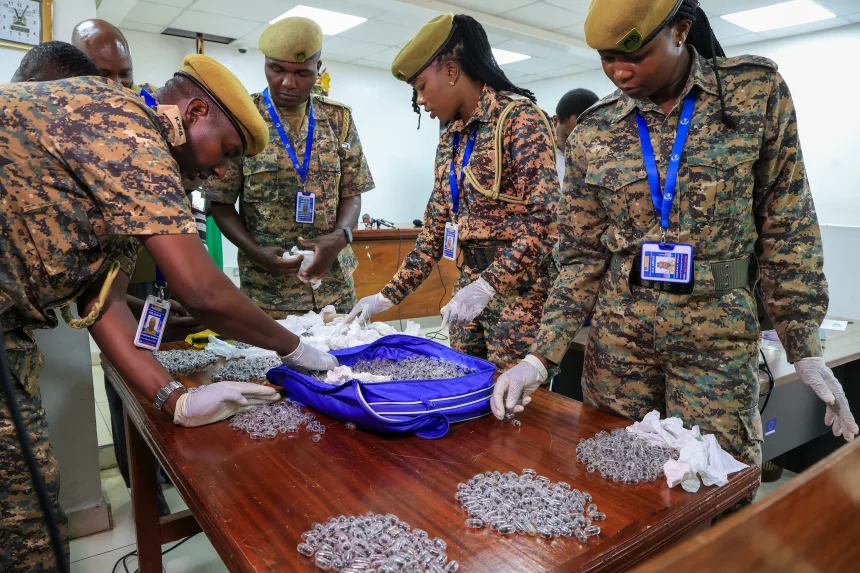
Kenyan wildlife official examine luggage of ant smuggler
Nairobi, KenyaReuters — A Kenyan court on Wednesday ordered a Chinese man to pay a fine of 1 million shillings ($7,746) and gave him a 12-month jail term for trying to smuggle live ants out of the country.
The magistrate in the case said a stiff sentence was needed as a deterrent, given a spate of cases in Kenya of ant-trafficking.
It serves markets, such as China, where enthusiasts have paid large sums to maintain ant colonies in large transparent vessels known as formicariums that allow them to study the species’ complex social structures and behaviors.
Chinese national Zhang Kequn was arrested last month at Nairobi’s main international airport with more than 2,200 live garden ants in his luggage.
Zhang’s lawyer said he would appeal against his sentence.
He initially pleaded not guilty to charges including dealing in live wildlife species but later changed his plea to guilty.
“Noting the increasing and rising cases of dealing in large quantities of garden ants and the negative ecological side effects of massive harvesting, there is a need for a stiff deterrent,” magistrate Irene Gichobi said.
A Kenyan man, Charles Mwangi, was also charged in the case, accused of supplying the ants to Zhang. Mwangi has pleaded not guilty and is out on bail. His case was not before the court on Wednesday.
Last year, four men were fined 1 million shillings each for trying to traffic thousands of ants. Wildlife experts said at the time that the case signaled a shift in biopiracy from trophies like elephant ivory to lesser-known species.
By Stacy M. Brown NNPA Newswire Senior National Correspondent
Quincy Jones, the record producer, arranger, and cultural trailblazer whose influence spanned more than seven decades, has died at 91. His publicist, Arnold Robinson, confirmed his death in a statement, noting that Jones died peacefully at his home in Bel Air. The statement did not specify the cause.
Known for producing Michael Jackson’s landmark albums, “Thriller” and “Bad,” Jones’s career far exceeded even those iconic works.
Jones transformed genres, introduced new styles, and championed Black artistry in a largely segregated industry. The Rock and Roll Hall of Fame, which inducted him in 2013, called him a “Jack of All Trades” but noted that Jones “excelled at every role he took on.” His contributions as a record producer, arranger, composer, and performer reflect a boundless curiosity that kept him at the cutting edge of music across generations.
His presence shaped countless albums, film scores, and even social movements, making him a bridge between jazz, R&B, pop, and hip-hop and between Black and white audiences. Jones began as a jazz trumpeter, arranging for bands like Count Basie’s and becoming a respected composer in his own right. His compositions for films, including The Pawnbroker and The Color Purple, displayed his extraordinary range, mixing classical, jazz, funk, and Afro-Cuban influences. His television scores, such as those for Sanford and Son and Ironside, brought Black music to mainstream audiences, shaping a generation’s auditory landscape.
The three Jackson albums Jones produced — Off the Wall, Thriller, and Bad — stand among his most famous works. The albums broke sales records and redefined the global pop music industry, bridging racial divides and setting new standards for production. But Jones’s career had already reached milestones before those records. He had become the first Black vice president at Mercury Records in 1964 and had garnered critical acclaim for his arrangement of Count Basie’s “I Can’t Stop Loving You.” Over time, he received 28 Grammy Awards from 80 nominations, a record surpassed only by a few.
Born in Chicago on March 14, 1933, Quincy Delight Jones Jr. faced a childhood filled with challenges and resilience. According to his official biography, Jones was primarily raised by his father, a carpenter, after his mother was diagnosed with schizophrenic disorder. Moving to Seattle in his early teens, he honed his craft in a music scene as diverse as his musical inclinations. By 15, Jones had already earned a spot in Lionel Hampton’s band, launching a career that would take him across the globe and into the company of jazz greats like Dizzy Gillespie and Ray Charles, who would become a lifelong friend and collaborator.
Jones’s time as a jazz bandleader and arranger in the 1950s established his name in elite music circles, but his ambitions led him into film and television scoring, where he created iconic soundtracks. Throughout the 1960s and 70s, Jones’s music could be heard in theaters and living rooms, with scores for films like In Cold Blood and The Deadly Affair and contributions to Alex Haley’s Roots, the celebrated mini-series. His soundtrack for The Color Purple in 1985, adapted from Alice Walker’s novel, remains a cultural milestone.
In 1985, Jones united more than 40 of the world’s biggest music stars for the charity single “We Are the World,” raising awareness and funds for famine relief in Africa. The project’s success further cemented his reputation as a visionary capable of bridging divides for a greater cause. His label, Qwest, produced a roster as diverse as his interests, featuring artists from George Benson to the experimental jazz saxophonist Sonny Simmons.
Through the 1990s and 2000s, Jones expanded his reach beyond music, producing television hits like The Fresh Prince of Bel-Air and the magazine Vibe. In his later years, he remained active, working on projects that celebrated his love for jazz and hip-hop alike. In 2022, he collaborated with The Weeknd on Dawn FM, delivering a spoken monologue reflecting his decades of life and artistry. His work became a rich tapestry, woven with threads from every major genre and cultural moment in modern American history. “He always is soaring ahead and doesn’t like to look backwards,” Oprah Winfrey said of him during his Rock and Roll Hall of Fame induction.
Jones leaves behind seven children: Jolie, Kidada, Kenya, Martina, Rachel, Rashida, and Quincy III in addition to his brother Richard, sisters Margie Jay and Theresa Frank.
Kenyan carrying cloth bag at market
Aug. 28, 2017 (GIN) – If it’s a choice between suffocating seabirds, strangling turtles or the convenience of a plastic bag, Kenya is taking the side of marine animals.
Starting this week, citizens producing, selling or even using plastic bags will risk imprisonment of up to four years or fines of $40,000. It’s the world’s toughest law attacking plastic pollution which threatens land and sea.
Throughout Kenya, plastic bags are found everywhere — on roofs, on walls and clogging drainage. Kenyans are estimated to use 24 million bags a month. “It is a toxin we must get rid of,” Judi Wakhungu, the country’s environment minister, told reporters. “It’s affecting our water. It’s affecting our livestock and, even worse, we are ingesting this as human beings.”
In Nairobi’s slaughterhouses, some cows destined for human consumption have had bags removed from their stomachs. “This is something we didn’t get 10 years ago but now it’s almost on a daily basis,” said county vet Mbuthi Kinyanjui as he watched men in bloodied white uniforms scoop sodden plastic bags from the stomachs of cow carcasses.
Plastic bags take between 500 to 1,000 years to break down.
Kenya’s law allows police to go after anyone even carrying a plastic bag but enforcement will initially be directed at manufacturers and suppliers.
More than 40 other countries have banned, partly banned or taxed single use plastic bags, including China, France, Rwanda, and Italy.
What’s good for the turtle, however, is not necessarily a welcome idea for manufacturers who complain that some 176 companies with thousands of workers producing plastic bags will have to close. Kenya is a major exporter of the bags to the region.
“The knock-on effects will be very severe,” said Samuel Matonda of the Kenya Association of Manufacturers. “It will even affect the women who sell vegetables in the market – how will their customers carry their shopping home?”
Meanwhile, in Nairobi, many supermarkets have switched from plastic bags to reusable, cloth sacks, but a quick drive around Nairobi revealed that plastic bags are still in use. So far, there have been no reports of any enforcement actions.
July 5, 2016 (GIN) – Four police officers have been arrested in the torture/murder of a noted Kenyan human rights lawyer and two other men.
The Law Society of Kenya called it “a dark day for the rule of law” and a countrywide boycott of the courts has been called. The respected lawyer disappeared with his client and a taxi driver after filing a charge of police brutality. The officers are being held without bail while an investigation is underway.
Lawyer Willie Kimani, his client Josephat Mwenda, and their driver disappeared on June 23 after making the court filing. Their bodies were found on June 30, floating in the Oldonyo Sabuk river. CapitalFM, a local media group, said the men had been tied up with ropes and their bodies mutilated.
A government pathologist said their deaths were the result of beatings with a blunt object and strangulation. The incident has outraged the legal community where the rise of police killings has been a matter of concern.
“These extrajudicial killings are a chilling reminder that the hard-won right to seek justice for human rights violations is under renewed attack,” said Muthoni Wanyeki from Amnesty International.
“Police are there to protect Kenyans and not to kill them,” said Yash Pal Ghai, director of the Katiba Institute, a Kenyan legal group promoting social transformation through the constitution.
This week, hundreds of Kenyans including lawyers, human rights activists and taxi drivers held a peaceful protest as lawyers began a week-long walkout that will paralyze court operations around the country.
The Department of Public Prosecutions issued a statement assuring the public and legal fraternity that any rogue elements in the department “do not represent what the National Police stands for.”
But activists replied that extra-judicial killings were creeping back, and the Inspector General of Police should “pack and leave if he cannot assure Kenyans of security.”
Mr. Kimani had been working at the International Justice Mission (IJM), a U.S.-based rights group, when he was killed. An online petition calling for justice for Kimani, his client, and their driver Joseph Muiruri had 24,594 signatures at press time. The petition can be found at http://www.IJM.org/JusticeinKenya
“In Kenya,” it reads in part, “it is far too easy for a corrupt or incompetent police officer to frame and imprison an innocent person, who must then wait in jail, often for years on end, for a chance to prove his or her innocence. This corrupt system has packed Kenyan prisons full of innocent men and women with no way out and no lawyer to fight for their release – and the police who abuse their power are not held accountable.
“Willie Kimani was working to protect the innocent from such abuse, and he was murdered while courageously pursuing that mission.”
“Poaching steals from us all.” That is the message Kenyan Oscar-winning actress Lupita Nyong’o brings to the Kenyan public in the newest awareness PSA from African Wildlife Foundation (AWF) and WildAid.
The countrywide campaign also enlists the help of popular afro-pop band Sauti Sol and local radio personality Caroline Mutoko to bring attention to the natural and economic value of elephant conservation.
In a 2015 campaign survey of 2,000 Kenyans, 28 percent said poaching didn’t affect them, while 75 percent said losing elephants would matter to them a great deal. This campaign aims to bridge the gap and prove elephants’ intrinsic value to Kenya’s heritage, biodiversity and economy. “If we lose our elephants and other wildlife to this threat, it will not be because we lacked the knowledge or tools to save them, but because we all failed to take ownership of our wildlife heritage. None of us can afford to be bystanders when so much is at stake,” AWF VP of Program Design and Government Relations Daudi Sumba said.