Rural Coalition joins O’Gilvie in urging state and federal leaders to immediately address barriers to food assistance and listen directly to families, farmers and rural and urban communities
WASHINGTON, D.C. — August 12, 2026 — Rural Coalition and its members stand today in solidarity with our colleague and member Liz Wills-O’Gilvie, Executive Director of the Springfield Food Policy Council (Mass.), in demanding urgent action from policy makers to address the growing hunger crisis facing families across Massachusetts and throughout the nation.
O’Gilvie, 63, also a member of the Governor’s Anti-Hunger Task Force in Massachusetts, stopped eating over a week ago because “I couldn’t sleep at night, with a full belly knowing that children and their families across the State were hungry.” She is calling on Massachusetts Governor Maura Healey and all Governors across the country to immediately “find any loose change in their [state] pockets,” to expand state agency staffing and take action to reach all SNAP (Supplemental Nutrition Assistance Program) recipients who have lost SNAP benefits “through no fault of their own,” but due to the draconian rule changes, and to immediately restore them to the program.
O’Gilvie explained that it started like this: “My neighbor came to my house and asked if she could borrow some food. She told me that her kids had been playing with some neighbor kids and their mother gave her own kids sandwiches. Her kids told the neighbor that they were hungry too, but the mother did not offer them a sandwich – instead she called the Department of Children and Families.”
“My neighbor told me that DCF was coming by to visit her house but that the pantries that usually open on Friday did not open that Friday. I told her ‘You don’t borrow food’, and that I would buy her some food. Liz read DTA correspondence and helped her to set up an online account with DTA. Her lapse in SNAP benefits was all paper – her signature was needed on one document and a birth certificate was not on file for one of her children. “The idea that DCF might be coming to her house due to paperwork was horrifying for me,” said Liz. “I understood that this was happening in every single city and every single state. I had to do something.”
“I am standing in hunger out of love for my neighbors—I am sad and mad that people don’t have what they need,” O’Gilvie continued.
SNAP crisis arises as a result of H.R. 1 cuts
The current crisis emerged due to changes enacted in the “One Big Beautiful Bill Act”, also known as H.R.1, which took effect on July 4, 2025. According to the Center for Budget and Policy Priorities, H.R.1 made “deep cuts in the Supplemental Nutrition Assistance Program (SNAP)…shifting significant new costs to states…We expect these harms to grow as states fully implement eligibility restrictions and take actions to lower their error rates.” (see SNAP Tracker- Center for Budget Policies and Priorities)
Since then, over 64,000 children have been dropped from SNAP rolls in Massachusetts alone. The total number of Massachusetts families who lost benefits through these attempts to bring down payment error rates is over 160,000, which includes eligible families who shouldn’t have been terminated. Behind those numbers, families are being forced to make impossible choices about how to put food on the table, at a time when food costs remain high and community food systems are under immense pressure.
In their consideration of the long-delayed renewal of the 2018 Farm Bill, Congress has thus far failed to restore cuts made to the SNAP Program in H.R 1. On August 6, 2026, the Senate Agriculture Committee considered only partial delays to the deep cuts to the program already going into effect, cuts which will force states to cover more of the costs administering SNAP and other program costs based on SNAP payment error rates in each state.
O’Gilvie’s action is directed at bringing increased attention to the causes and real-life consequences families can face when so-called “error rates”—which encompass administrative barriers, paperwork problems, staffing limitations or delays—interrupt access to nutrition assistance. As the impact of these changes grows, O’Gilvie reflected that “I needed to do something to help them to understand what is happening.”
For the Fiscal Year 2027 state budget, Massachusetts’ Anti-Hunger Task Force recommended $147.7 million in funding to bolster staffing at the Department of Transitional Assistance (DTA), the state agency responsible for administering SNAP. Only $122 million was approved—more than $25 million below the Task Force’s recommendation—was signed into effect. Community members across Massachusetts continue to report widespread disruptions to program services as a result of staffing shortages at DTA.
For O’Gilvie, this funding gap has significant consequences for families navigating an already strained system. In the second week of May 2026, she assisted a 70-year-old woman with setting up her online SNAP account and uploading required recertification documents. That same woman notified her that her SNAP benefits were finally reinstated in late July 2026.
“Elders at 70 years old can’t travel to the offices to recertify or correct errors in addresses and often don’t have the ability to access online systems” said O’Gilvie. “At the Department of Transitional Assistance, only one in 5 calls is now being answered. And because elders often have special health needs, they can’t find the food they need at food pantries.”
Farmers are losing critical markets as SNAP access declines
She noted that she worked closely legislators and advocates Massachusetts Healthy Incentives Program (HIP), a state-funded SNAP matching program that is automatically added to every SNAP recipient’s account each month, and accessed when their EBT card is used to buy healthy, local fruits and vegetables from HIP-approved farm vendors. The program was first piloted in Springfield, Mass. These HIP benefits are accessible to every SNAP recipient, even if they have only one cent left on their SNAP benefit card. The HIP benefit ranges from $40-$80 per month depending on family size, helping to fill the gap until the family’s next SNAP benefit arrives.
A farmer herself, Liz works with a network of producers across the state. She noted that, as this program grew since its formal enactment in 2016, farmers in Massachusetts have expanded their markets with over $100 million in additional SNAP sales.
That is another key point she, and Rural Coalition, want policy makers and the public to
understand. SNAP is not just a critical and effective food program. It also expands the economic viability of farm and ranch operations and local grocers and retailers, and benefits rural communities and their livelihoods, and the health of our overall national economy.
Passage of a strong Farm Bill is essential to addressing the dire economic conditions farmers and ranchers nationwide are facing, including impacts of tariffs and lost markets, high input costs, disruptions in federal funding, extreme weather conditions, inflation, and much more. As an organization representing thousands of farmers and ranchers across the U.S., Rural Coalition members join O’Gilvie’s call for full restoration of SNAP funds at the national level. These cuts are hurting not just hungry communities, but also producers, because the dollars invested in SNAP and related programs support a critical market for producers in Massachusetts and across the nation.
Rural Coalition calls for immediate action at the State and Federal levels
Rural Coalition members across the nation ask you to join us in calling on policy makers and the public to support and amplify O’Gilvie’s call for immediate action at the State and Federal level to restore SNAP benefits to children and families. This includes concerted cooperation and action to provide states more time and funds for staffing to assist the additional populations, including elders up to age 65, veterans, caregivers of children over age 14, people experiencing homelessness, and those living in areas with few job opportunities who under H.R. 1 were newly added to the groups who must submit detailed documentation to meet the program’s work requirements.
We further call on you to reach out to your own state leaders and members of Congress to examine what is happening in your own states and determine to what extent eligible residents are losing or struggling to recertify their SNAP benefits because of administrative barriers, and what funding and action is necessary to meet these needs.
Finally, during last week’s Senate Agriculture Committee Farm Bill Mark-up Senator Cory Booker noted that the Agriculture Committees have heard from so many constituencies who benefit from this nation’s Farm Bill, but not the voices of the people who need and use SNAP and other federal food programs. As Members of Congress return home for town halls, State Fairs, and other public events in the coming weeks, we encourage you to reach out to SNAP recipients, farmers and ranchers, advocates, and rural community members and to help ensure their experiences and needs are uplifted and widely shared.
We stand in solidarity with O’Gilvie as she calls attention to families struggling to access Supplemental Nutrition Assistance Program (SNAP) benefits and urges leaders to recognize the broader consequences for families, farmers and local economies.
We urge supporters across the country to call their Governors and demand action to protect families who have lost or are at risk of losing SNAP benefits. We also call on Congress to hear directly from families, farmers and ranchers, and rural communities affected by these cuts and to restore SNAP funding through the Farm Bill.
Stand with Liz: Take action to protect SNAP and those who need and use the program
As we reach the end of the month, as SNAP benefits run out for many families, Rural Coalition joins Ms. Wills-O’Gilvie in her call to the public to commit to taking additional actions to help our neighbors including:
Rushing support to your local Food Banks.
Donating half of your CSA share to someone who needs it.
Asking producers to open your fields to faith communities willing to glean and distribute foods after the harvest.
Making sure policymakers know of your actions and concerns.
Finally, please share this message widely on social media and in your community.
Liz Wills-O’Gilvie has chosen to go without food because too many of her neighbors are being forced to do the same. Her choice is a call to action. We cannot allow her to stand in hunger alone. Please join us.
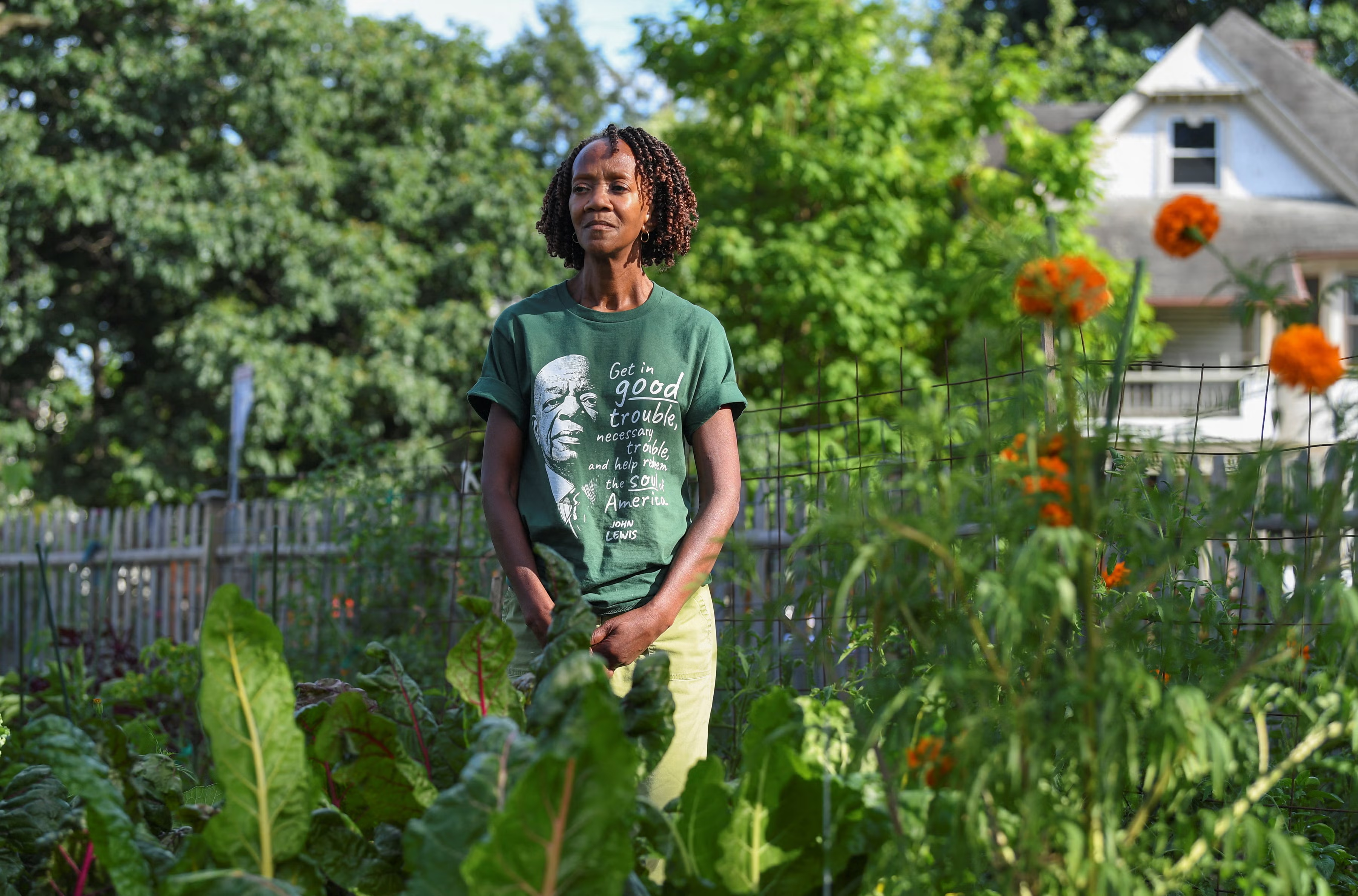
Featured Image: Anti-hunger advocate Liz Wills-O’Gilvie, 63, said she has not eaten for 15 days in a bid to push Governor Maura Healey to raise funding for Massachusetts’ shrinking food stamp program (REUTERS)
Leave a Reply