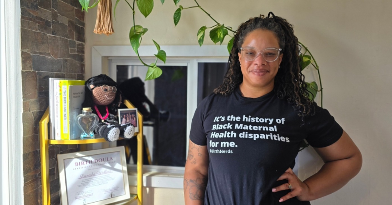
by Cecil Egbele, Bakersfield News Observer
It was around 6 p.m. on April 1, 2023, when Treana Adams, a Black Bakersfield mother, arrived on the delivery floor four centimeters dilated. Ready to give birth to her second child, she immediately phoned her doula Dani Wallace.
“I was very relieved when I actually saw her walk through the door,” said Adams, a corrections officer. “Having somebody there that was standing up for me, understood the terms, and broke everything down so that I could adequately understand and make a decision for myself — that was very beneficial.”
Nationally, Black women die from pregnancy-related causes at more than three times the rate of white women. According to the CDC’s Maternal Mortality Review Committees in 2022, 85% of these deaths are preventable. In California, the racial gap is even wider than the national rate: Black women die at nearly four times the rate of white women, according to the California Department of Public Health.
Pregnancy-related mortality describes the death of the mother during pregnancy or within a year of childbirth. When you head into Kern County, statistics around pregnancy-related mortality spell a crisis for all mothers.
“Our maternal health statistics, when we take a look at that data — unfortunately our rates are poorer than we see at the state average,” said Kimberly Hernandez, Kern County Public Health’s division director of health services.
For Black mothers in Kern County, the No. 1 agricultural-producing region in the country, the numbers are bleaker still. For this group, life-threatening birth complications are seen at nearly three times the rate of white women in the same county.
“We know we have room to grow in efforts around increased prenatal care in the first trimester, decreasing infant mortality, and decreasing low birth weight,” said Hernandez at the county health department. “And when we look more granularly, we continue to have higher rates in Black and African American mothers and babies born to Black and African American mothers.”
The presence of doulas here is increasingly seen as an essential part of efforts to reduce maternal mortality.
Later, when Block did visit her doctor, she told them that she had a doula. The doctor seemed surprised, Block said. When asked why she had a doula, Block told the doctor she was worried. “I don’t trust you guys, to be frank,” she said, noting the much higher risks faced by Black mothers in childbirth.
“What we are trying to do as doulas is really bridge the gap between patients and physicians,” said Raven Thomas, co-founder of the Three Moons Doula Collective, an association of doulas and advocates in Kern County.
“Patients don’t get a whole lot of knowledge from providers about how they should be feeling or what changes are going on in their bodies. We’re trying to help people advocate for themselves, so they’re able to say, ‘This is what I like, this is what my body does, this is how I’d like to give birth.’”
DHCS lists 26 doulas in Kern County. This past March, Wallace trained 29 certified doulas, while Raven Thomas’ Three Moons Doula Collective is set to train another batch in June.
“The doula, like the nurse and myself, are like a team. Our goal is to make sure that the mom and the baby have a successful outcome.”
Dr. Anucha is careful to draw a line, however: he said a doula should never tell her patient not to listen to her medical team. But there’s a role for a doula who advocates for a patient’s birth plan, who catches something the clinical team missed, who helps a woman feel safe enough to speak, he said.
“If for some reason I’m doing something that a doula doesn’t think is the right thing, she can call my attention. I would be glad to explain. I wouldn’t in good conscience do anything detrimental to my patient.”
On a typical weekday in Bakersfield, Wallace is on the floor of someone’s living room or in her childbirth education room, sprawled on the floor to demonstrate stretches for the lower back and hips — all the places that hurt most in the third trimester. When her client looks uncertain, she repeats the exercise slowly.
Adams, 32, the corrections officer, clearly remembers performing these exercises when Wallace came to visit. “We did yoga right here in the living room. We went outside and walked the neighborhood. She even incorporated my partner, showed him how to massage if something was hurting, how to help me stretch.”
Adams’ first pregnancy at 19 culminated in a C-section, which she believes she never needed. For her second pregnancy she wanted a doula. She had Wallace.
Her son Jeremiah was born on April 10, 2009, and died seven months later. While there are no definitive answers, Wallace still wonders many years later if her son would have survived if her health complications during pregnancy had been addressed.
Nu’Ponica Barker, a caregiver with In-Home Supportive Services, describes a disturbing moment before the birth of her second child in 2023.
Barker remembers the moment she heard Wallace’s voice outside the delivery room. She knew her doula was close. When Wallace came through the door, something settled.
“It was like night and day. She was there for me in a way that no one was able to do prior to that,” Barker recalled. “She mirrored what I wanted, what I needed. She brought a sense of calm and peace and assertiveness,” said Barker. “She was my backbone. Whatever I said, she was there to assert.”
In any given week, Dani Wallace is on the living room floor practicing yoga with a pregnant mother, on the phone with a hospital director making sure she gets into a delivery room, or mapping out her next advocacy plan so that another Black pregnant woman will be heard.
“I do tell people, if you’re going to have a child, get a doula,” Block said.
Cecil Egbele is a Bakersfield reporter with the Observer Group of Newspapers Southern California and a California Local News Fellow. She has experience across multimedia platforms, including investigative reporting with Bloomberg News, TV broadcasting with Nigeria’s national television (NTA), and local reporting with Oakland North. Cecil is also a documentary filmmaker skilled in video and photojournalism, with a passion for amplifying underrepresented voices. In Bakersfield, she reports on the Black community. Got a story or an idea? Reach her at cecil.egbele@ognsc.com.
Leave a Reply