By John Zippert, Co-Publisher
The Black Belt Community Foundation (BBCF) held its Black Belt Legacy Dinner on Monday, October 5, 2026, at the Elevation Convening Center & Hotel located at 600 Montgomery St, Montgomery, AL.
Established in 2014, the Black Belt Legacy Dinner honors leaders from throughout the state of Alabama who have distinguished themselves in providing leadership and support of BBCF’s mission. Funds raised in honor of these distinguished leaders provide grant support for nonprofits in the Black Belt Region.
This year, BBCF’s Legacy Dinner honored Bryan Stevenson, founder and Executive Director of the Equal Justice Initiative (EJI). Stevenson founded EJI to provide legal assistance to indigent Black prisoners on Alabama’s Death Row. He was successful in the exoneration and release of several innocent people from Alabama prisons.
He then diversified EJI to have a museum of civil rights contributions to the Montgomery area, a memorial to the hundreds of people who were lynched in Alabama, a sculpture garden, and other exhibits that measure the impact of slavery, Reconstruction, Jim Crow, and the civil rights legacy of Alabama.
In his remarks at the dinner, Stevenson said, “I can’t think of a part of America that is more essential, more critical to the American story and culturally richer than the Black Belt. It’s also a region of this country that needs to be aided, not from a perspective of charity, but from a perspective of obligation. We owe people in this region more than they have received. We owe them fairness. We owe them opportunities that they were denied and deprived for too long.”
Stevenson continued, “It’s amazing that the rich cotton farmers and those groups that became wealthy off the backs and the sweat of the people in the Black Belt are the ones who are least likely to help us now. It is shameful to realize that those neglected people across the region found the means to contribute far more than labor to this land.
“The art, the music, the traditions that have given America such visibility and such glamour and such notoriety,” Stevenson said, “many of them were formed in the Black Belt, from the quilts of the women in Wilcox County, to the blues that came out of the Delta, and the jazz, and all of these art forms that emerged in this region.
“It’s one of those things that always confounds me when I see politicians trying to divide us, political mobs talking of “us” and “them.” Because the things we hold most dear in Alabama — barbecue and cornbread, football and song and the rhythm of the very words we speak — are stewed in a gumbo, formed by the collision of our cultures. Even if that collision did not come willingly.
“We are better together, stronger when we are all strong. Yet we inevitably find ways to fight, to forget and to ignore the fact that people of all descriptions made this place what it is. For good or for ill.
“Alabama does owe the people of the Black Belt something, and not just for age-old wrongs. It has in recent years refused to expand Medicaid and made healthcare in the region harder to find. It has made voting more difficult and representation less sure. It has neglected those who need help the most, and those decisions don’t just taint us all; they limit our possibilities.”
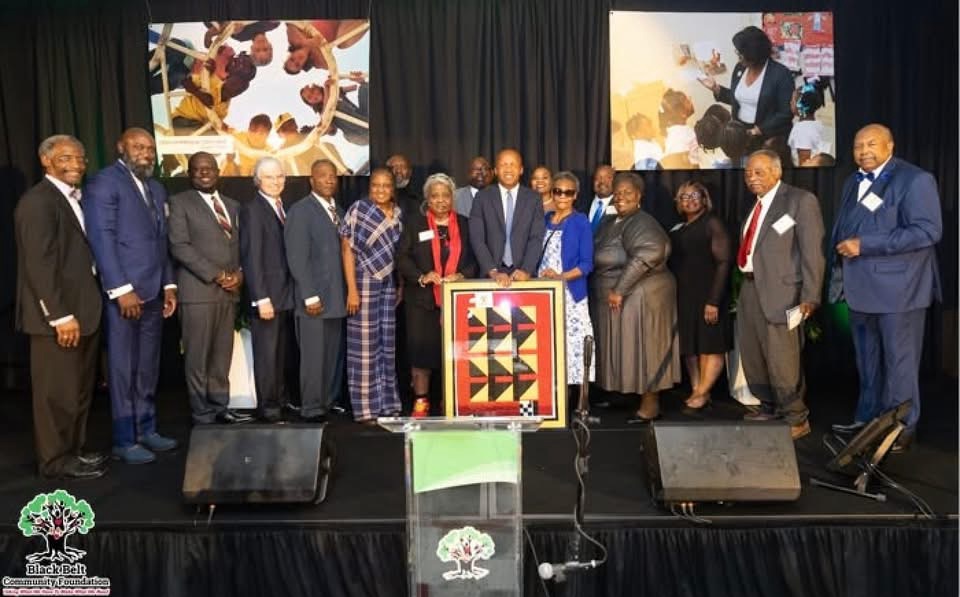
Chris Spencer, BBCF Executive Director, said one of the high points of the dinner was presenting Bryan Stevenson with a framed quilted patch made by the Gee’s Bend Quilters as part of honoring his contributions to the Alabama Black Belt.
Over 150 business, civic, and community leaders gathered at the Legacy Dinner to celebrate their collective work in helping to transform the Black Belt Communities. The funds raised at the dinner from sponsorships and ticket sales will go to support the foundation’s community grants program. For more information on the foundation, you can visit the organization’s website: http://www.blackbeltfound.org
Featured Image: Bryan Stevenson with gifted quilt at the Black Belt Legacy Dinner (Friends of Gee’s Bend Quilters Collective)
Leave a Reply