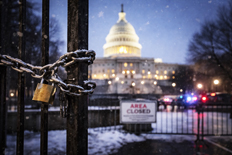
Newswire : Philadelphia sues after slavery exhibits were taken down from President’s House site

 Staff dismantling slavery exhibit in Philadelphia

The lawsuit says the National Park Service removed the displays referring to slavery “presumably pursuant to the mandate” of an executive order from President Donald Trump.

By Joe Kottke and Phil Helsel NBC News

The city of Philadelphia sued the Department of the Interior and the acting director of the National Park Service on Thursday over reports that slavery exhibits were being dismantled in the city’s historic district.
The suit, filed in federal court, seeks a preliminary injunction to restore the exhibits at the President’s House Site, part of Independence National Historical Park.
The lawsuit says that “the National Park Service has removed artwork and informational displays at the President’s House site referencing slavery, presumably pursuant to the mandate” of Executive Order No. 14253, which President Donald Trump signed in March. 2025.
The city said in the suit that it learned Thursday that the educational panels that referred to slavery had been removed.
“Removing the exhibits is an effort to whitewash American history,” Philadelphia City Council President Kenyatta Johnson said in a statement Thursday. “History cannot be erased simply because it is uncomfortable. Removing items from the President’s House merely changes the landscape, not the historical record.”
NBC Philadelphia aired video Thursday that shows people with crowbars taking down panels, one of which reads “The Dirty Business of Slavery.”
The suit says the city was given no notice about the change to the President’s House.
It calls the removal of the displays “arbitrary and capricious.”
“Defendants have provided no explanation at all for their removal of the historical, educational displays at the President’s House site, let alone a reasoned one,” the lawsuit says.
White House spokesman Davis Ingle said Trump “continues to fulfill his promise to restore truth and common sense to the United States and its institutions.” 
“President Trump is ensuring that we are honoring the fullness of the American story instead of distorting it in the name of left-wing ideology,” Ingle said in a statement. 
A spokesperson for the Department of the Interior, which oversees the National Park Service, said “all federal agencies are to review interpretive materials to ensure accuracy, honesty, and alignment with shared national values” while it implements Trump’s executive order.
“Following completion of the required review, the National Park Service is now taking appropriate action in accordance with the Order,” the spokesperson said in a statement.
The National Park Service did not immediately respond to NBC News’ requests for comment late Thursday.
Trump’s executive order directs the Department of the Interior in its materials not to include “descriptions, depictions, or other content that inappropriately disparage Americans past or living (including persons living in colonial times).”
It instructs the department to “instead focus on the greatness of the achievements and progress of the American people or, with respect to natural features, the beauty, abundance, and grandeur of the American landscape.”
The order, titled “Restoring Truth and Sanity to American History,” has been criticized.
The American Historical Association said it “egregiously misrepresents the work of the Smithsonian Institution,” which the executive order criticized by name.
“Historians explore the past to understand how our nation has evolved. We draw on a wide range of sources, which helps us to understand history from different angles of vision,” the group said March 31.
“Our goal is neither criticism nor celebration,” it said. “It is to understand — to increase our knowledge of — the past in ways that can help Americans to shape the future.”
The President’s House is a site where President George Washington resided in Philadelphia, and he brought slaves who were in the home, according to the lawsuit and the National Park Service’s webpage about the site. President John Adams also lived there.
A spokesperson for the National Parks Conservation Association said the dismantling of the exhibit is “an insult to the memory of the enslaved people who lived there and to their descendants.” and “sets a dangerous precedent of prioritizing nostalgia over the truth.”
The House of Representatives urged the National Park Service in 2003 to recognize the slaves there. The agency and the city entered into a cooperative agreement in 2006 to establish an exhibit about the site, the suit says.
A memorial and panels about slavery at the President’s House have been up since it opened in 2010, according to the suit.
The Black Journey, a group that conducts walking tours in Philadelphia about Black history, said removing the panels can’t erase the past.
“The Black Journey is outraged and deeply disappointed by the removal of this important and irreplaceable piece of American history,” Raina Yancey, president and CEO of The Black Journey, said in a statement. 
Yancey said the group will continue to lead weekly tours and pursue its mission “to tell the full and truthful history of our ancestors,” saying “no political action will silence this history.”
She added that since the removal occurred, she has heard from fellow tour guides and individuals who have taken tours. 
“Their messages make it clear: the public will not accept the erasure of history, and neither will we,” she said.
U.S. Rep. Brendan Boyle, D-Pa., whose district includes part of Philadelphia and the President’s House, also condemned the removal.
“Philadelphia and the entire country deserve an honest accounting of our history, and this effort to hide it is wrong,” he said in a statement.
CAIR-Philadelphia Executive Director Ahmet Tekelioglu said the civil rights organization “stands in solidarity with the City of Philadelphia, advocacy groups, civil rights leaders, and historians.”
Tekelioglu said the exhibit’s removal “has drawn widespread condemnation from community leaders, historians, and elected officials who argue that understanding the full scope of American history — including the brutal reality of slavery — is critical to our collective progress.”
During the Trump administration, the National Park Service has made other changes that have backtracked on previous information.
In February, before the executive order, the National Park Service website for Stonewall National Monument’s web page was changed to erase references to transgender and queer people.
The Stonewall Inn is the site of a milestone in the fight for gay rights, recognition and the fight to end persecution by authorities.

Newswire : New Trump Tax Law locks in gains for the rich, leaves Black households behind


 Trump and Black tax payers

By Stacy M. Brown
NNPA Newswire Senior National Correspondent

President Donald Trump’s new tax law is now in force, and as the 2026 filing season begins, economists say the damage is not theoretical. It is already written into the tax code. The legislation locks in and expands Trump’s 2017 overhaul while layering on new provisions that funnel wealth upward, raise taxes on millions of low-income Americans, and deepen racial inequities that have defined the U.S. economy for generations.
“This massive tax-and-spending package does more to transfer wealth upward than any other single piece of legislation in decades while penalizing lower-income Americans and cutting public benefits,” the Institute on Taxation and Economic Policy said in its analysis of the law.

According to ITEP, the poorest 40 percent of Americans will pay more in taxes under the new law, while the middle fifth receives only marginal relief. The richest 1 percent, however, will take home more benefits than the bottom 80 percent combined in 2026. The racial divide is stark. High-income households are disproportionately white, while Black and Latino families are far more likely to be concentrated in income groups that lose ground.
At the center of the imbalance is the expanded pass-through business deduction, increased from 20 percent to 23 percent. Treasury Department data show that nearly all of the $1 trillion in tax cuts generated by this provision over the next decade will flow to the top 1 percent. Hispanic taxpayers, who account for 15 percent of the population, receive about 5 percent of the benefit. Black taxpayers, 11 percent of the population, receive roughly 2 percent.
The law also sharply weakens the estate tax by permanently raising the exemption to $15 million for individuals and $30 million for married couples, indexed to inflation. Economists say the change all but eliminates the tax for ultra-wealthy families while locking in racial disparities tied to inherited wealth. White families are about three times as likely as Black families to receive an inheritance, and the median inheritance for White families is roughly 25 percent higher.
Supporters of the law point to larger tax refunds expected this year as proof that working Americans are benefiting. The Tax Foundation estimates individual income taxes were reduced by $129 billion for 2025, with as much as $100 billion likely to be paid out through higher refunds during the 2026 filing season. Average refunds could rise by several hundred dollars, and in some cases close to $1,000.
But analysts say those refunds are largely the result of delayed withholding adjustments, not sustained gains in wages or financial security. Many low-income filers, particularly those with little or no tax liability, receive little to nothing. ITEP said provisions marketed as help for working families continue to bypass the poorest households, many of them Black.
The child tax credit was raised to $2,200 per child, yet it remains only partially refundable and far below its 2021 level. Millions of very low-income families are still excluded. Census data show that nearly one in five Black and American Indian people lived below the poverty line in 2024, placing them among those least likely to see any benefit.
The law offsets tax cuts at the top by reducing funding for health care, food assistance, and other programs relied upon by working families. Economists warn that the long-term costs will fall heaviest on younger Americans. Millennials and Gen Z, the most racially diverse generations in U.S. history, will inherit higher deficits and fewer public resources.
The Internal Revenue Service began accepting 2025 returns on Jan. 26 and expects to process roughly 164 million filings this year. New deductions for overtime, tips, auto loan interest, and seniors are now available, though many phase out well before reaching higher income levels. Analysts note that administrative readiness does not change who ultimately wins and loses under the law.
ITEP said Congress had options that would have protected working families without deepening inequality, including limiting tax extensions to households earning under $400,000 and restoring the expanded child tax credit. That approach would have delivered larger tax cuts to the bottom 60 percent of Americans at a fraction of the cost.
“This law harms the economic well-being of poor and working families of all races, especially people of color,” ITEP said. “The new tax and spending law doesn’t meet the basic test of fairness, and it falls tremendously short.”

Newswire : Trump Administration scrambles to blame Alex Pretti for his own death; Undermining 2nd Amendment in the process

Makeshift memorial to Alex Pretti, at the site of his death in Minneapolis, Minnesota

By Zack Linly, NewsOneInsert

It’s quite possible that the Trump administration has finally flown too close to the sun, regarding its latest narrative of observably false propaganda against the latest victim of a killing by immigration cops in Minnesota.
When 37-year-old Alex Pretti was gunned down by ICE agents while trying to protect a woman an agent had pushed to the ground and started pepper-spraying for no discernible reason, the Trump administration began its usual routine of trying its best to get ahead of the media by smearing the victim and claiming the agents were in imminent danger and in fear of their lives.
White House Deputy Chief of Staff Stephen Miller, who has falsely claimed that immigration agents have“immunity” from prosecution, called Pretti a “domestic terrorist” and an “assassin” who “tried to murder federal agents” in a tweet that was re-tweeted by Vice President JD Vance, according to CNN.
Homeland Security Secretary Kristi Noem told reporters Saturday that Pretti “impeded the law enforcement officers and attacked them,” and that he “had a weapon on him, and multiple dozens of rounds of ammunition; wishing to inflict harm on these officers, coming, brandishing like that.”
Minneapolis Police Chief Brian O’Hara refuted Noem’s claim about Pretti “brandishing” his gun — which he carried legally, and which video clearly shows that he never even touched, let alone brandished — saying, “I don’t have any evidence that I’ve seen that suggests that the weapon was brandished.” Noem also said in a Fox News interview Sunday that Pretti was “laying hands on law enforcement,” which video footage also shows is simply untrue.
Border Patrol commander Gregory Bovino — who has been at the center of clashes between immigration cops and protesters almost everywhere agents have been deployed, and has been ripped to shreds multiple times by federal judges for violating their orders restricting certain uses of force and for lying about protest violence to justify it — claimed it “looks like” Pretti “wanted to do maximum damage and massacre law enforcement.” He also claimed Pretti “assaulted federal officers” during an interview with CNN’s Dana Bash, but when asked where in the viral video footage that happened, Bovino had no answers.
Make no mistake, they lied on Renee Nicole Good the same way, expecting us to ignore video footage that showed her attempting to drive away from ICE agents before she was shot and killed by one, in favor of nonsense about her attempting to weaponize her vehicle against ICE, which is the same lie DHS told after agents shot Marimar Martinez as she sat in her vehicle, and after agents shot Richard LA, the TikTok influencer who documents ICE activities, in Los Angeles. In both cases, criminal charges against the victims were dropped because evidence proved the government was lying.
This time, the Trump administration has gotten so desperate to smear Pretti the same way that it’s even going against conservative America’s sacred pro-Second Amendment doctrine by essentially claiming Pretti had no right to be armed.
Perhaps this is why even Republican senators are calling for a fuller investigation into Pretti’s death.
Meanwhile, Democratic senators are now vowing to oppose funding for homeland security over federal violence in Minnesota, threatening to cause yet another government shutdown on President Donald Trump’s watch.
Has any administration ever been the cause of all of its own issues the way this one has? It just keeps shooting itself in the foot and blaming everyone else.

Newswire : Midnight Friday deadline nears as Congress risks another shutdown

By Stacy M. Brown
NNPA Newswire Senior National Correspondent

The federal government is once again facing a shutdown deadline, with funding set to expire at midnight Friday, January 30, just two months after the nation emerged from a prolonged lapse that disrupted lives far beyond Washington.
That October to November shutdown left deep scars across the country. Families who rely on federal nutrition programs saw benefits delayed, reduced, or halted altogether. Some households receiving SNAP and WIC assistance stopped getting benefits entirely, while others received only partial payments. Many of those families are still struggling to recover, juggling rent, utilities, and food costs after weeks of instability caused by the funding lapse.
Despite those recent consequences, Senate Republicans are moving ahead with plans to advance a sweeping funding package as a single vote, even as Democrats warn that no workable agreement has been reached.
A Senate Republican leadership aide told NBC News that GOP leaders intend to press forward.
“Government funding expires at the end of the week, and Republicans are determined to not have another government shutdown,” the aide said. “We will move forward as planned and hope Democrats can find a path forward to join us.”
Democrats say discussions with Republicans and the White House have not produced a viable solution. A Senate Democratic leadership aide said outreach has occurred but “have not yet raised any realistic solutions.”
The timeline remains tight. The House is on recess for the week, making it unlikely that any revised package requiring another vote could be approved before the deadline. Severe winter weather has also disrupted congressional schedules, further narrowing the window for negotiations as the clock runs down.
Senate Majority Leader Chuck Schumer said Democrats will block the current Department of Homeland Security funding bill, tying the standoff to broader concerns about immigration enforcement and public safety nationwide.
“Senate Democrats will not allow the current DHS funding bill to move forward.,” Schumer stated. “The appalling murders of Renee Good and Alex Pretti on the streets of Minneapolis must lead Republicans to join Democrats in overhauling ICE and CBP to protect the public. Senate Republicans must work with Democrats to advance the other five funding bills while we work to rewrite the DHS bill.”

Newswire : Claudette Colvin, who refused to move before the nation was ready, dies at 86

Claudette Colvin

By Stacy M. Brown
NNPA Newswire Senior National Correspondent

History often remembers movements by their most recognizable moments. It less often remembers the teenagers who moved first.
Claudette Colvin, whose refusal to surrender her seat on a segregated Montgomery bus came months before the moment that would enter textbooks, died Tuesday at 86. Her death was confirmed by the Claudette Colvin Legacy Foundation, which said she died of natural causes in Texas.
On March 2, 1955, Colvin was 15 years old and riding home from school when the bus driver ordered Black passengers to give up their seats to white riders. Three students stood. Colvin did not. Police arrested her, charged her under segregation laws, and placed her on probation. She later said she was thinking about the Constitution and the rights she believed belonged to her.
Colvin’s arrest came at a time when Montgomery’s Black community was already pressing against the daily restraints of Jim Crow. Her stand did not ignite a boycott that day, but it did register. It landed in conversations, church meetings, and legal strategy sessions that would soon follow.
“This nation lost a civil rights giant today,” Tafeni English-Relf, Alabama state director of the Southern Poverty Law Center, said. “Claudette Colvin’s courage lit the fire for a movement that would free all Alabamians and Americans from the woes of southern segregation.”
Unlike others whose names became shorthand for the era, Colvin paid a quieter price. She was young and outspoken and was later judged by standards that did not apply to older leaders. She was never elevated as the public face of the movement. Her life unfolded mostly outside the spotlight she helped create.
Yet Colvin’s role proved decisive.
She became one of four plaintiffs in Browder v. Gayle, the federal lawsuit that reached the Supreme Court and ended bus segregation in Montgomery and across Alabama. The case dismantled the legal framework that made her arrest possible.
“At age 15, Ms. Colvin was arrested on March 2, 1955, in Montgomery, Alabama, for violating bus segregation ordinances, nine months before Rosa Parks,” Phillip Ensler wrote. “In 2021, it was the privilege of a lifetime to serve on the legal team that helped Ms. Colvin clear her record from the conviction.”
“As we worked on the court motion, I had the honor of spending time with Ms. Colvin to hear her story and get to know her,” Ensler wrote.
“Today we lost an unsung yet significant hero of the civil rights movement,” Sen. Rev. Raphael Warnock said. “Her courage paved the way for Rosa Parks’ decision and the launching of a movement that would end segregation.”
“History did not always give Claudette Colvin the credit she deserved, but her impact is undeniable,” Illinois Gov. J.B. Pritzker said.
“Her life reminds us that progress is shaped not only by moments, but by sustained courage and truth,” Bernice King said.


Newswire : The exit signs are flashing at the place that wrote the authoritarian playbook

By Stacy M. Brown
NNPA Newswire Senior National Correspondent

The Heritage Foundation is beginning to come apart in public, and what is unraveling is not simply a think tank but a long-maintained illusion. More than 60 senior staff members, fellows, and trustees have now resigned from the institution that spent decades presenting itself as the sober custodian of conservative thought.
Board members tied to major donors have stepped down. Veteran policy writers have walked away. What remains is an organization forced, perhaps for the first time, to reckon with the distance between how it spoke about America and what it planned to do to it.
Philosophers have long maintained that power, when it believes itself righteous, often mistakes silence for consent. The Heritage Foundation thrived on that mistake. For years it wrote in careful abstractions, never naming the people its policies would dispossess, never acknowledging the communities that would be bruised by its ideas.
Project 2025 changed that. Nearly 900 pages long, the document spoke plainly. It described how to bend the federal government toward a single will. It explained how to weaken civil rights enforcement, how to hollow out agencies, how to turn immigration into mass detention, and how to place ideology above law. It did not whisper. It declared.
Donald Trump told the country he had nothing to do with it. He said he did not know the authors. He dismissed the warnings as political theater. Those words collapsed the moment he returned to the White House and appointed Russell Vought, one of Project 2025’s principal architects, to run the Office of Management and Budget. The blueprint Trump denied became the machinery through which his presidency now moves.
“A lot of the policies from Day 1 to the last day and in between that the administration has adopted are right out of Project 2025,” California Attorney General Rob Bonta said, as his office and others prepared lawsuits not in reaction, but in expectation.
What followed has been neither theoretical nor restrained. In Minneapolis, a federal agent shot and killed a man during an operation, igniting protests in a city that already carries the memory of unchecked force. Immigration hardened into something colder still when the administration suspended visa processing for applicants from 75 countries, closing pathways without warning and without apology. Across the nation, demonstrations rose as Americans confronted a government that now acts as though consent is an obstacle rather than a foundation.
Project 2025 anticipated this atmosphere. Its immigration chapter calls for ending asylum at the border, canceling legal status for millions, compelling local police to serve federal deportation goals, and expanding detention camps through executive authority alone. It treats people as numbers to be managed and rights as technicalities to be brushed aside.
For Black America, this moment is not unfamiliar. Civil rights organizations have warned that Project 2025 threatens voting access, education protections, housing enforcement, and reproductive autonomy. The document rarely names Black communities directly, yet it targets the very systems that protect Black citizenship and political power. The danger lies not in what it says aloud, but in what it dismantles quietly.
Abroad, the same logic has spilled beyond U.S. borders. On January 3, American forces struck Venezuela and captured President Nicolás Maduro and his wife, transporting them to New York to face federal charges. Governments across Europe and Latin America condemned the action as a breach of international law. The United States escalated further by seizing Venezuelan oil tankers, tightening control over the country’s resources and deepening regional instability.
In the Arctic, Trump renewed his demand for U.S. control of Greenland, declaring anything less unacceptable. Denmark deployed troops. Protests filled streets in Greenland and Copenhagen. A Greenlandic official broke down on live television after a White House meeting failed to soften Washington’s posture. At Davos, Trump’s confrontations with European leaders turned diplomacy into spectacle and strained alliances that had taken generations to build.
This is not chaos without authorship. Analysts tracking implementation estimate that roughly half of Project 2025 has already been executed through executive orders, agency restructuring, and enforcement changes. This was not improvisation. It was preparation made visible.
Now the institution that helped write the script is fracturing. Donors have pulled back. Trustees have resigned. Senior figures have said privately that Heritage no longer distinguishes between conservative governance and extremism. The organization insists the departures are part of a realignment, yet those who left describe something else entirely. They describe an unwillingness to confront hatred. They describe a tolerance for rhetoric that stains everything it touches. They describe an institution that chose influence over responsibility.
“When an institution hesitates to confront harmful ideas and allows lapses in judgment to stand, it forfeits the moral authority on which its influence depends,” former trustee Abby Spencer Moffat said.

Newswire : Kenneth Traywick speaks out after 35-day hunger strike at Bullock prison

The prison reform advocate called his 35-day strike a “failure” after ADOC met none of his demands before medical issues forced him to stop.

By Alx Jobin, Alabama Political Reporters

From November 20 to December 25, 2025, Kenneth Shaun Traywick did not eat.
Traywick is a prison reform advocate also known as Swift Justice, and his 35-day hunger strike came in response to an incident at Bullock Correctional Facility in which ADOC correctional officer Darius A. Glover pepper-sprayed Traywick from behind. According to Traywick, the assault came as retaliation for Traywick’s own advocacy on behalf of other inmates who were also being assaulted by Bullock staff.
His hunger strike now over, Traywick spoke with APR from inside Bullock to share his experience and how he plans to continue fighting for reform.
“Physically… I’m still having issues with my stomach, but that’s to be expected,” Traywick said of how he has been feeling following the strike. “Mentally, emotionally… I’m pretty stressed out that I didn’t accomplish anything outside of getting a little bit of media attention. As far as accomplishing what I wanted to accomplish, to me it’s a failure.”
While on strike, Traywick made several demands of ADOC, including transfer out of Bullock; the end of “retaliatory and excessive force practices;” the ability to send and receive written mail; a meeting with ADOC Commissioner John Hamm and an investigation “into CERT Officers Glover and Bowen as well as any other officer accused of excessive force or retaliatory discipline/citation write ups.”
According to Traywick, ADOC met none of those demands before medical complications with his kidneys forced him to end the strike.
“One of the issues I’m having now is how easily ADOC ignored my strike and the fact that I was willing to go to the extreme just to be heard,” Traywick told APR. “They’re sending me a message and that, to me, is emotionally draining after so many years of us peacefully protesting in nonviolent ways and trying to reclaim our humanity so-to-speak instead of acting like animals, which is what we used to have to do to get the public to hear us.

“They’re sitting there saying they’re not going to pay me any attention or address the issue—or even just listen to the issue… they just ignored it, so, they’re basically telling us they don’t care about us acting like human beings,” he continued.
Traywick also told APR that ADOC had not discussed the possibility of transferring him from Bullock to a different correctional facility per his demands. However, he said that he is fine staying in Bullock for now, as it could give him another opportunity to shed light on malpractice and mistreatment within the facility.
“If I can’t have all of my demands met, then I don’t want not one of them met,” Traywick said. “Matter of fact, the longer I stay here, the more likely [Glover] is to mess up again and do something again, so I’d much rather just stay here… even since I’ve been out, he’s been aggressive and been taunting me… eventually I expect him to wind up blowing and playing into my hand.”
According to Traywick, the only communication he had with ADOC officials during the course of his hunger strike was with a warden who would simply ask Traywick if he was ready to end his strike.
“The warden would only come around and ask me, ‘when are you coming off the strike?’” Traywick said. “He wouldn’t even engage in why I was on strike.”
Traywick said that ADOC did allow him to file an official grievance related to the assault by Officer Glover, but that grievance was dismissed with ADOC declaring that the officer’s actions were justified. However, Traywick noted that he was able to have disciplinary infractions related to the incident dropped from his record.
Even though he expressed disappointment at the lack of tangible results from his hunger strike, Traywick told APR that he will continue to advocate for reforms in any way he can—including by drafting legislative proposals.

“One of the things I want to do is continue to show the public and our lawmakers the issues inside ADOC,” Traywick said. “One of the things me and my team are doing right now is drafting a piece of legislation and that’s something we’d like to see get [bipartisan sponsorship] dealing with the oversight of ADOC.”
Traywick and his nonprofit organization, Unheard Voices of the Concrete Jungle, UVOTCJ, shared with APR a draft of the legislative proposal he and other inmates are currently working on and hoping to find sponsorship for.
The proposal, which has been titled the “Alabama Correctional Transparency, Accountability, and Risk-Reduction Act,” looks to establish an Independent Oversight Authority, IOA, that would operate outside of ADOC. The IOA would be led by a director selected through a “merit-based process administered by the Alabama Personnel Board” and confirmed by the Alabama Joint Prison Oversight Committee.
Under the proposal, no more than one-third of IOA staff would be allowed to be former ADOC employees or contractors, and any such individuals would need to be separated from ADOC for at least two years before joining the IOA. The body would be tasked with reviewing use of force incidents within ADOC; analyzing systemic trends related to use of force, training, staffing and facility conditions; and issuing reports on their findings, both to the public and to the Joint Prison Oversight Committee.
Additionally, the proposal outlines standards for preserving evidence related to reported incidents of misconduct or harm within ADOC, and includes provisions for the implementation of body-worn cameras, BWCs, in ADOC facilities.
“My goal isn’t to take away any of the authority of ADOC, but at the same time we’re going to have to have independent oversight,” Traywick explained, arguing that the current lack of independent prison oversight in Alabama allows ADOC officials to skirt accountability and squash calls for reform.
“The only thing that anybody can go by is what ADOC says… and there is no independent oversight in this,” Traywick continued. “We actually need [independent oversight], not only to expose any kind of corruption, but to look after the taxpayer and the public. The simple fact is we’re spending millions, hundreds of millions of dollars in settlements every year in lawsuits, and that’s not even counting the hundreds of millions of dollars we’re paying these lawyers to represent the ADOC. So, we’ve got a huge cost that’s being impacted on the taxpayers just to fuel the corruption that’s going on on the inside.

“I want, not only our legislators, but I want the public to know this: these pieces of legislation are coming from guys on the inside, and who better else is there to know the situation or the problems than the ones that are closely, directly involved in the problem?” Traywick said.

Traywick is currently serving a 25-year sentence after being convicted on charges of first-degree robbery and first-degree sodomy in 2009. He has maintained his innocence since his conviction, leading him to become an outspoken advocate for prison reform in Alabama—including by writing several opinion pieces published by APR. The Alabama Board of Pardons and Paroles denied Traywick’s latest parole application in June of 2024, with his next parole hearing set for 2029.

Newswire : State of the Dream 2026 finds Black America facing a recession across jobs, housing, and technology

By Stacy M. Brown
NNPA Newswire Senior National Correspondent

Black unemployment surged to 7.5 percent by December 2025, a level that would signal a recession if it were reflected across the national workforce. But the latest “State of the Dream 2026” report makes clear the damage extends far beyond jobs. From broadband access and housing to artificial intelligence and federal workforce policy, the Joint Center for Political and Economic Studies finds that 2025 marked a sharp economic breakdown for Black America driven by policy reversals and the removal of long-standing safeguards.

Released this week, “State of the Dream 2026: From Regression to Signs of a Black Recession” draws on research from the Joint Center and partners including United for a Fair Economy, the Center for Economic Policy Research, the National Community Reinvestment Coalition, and the Onyx Impact Group. The report situates rising unemployment within a wider retreat from equity-focused policy across nearly every sector shaping economic opportunity.

Employment remains the most visible signal. Black unemployment rose from 6.2 percent in January 2025 to 7.5 percent by December. Black youth experienced severe instability, with unemployment spiking from 18.6 percent in September to 29.8 percent in November before falling back to 18.3 percent in December. The report finds that if Black workers had maintained their 2024 prime-age employment rate, roughly 260,000 more Black adults would have been working in 2025, including about 200,000 prime-age Black women.
The collapse of federal employment accelerated the trend. Roughly 271,000 federal jobs were eliminated in less than a year, hitting Black workers particularly hard because they have historically been overrepresented in government roles offering stable wages, benefits, and protections. Before the cuts, Black Americans made up nearly 19 percent of the federal workforce, compared with about 13 percent of the overall labor force.
“Federal employment has historically functioned as an important sector for Black workers,” the report notes, warning that buyouts, hiring freezes, and the dismantling of diversity-focused recruitment pipelines removed one of the most reliable pathways to middle-income stability.
Tax policy deepened the strain. The One Big Beautiful Bill Act of 2025 made permanent tax cuts for high-income households and corporations while reducing investment in poverty-alleviating programs. Business preferences such as Section 199A, bonus depreciation, and estate tax benefits overwhelmingly favored wealthy households, while refundable credits that matter most to Black workers were left unchanged.
Black-owned businesses faced a parallel contraction. Executive orders issued early in 2025 redirected federal support away from disadvantaged firms, lowered small, disadvantaged business contracting goals, and moved to dismantle the Minority Business Development Agency. The Joint Center estimates these actions threaten $10 billion to $15 billion annually in lost federal support for Black-owned firms. At the same time, the U.S. Treasury Department’s Community Development Financial Institution Fund, a key source of capital for minority businesses, was defunded.
Beyond jobs and business, the report documents setbacks in broadband policy that risk widening the digital divide. The cancellation of the Digital Equity Act, the removal of mobile hotspots and school bus Wi-Fi from E-Rate eligibility, and weaker broadband pricing transparency requirements undercut efforts to expand internet access and adoption in Black households.
The information environment also shifted. While federal social media policy remained largely unchanged, platforms themselves pulled back on fact-checking and content moderation. The report notes that these platform-driven decisions reshaped the online information ecosystem, raising concerns about misinformation and its impact on communities that already face barriers to accurate and timely information.
Artificial intelligence policy marked another turning point. A new executive order titled “Removing Barriers to American Leadership in Artificial Intelligence” moved federal policy away from precautionary regulation toward a deregulatory, innovation-first approach. The report warns that unchecked AI deployment risks embedding bias into hiring, lending, housing, and public services without accountability.
Workforce policy changes further reinforced inequality. While apprenticeship programs expanded, initiatives designed to advance African American workforce participation stalled or were cut, setting the stage for reinforcing racial disparities rather than closing them.
Housing remains one of the most entrenched fault lines. U.S. Census Bureau data show Black homeownership at 45 percent compared with 74 percent for white households, a nearly 30-point gap that has persisted for generations.
“At a moment when hard-won rights and safeguards are being eroded, rigorous analysis is essential to building a fair economy,” Joint Center President Dedrick Asante-Muhammad said in the report.

DeAngelo Hall Qualifies for Sheriff of Greene County

DeAngelo Hall has officially qualified to run for Sheriff of Greene County.

“The journey continues,” Hall said. “I ask the citizens of Greene County to keep me in their prayers as we move forward with a safe, respectful, and clean campaign.”

Hall also reflected on the personal significance of the moment, noting that he wished his grandmother, Velma Robinson, were present to witness the occasion. “I can still hear her saying, ‘Praise the Lord,’” he said.

Hall currently serves as Constable and remains committed to public service, accountability, and community safety.

— DeAngelo Hall

Constable, Greene County

Candidate for Sheriff


Eutaw City Council approves Human Trafficking Prevention Month Proclamation

Two representatives of the Tuscaloosa Area Human Trafficking Taskforce, Johnathan Lovejoy and Carey Branscome stand behind Mayor Corey Cockrell, as he signs proclamation

The Eutaw City Council met on January 13, 2026, for its regular meeting. Mayor Corey Cockrell and all Council members were present.
The Council approved a proclamation naming January as Human Trafficking Prevention Month and designating the City of Eutaw as a Trafficking Free Zone. Mayor Cockrell signed the proclamation during the meeting after the Council approved it. Human trafficking is a grave problem of exploitation of women and children for sexual purposes. Many of the victims are immigrants, homeless people or persons from other countries.
Shuryon Macon, a municipal bond specialist with the firm of Knight & Day Group of Houston, Texas addressed the City Council. He said he was available to help finance large projects to generate jobs and services for the people of the city and other communities. He said he had met with the mayor and was interested in helping to finance projects . In response to a question from Councilwoman Valerie Watkins, he said his fees were paid out of the bond proceeds and would not be an upfront obligation of the city.
The City Council also heard from Anita Lewis, Executive Director of the Greene County Housing Authority (GCHA) and Marilyn Armstead, grant writer for the Housing Authority on the need for funding to improve the sewage and water system serving Branch Heights and King Village, sub-divisions under the control of the GCHA . These water and sewer systems are tied into the City of Eutaw systems. Other Council members supported that sewage back-ups and water problems were occurring all over the city. Mayor Cockrell said the city was looking for grant funds from ADECA and other sources to deal with the city’s infrastructure problems – streets, water, sewer, park improvements and other needs.
In other actions, the Eutaw City Council approved travel for Mayor Cockrell and Joe Powell to attend a water infrastructure training in Demopolis on February 18, 2026; approved the K-9 contract for purchase of a police K-9 dog; and approved payment of bills.
In his Mayor’s report, Cockrell highlighted that he was holding community meetings in each council district to listen to residents and project some of the services and activities are planned. He also passed out a list of monthly special events, he was planning for 2027. He also indicated that a water department clerk had been employed and would start work soon. Cockrell also stated he was working with the County Commission to find solutions to the problems of the Greene County EMS ambulance services.